-
by sayum
19 August 2026 8:35 AM







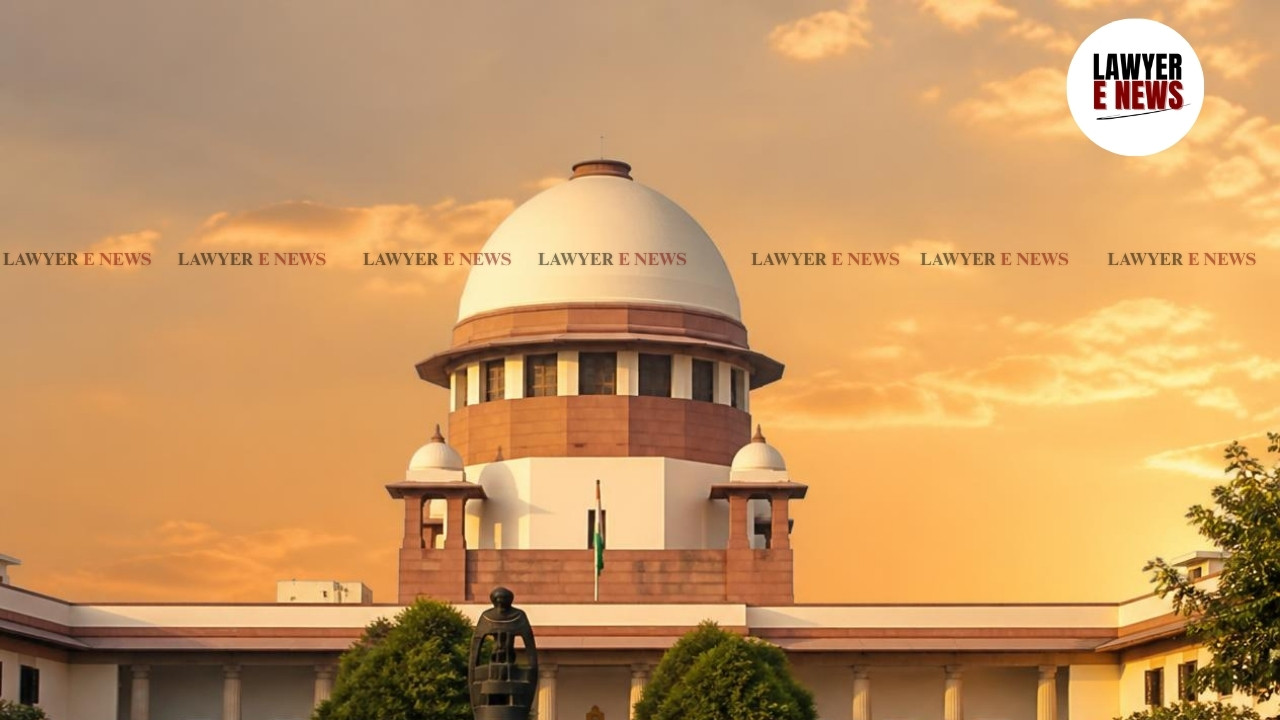
"The basic requirement of an arbitration agreement — mutuality and consensus ad idem — was completely absent", In a ruling that sharply reaffirms the foundational requirements of a valid arbitration agreement, the Supreme Court of India dismissed a Special Leave Petition challenging the Bombay High Court's order setting aside an arbitral award obtained through a unilaterally appointed arbitrator — one foisted on the Municipal Council without its consent, under a provision of a state municipal law that conferred no such power.
A bench of Justice Pamidighantam Sri Narasimha and Justice Alok Aradhe held that the entire arbitral proceedings were coram non judice and the resulting award was non-est in law.
The Court examined whether Section 143-A(3) of the Maharashtra Municipal Councils Act empowered the State Government to appoint an arbitrator; whether Clause 22 of the contract constituted a valid arbitration agreement under Section 2(a) of the Arbitration Act, 1940; whether the Municipal Council's participation in the arbitral proceedings amounted to waiver or estoppel precluding it from challenging the award; and whether the award could survive the absence of arbitral jurisdiction.
Section 143-A(3) Confers No Power to Appoint an Arbitrator
The Court examined Section 143-A(3) of the 1965 Act, which empowers the State Government to issue "general or special orders" to regulate the collection of octroi and the procedure therefor. The petitioner sought to derive the State Government's power to appoint an arbitrator from this provision.
The Court rejected this argument with no hesitation. It held that the provision is confined entirely to policy directions on the manner and procedure of octroi collection. "Under no circumstances can such a power be extended to appoint an arbitrator unilaterally, notwithstanding the statutory or contractual relationship that may exist between the Municipal Council and its agent," the Court held. The State Government simply had no jurisdiction to "foist arbitration on parties who are governed by a concluded contract between them."
Clause 22 Is a Departmental Mechanism, Not an Arbitration Agreement
The petitioner further argued that Clause 22 of the octroi collection contract itself constituted an arbitration agreement. The Court disagreed emphatically. Clause 22 provided that disputes would be referred to the Collector, whose decision would be final and binding, with appeals lying to the Divisional Commissioner and thereafter to the Urban Development Department.
The Court held that "a simple, plain reading of Clause 22 would reveal that the parties have not agreed upon resolving the existing disputes between them through arbitration." It is a tiered departmental dispute-resolution mechanism — deliberate in its design. "Octroi is an important source of income, and the power to impose and collect octroi is integral to the jurisdiction and functioning of Municipal bodies under Part IXA of the Constitution," the Court noted, adding that "it is for this reason that the power to resolve disputes is kept within the fold of the governmental hierarchy." The agent's remedy lay through judicial review, civil suits, or statutory remedies — not arbitration.
Entire Proceedings Were Coram Non Judice — The Award Was Non-Est
The Court held that because the Arbitrator was appointed without any valid arbitration agreement and without the consent of the Municipal Council, "the Arbitrator lacked inherent jurisdiction." The consequence was stark: "the entire proceedings were a nullity — coram non judice — and the resulting award was non-est." An award rendered without jurisdiction is not merely voidable; it is void from inception, as though it never existed.
Participation Under Compulsion Cannot Create Estoppel
The petitioner's most forceful argument was that the Municipal Council, having participated in the arbitral proceedings, was estopped from challenging jurisdiction. The Court rejected this with equal force.
It was undisputed that at the time, the Municipal Council was functioning under an Administrator appointed by the State Government — the very government that had appointed the Commissioner, Konkan Division, as Arbitrator. The Administrator was, in effect, subordinate to the very officer sitting as Arbitrator. The Municipal Council had no realistic choice but to appear and file a reply. The Court quoted the High Court's pointed observation that "the Administrator was the officer subordinate firstly to the State Government as also to the Revenue Commissioner, Konkan Division who came to be appointed as Arbitrator." Participation in such circumstances, the Court held, could not amount to informed consent or voluntary acquiescence.
"Participation Does Not Confer Jurisdiction"
On the estoppel argument, the Court laid down a clear principle: "There is no estoppel against the Municipal Council for the reason that it had initially participated in the arbitral proceedings. This is for the reason that they were forced into arbitration without consent and contract. At the same time, they challenged the award on jurisdictional grounds before the Civil Court as well as the High Court." Jurisdiction cannot be conferred by compelled participation; it can only be conferred by agreement. The Municipal Council had never agreed.
The Award Was Perfunctory on Its Face
The Court also noted, with evident disapproval, the circumstances of the arbitral proceedings themselves. The award was delivered in just 42 days — the Municipal Council was given nine days' notice, a reply was filed in one day, a hearing was held, and the award followed within days. The Arbitrator was also required, under the Government Resolution appointing him, to submit an "arbitration report" to the State Government within one month — an arrangement more characteristic of a departmental inquiry than an independent adjudication. Once the award was set aside on jurisdictional grounds, these concerns were rendered academic, but the Court noted them as reinforcing the conclusion that the proceedings were irregular in character.
Date of Decision: March 24, 2026