
-
by sayum
26 August 2026 1:49 PM







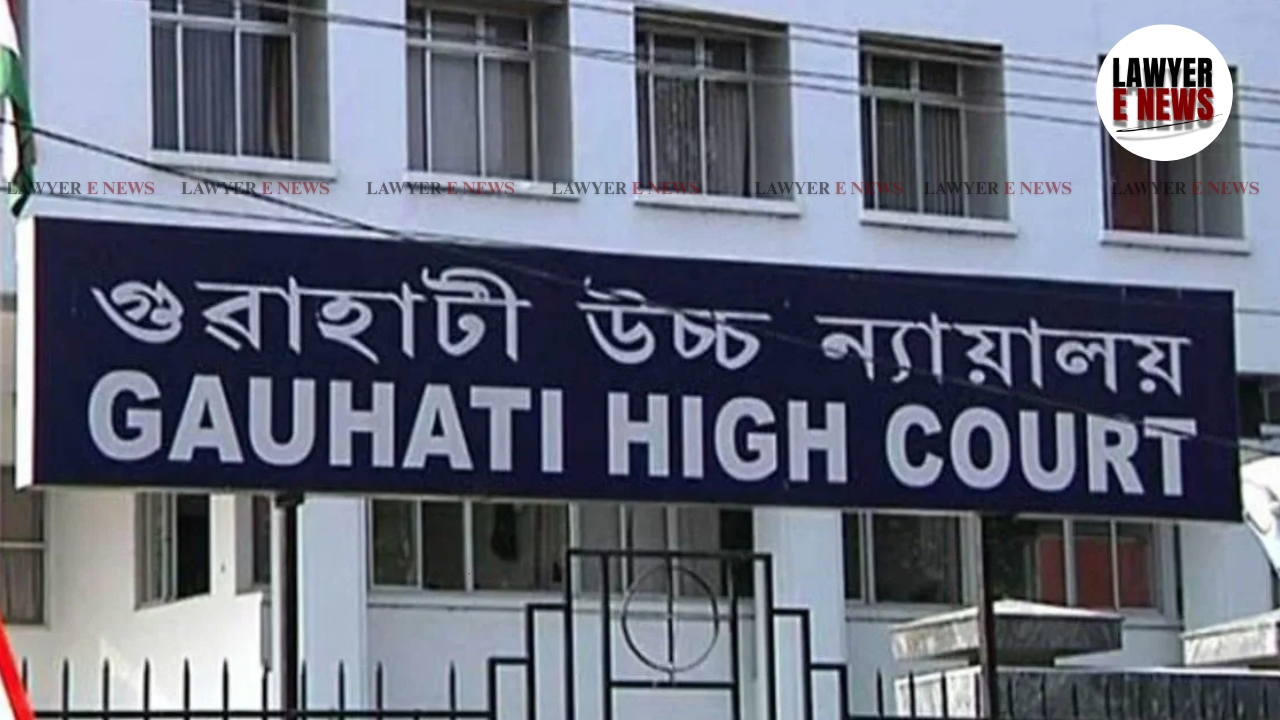
"Mere Reliance on Unproved MVI Reports is Arbitrary When Charge Sheet and Eyewitness Pin Liability on Truck Driver" — In a significant decision Gauhati High Court, exercising its appellate jurisdiction in MAC Appeal No. 91 of 2020, set aside a finding of exclusive negligence passed by the Motor Accident Claims Tribunal (MACT), Tezpur, in a fatal road accident case, and instead held that both vehicles involved in a head-on collision were liable, thereby directing apportionment of liability between two insurance companies. The Court not only corrected the Tribunal’s approach but also enhanced the compensation from ₹10,00,150/- to ₹14,56,216/- in line with Supreme Court precedents on the calculation of just compensation.
The appeal was preferred by Smti Bina Devi, widow of Om Prakash Sah, who died in a tragic accident on 28.11.2017, when a WagonR (DL-03CR-6768) collided with a truck (AS-14C-0806) near Batamari on NH-15, Assam. The Tribunal had fastened entire liability on the insurer of the WagonR, United India Insurance Co. Ltd., based on MVI reports and testimony of an insurance company officer, disregarding the charge sheet and an eyewitness account that pointed towards the truck driver’s negligence.
Tribunal Erred in Ignoring Police Charge Sheet and Eyewitness Testimony While Fixing Negligence
The High Court found that the Tribunal’s finding — that the accident was solely due to rash and negligent driving by the WagonR driver — was based on legally unsustainable evidence. The Tribunal had heavily relied on MVI (Motor Vehicle Inspector) reports to conclude that the damage to the truck was at the rear end, thus suggesting the WagonR struck it from behind. However, as Justice Robin Phukan noted:
“The finding so arrived at by the learned Tribunal solely relying upon the hearsay evidence of DW-1 and the MVI Reports, without examining and proving the same through the concerned MVI, appears to be ex-facie illegal and arbitrary.” [Para 13]
The Court emphasised that DW-1’s testimony was based on a private investigator’s report, and that neither the investigator nor the MVI were examined, thereby rendering the MVI reports unproven.
In contrast, the charge sheet submitted by the police against the truck driver and the categorical statement of CW-2, an eyewitness, implicated the truck driver for rash and negligent driving.
“CW-2 deposed in no uncertain terms that due to rash and negligent driving on the part of the driver of the Truck... the accident took place. The factum that the Truck was driven in rash and negligent manner remained un-rebutted.” [Para 10]
The High Court concluded that the Tribunal “misread the evidence of eye witness i.e. CW-2 and the Accident Information Report, the Ejahar and the Charge Sheet”, and failed to appreciate that strict rules of evidence do not apply in motor accident claims. [Para 12]
“Standard of Proof in Motor Accident Claims is Preponderance of Probability, Not Proof Beyond Reasonable Doubt” — Court Relies on Supreme Court Rulings
Relying on Bimla Devi v. Himachal Road Transport Corp. (2009) 13 SCC 530, Kaushnumma Begum v. New India Assurance Co. Ltd. (2001 ACJ 421) and Rajwati v. United India Insurance Co. Ltd. (2022 SCC OnLine SC 1699), the Court reiterated the position that beneficial legislation like the Motor Vehicles Act must not be defeated by evidentiary technicalities.
Justice Phukan observed: “It is well settled that Motor Vehicles Act, 1988 is a beneficial piece of legislation... strict rules of evidence as applicable in a criminal trial, are not applicable in motor accident compensation cases... the standard of proof must be preponderance of probability.” [Para 14]
In light of this legal position and the evidence on record, the Court concluded that both vehicles were at fault, and liability must be shared equally between the insurers:
“This Court is of the view that the insurer of both the vehicles are liable for the accident and on such count liability to pay compensation has to be saddled, both upon the Truck and WagonR vehicle.” [Para 16]
Request for Remand Rejected; High Court Decides on Merits to Avoid Delay
Although the appellant’s counsel urged the Court to remand the matter to the Tribunal for a fresh finding on liability, the High Court firmly declined. Citing P. Purushottam Reddy v. Pratap Steels Ltd. (2002) and discussing Order XLI Rules 23, 23A, and 25 CPC, the Court observed that none of the legal conditions for remand were satisfied and that unwarranted remands prolong litigation without merit.
“An unwarranted order of remand gives the litigation an undeserved lease of life and must be avoided.” [Para 17]
Compensation Enhanced Using Pranay Sethi, Sarla Verma & Nanu Ram Principles
While the Tribunal had awarded ₹10,00,150/- in compensation, the High Court found that the calculation ignored the addition for future prospects, as required by National Insurance Co. Ltd. v. Pranay Sethi (2017) 16 SCC 680, and also failed to consider filial consortium, as laid down in Magma General Insurance Co. Ltd. v. Nanu Ram (2018) 18 SCC 130.
The Court recalculated compensation using:
Monthly income of ₹7,950/- (minimum wage in Assam for unskilled workers)
25% addition for future prospects, as deceased was 48 years old
Multiplier of 13, per Sarla Verma
1/4th deduction towards personal expenses (5 dependents)
₹48,000 each for five dependents under filial consortium
₹18,000 each towards funeral expenses and loss of estate (with 10% enhancement applied twice due to passage of 8 years)
“Accordingly, the compensation, which the claimant/appellant is entitled to, is assessed at Rs. 14,56,216/-.” [Para 26]
Interest at 9% per annum was directed to be paid on the entire amount from the date of filing the claim petition till realization, following the Supreme Court’s decision in Municipal Corporation of Delhi v. Uphaar Tragedy Victims Association (2011) 14 SCC 481.
Court Orders Equal Apportionment of Liability and Safeguards Compensation
The Court ordered that New India Assurance Co. Ltd. (insurer of the truck) and United India Insurance Co. Ltd. (insurer of the WagonR) shall each deposit 50% of the enhanced amount within 30 days.
It also protected the interest of the claimant by directing that ₹10,00,000/- be kept in a fixed deposit for 5 years, in a nationalized bank in the claimant’s name, not to be withdrawn without the Tribunal’s leave.
Judgment Upholds Principles of Substantive Justice in Motor Accident Claims
This judgment stands as a vital reaffirmation of the principle that claims under the Motor Vehicles Act must be adjudicated with a focus on justice and fairness, rather than evidentiary rigidity. It underscores that charge sheets and eyewitness accounts carry strong probative value, especially when unchallenged, and cannot be brushed aside merely based on unproved technical reports.
By ensuring proper attribution of negligence, fair apportionment of liability, and enhancement of compensation in line with established jurisprudence, the Gauhati High Court has delivered a ruling that reflects both legal precision and human compassion.
Date of decision : 13 October 2025





