-
by sayum
04 August 2026 1:39 PM







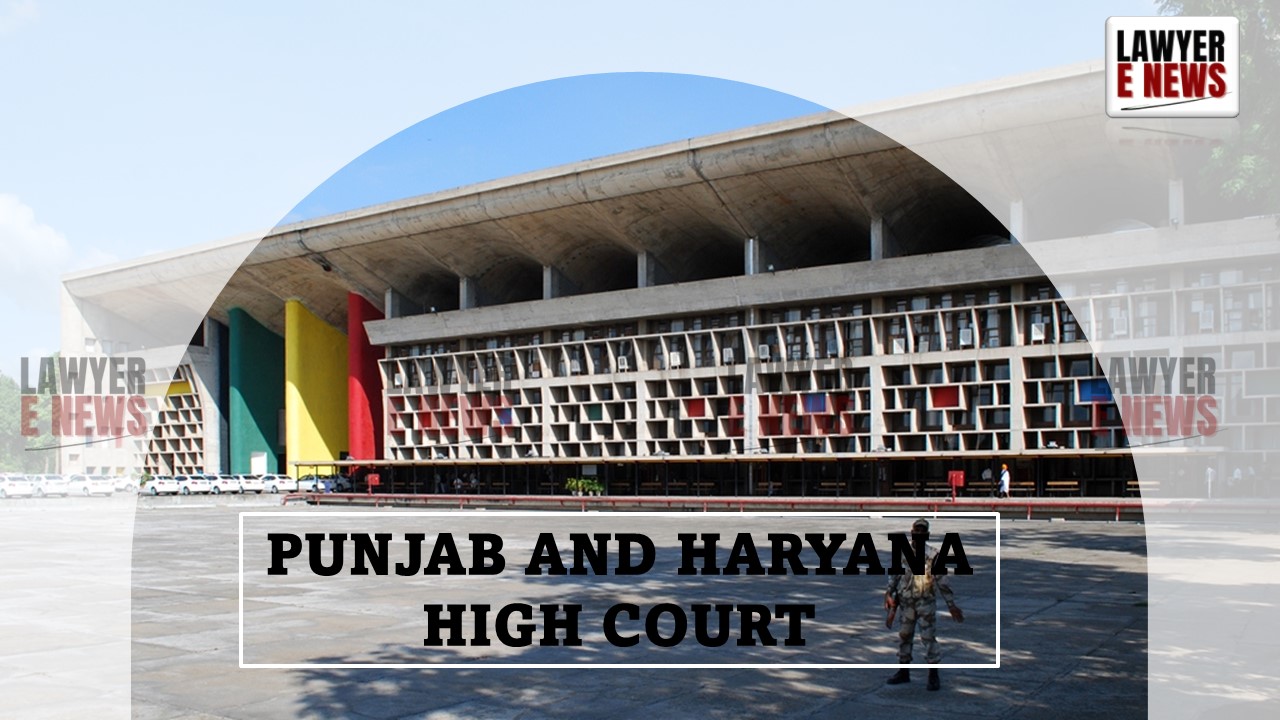
“Right of Redemption Under Section 62 TPA Survives Until Expressly Extinguished—Mortgagee Cannot Claim Ownership by Prescription Alone”: In a reportable judgment Punjab and Haryana High Court, through Justice Pankaj Jain, emphatically held that possession by a usufructuary mortgagee does not mature into ownership merely by passage of time. High Court reversed the findings of the First Appellate Court and restored the decree of the Trial Court, declaring the plaintiffs as absolute owners of their respective 1/3rd shares, free from encumbrances.
The Court invoked the binding precedent of the Supreme Court in Singh Ram v. Sheo Ram, AIR 2014 SC 3447, holding that “a usufructuary mortgagee is not entitled to claim ownership merely on expiry of 30 years from the date of mortgage,” and that Article 61 of the Limitation Act only begins to run when the mortgagor initiates redemption under Section 62 of the Transfer of Property Act, 1882.
The dispute arose from a claim of title over ancestral agricultural land originally owned by Balwant, whose estate was succeeded by his three sons—Mukhtiar Singh, Akhtiar Singh, and Hoshiar Singh. The plaintiffs—Nathu, son of Mukhtiar Singh, and Umed Kaur, widow of Akhtiar Singh—filed suit for declaration and possession, asserting that the mortgage created over the land had either merged with ownership or had been formally redeemed through prior judicial and revenue proceedings.
The plaintiffs relied on: “Mutation No.66 dated 08.02.1945 was sanctioned in their favour,” recording their inheritance, and later, “Mutation No.97 dated 29.01.1947” which acknowledged that “plaintiff No.1 became co-owner in the entire land to the extent of 1/3rd share free from all encumbrances.”
Further, Plaintiff No.2 had already obtained a judicial declaration of ownership in Civil Suit No.241 decided on 26.04.1974, and Jamabandi entries till the early 1980s consistently recorded both plaintiffs as owners. The plaintiffs alleged that it was only in 1988, via a unilateral fard-badar, that revenue records were altered in favour of the defendants as mortgagees—a change made after more than two decades without legal justification.
The Trial Court accepted the plaintiffs’ claims, declared their ownership, and found the defendants to be in possession as mortgagees. However, the Lower Appellate Court reversed this, holding that the mortgage was never redeemed and that “defendants had become owners by lapse of time,” relying on Nathu’s cross-examination where he admitted that mortgagee rights “were never formally redeemed.”
Justice Pankaj Jain firmly rejected the Lower Appellate Court’s conclusions, terming them legally flawed and contrary to settled principles.
On the primary legal issue—whether prolonged possession of a usufructuary mortgagee leads to ownership—the Court held:
“The conclusion drawn by Appellate Court regarding defendants having perfected their mortgagee rights into ownership by efflux of time is in the teeth of ratio of law laid down by Supreme Court in the case of Singh Ram v. Sheo Ram.”
Quoting the Supreme Court's authoritative interpretation, the Court reiterated:
“We… hold that special right of usufructuary mortgagor under Section 62 of the Transfer of Property Act to recover possession commences in the manner specified therein… Until then, limitation does not start for purposes of Article 61… A usufructuary mortgagee is not entitled to file a suit for declaration that he had become an owner merely on the expiry of 30 years.”
The High Court thus ruled that mere non-redemption or delay does not extinguish the mortgagor’s title, unless redemption is expressly denied or limitation begins under the statutory framework. Since no such process occurred here, the plaintiffs' rights remained intact.
On the value of revenue entries, Justice Jain noted that: “The Lower Appellate Court ignored the fact that after 1961-62, entries were in favour of the plaintiffs showing them absolute owners. The same were changed after more than two decades that too by a Fard-badar prepared on 14.03.1988.”
The Court criticized the unilateral change of ownership in revenue records via fard-badar and emphasized that such action “cannot displace title lawfully recorded and recognized in earlier judicial proceedings.”
Regarding the alleged admission in cross-examination by Nathu, which was the sole basis for the Appellate Court’s ruling, the High Court held:
“The Lower Appellate Court ignoring the aforesaid documentary evidence relied upon cross-examination of PW-1… Such selective reliance without reconciliation with consistent jamabandi entries and judicial proceedings is wholly unsustainable.”
The High Court decisively ruled: “This Court finds that the judgment passed by Lower Appellate Court being in the teeth of ratio of law laid down in Sheo Ram’s case cannot be sustained and is hereby set aside.”
Accordingly: “The present appeal is allowed. Suit filed by the plaintiffs is ordered to be decreed. Judgment and decree passed by the Trial Court is ordered to be maintained and that passed by the Lower Appellate Court is quashed.”
Thus, both plaintiffs—Nathu and Umed Kaur—were declared absolute owners of their respective 1/3rd shares, free from all mortgage claims. The revenue entries showing defendants as mortgagees or owners were held to be illegal and non-binding.
This judgment from the Punjab and Haryana High Court reinforces a central tenet of property law: a usufructuary mortgage, by its very nature, does not extinguish ownership of the mortgagor, regardless of the length of possession by the mortgagee. Unless statutory conditions of redemption under Section 62 TPA are fulfilled, ownership does not transfer by prescription.
Justice Pankaj Jain’s ruling is a caution against overreliance on stray admissions and manipulated revenue entries, and an affirmation that land ownership can only be lost through process of law—not by the slow erosion of time.
Date of Decision: 28 May 2025