-
by sayum
04 August 2026 1:39 PM







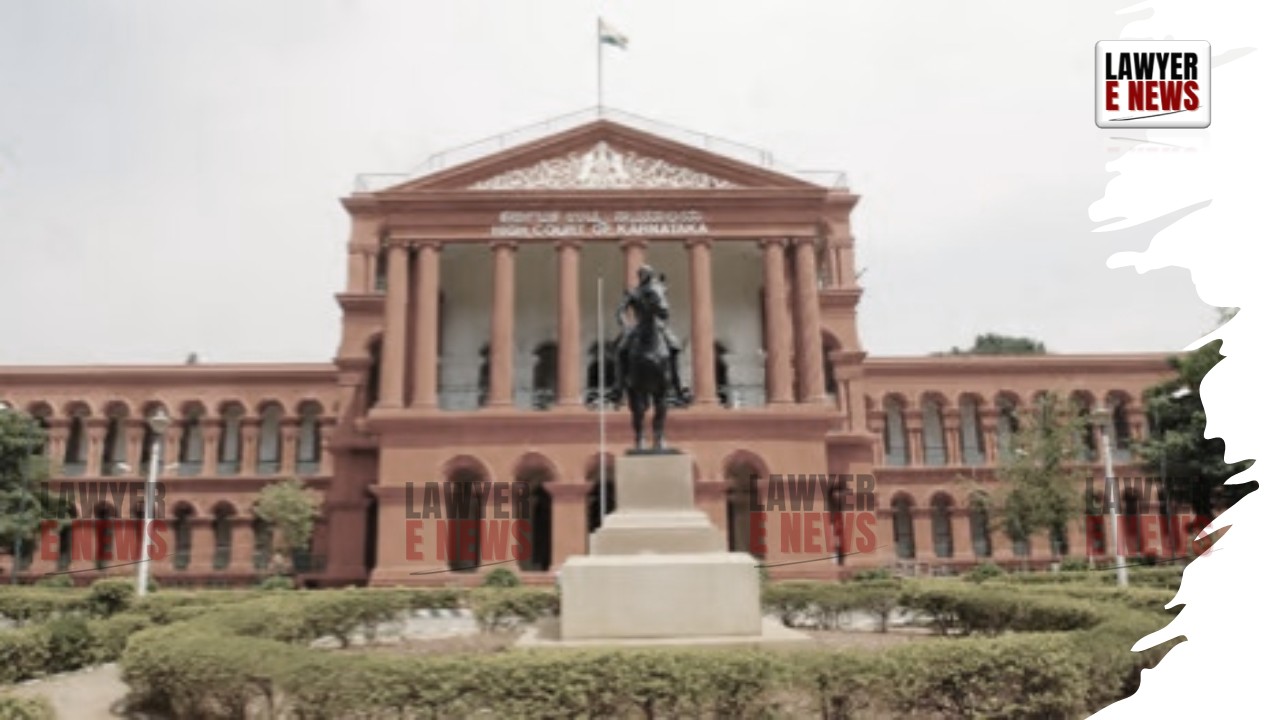
"Governance Can't Freeze to Protect the Status Quo" — In a judgment reinforcing transparency and accountability in community-led organizations, the Karnataka High Court allowed two connected writ appeals in the case of Sri Venugopal C. & Others v. Karnataka Pradesha Balija Sangha & Others (W.A. Nos. 280 & 234 of 2025). The Court set aside the earlier dismissal by a single judge and directed the Balija Sangha, a registered community welfare society, to immediately process membership applications from eligible persons and hold overdue elections. The Court firmly held that expired governing councils cannot use delay in elections as a shield to reject new members, especially when they continue to exercise full powers.
The appeals arose out of a long-pending dispute involving the Karnataka Pradesha Balija Sangha, a society registered under the Karnataka Societies Registration Act, 1960, dedicated to the welfare of the Balija community. Petitioners, all community members above the age of 18, had applied for membership but were ignored by the current governing council, whose original term expired on 30.09.2021. Alleging intentional exclusion to manipulate upcoming elections, the petitioners approached the District Registrar, who issued a letter on 03.01.2022 directing the society to consider the membership requests as per its bye-laws.
When the society refused to act on that directive, petitioners filed Writ Petition No. 3123 of 2022, seeking enforcement of the registrar's instruction. However, the learned single judge dismissed the writ, stating that only a newly elected committee could consider membership requests. This led to Writ Appeals 280/2025 and 234/2025, now decided in the appellants' favour.
Justice M.I. Arun, delivering the judgment on behalf of the Division Bench, held that the Managing Committee of the society, although beyond its original three-year term, continues to function with full legal authority under the society’s bye-laws until a new council is elected. The Court remarked:
“It is not the case of respondent No.3 that a 'No Confidence Motion' is moved… or that the Governing Council… is under suppression… Admittedly, the Governing Council is exercising all its powers under the bye-laws as on today.” [Para 23]
Referring to the Supreme Court’s precedent in U.P. State Cooperative Land Development Bank Ltd. v. Chandra Bhan Dubey, the Court reiterated that:
“Even if a society is not 'State' under Article 12, a writ will lie to enforce statutory public duties placed upon it.” [Para 12]
The Court also made it clear that the District Registrar acted within his authority in directing the society to process membership applications:
“The impugned letter issued by respondent No.2 does not direct respondent No.3 to necessarily admit… It has merely directed them to consider the request in accordance with the bye-laws of the Society.” [Para 21]
Rejecting the Single Judge’s Reasoning
The Court found fault with the single judge’s conclusion that since the elected term had ended, no action could be taken. It held that this interpretation would allow unaccountable governance to persist indefinitely:
“The learned Single Judge erred… and only on the ground that the original term of three years… had expired, has dismissed the writ petition.” [Para 26]
Given that the same governing council remained in power and was functioning with full authority, the Court found no legal bar to their obligation to consider applications for new members.
The High Court allowed both appeals and issued detailed directions:
“Respondent No.3 is directed to consider the request of the petitioners and similarly situated persons for membership… and admit such persons who are eligible… thereafter conduct necessary elections.” [Para 28(ii)]
Further, the Court imposed strict timelines: “Applications… shall be considered within four weeks… Elections… shall be conducted within three months thereafter.” [Para 28(iii)]
This ruling sends a powerful message: no society or community organization can delay elections and refuse new members under the guise of administrative convenience or continuity. The Court has reinforced that democracy and inclusion must prevail even within private or community bodies when they are entrusted with public functions or social mandates.
By restoring the right of eligible Balija community members to be considered for inclusion and ordering long-overdue elections, the Karnataka High Court has once again aligned institutional governance with constitutional values of fairness, representation, and accountability.
Date of Decision: 28 May 2025