-
by sayum
28 August 2026 10:07 AM







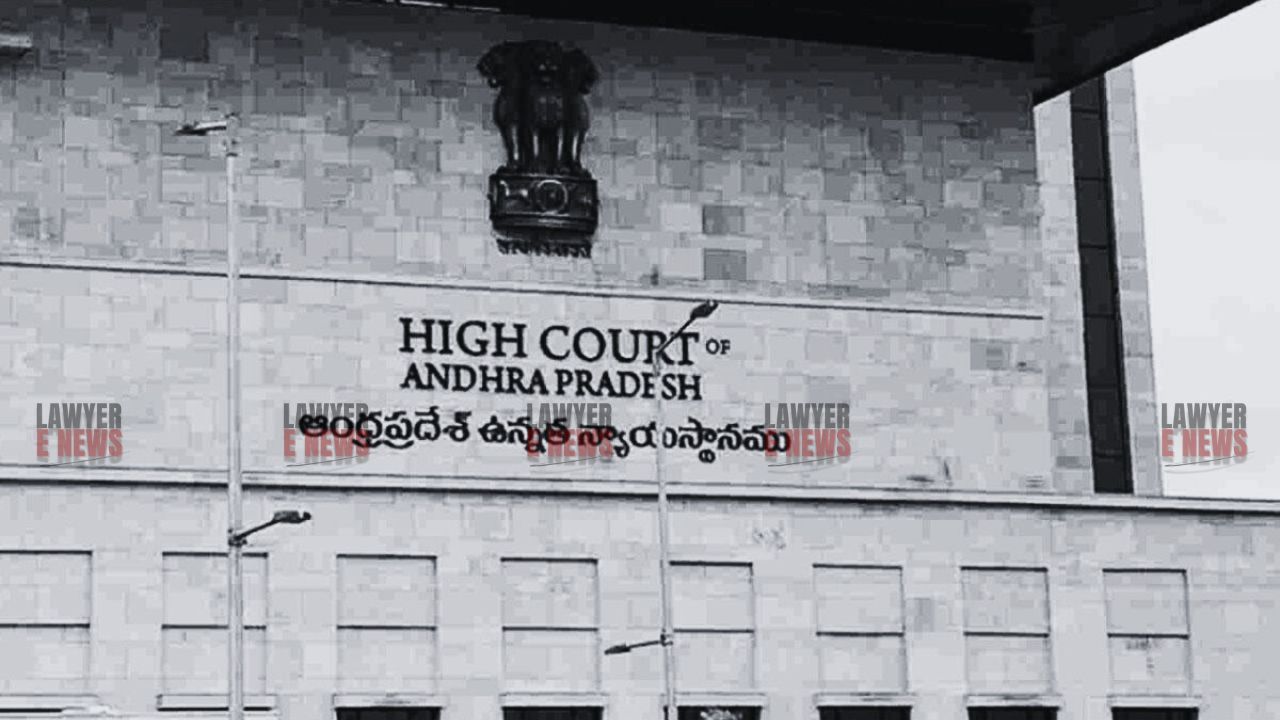
Delivering a significant ruling on October 8, 2025 Andhra Pradesh High Court, through a Division Bench comprising Justice Ravi Nath Tilhari and Justice Maheswara Rao Kuncheam, emphatically held that limitation cannot be decided at the stage of registration of plaint when it involves disputed facts and requires evidence, particularly regarding the date of knowledge. The Court set aside an order of the II Additional District Judge, Vijayawada, which had rejected a suit at the very threshold under Order VII Rule 11 of the Code of Civil Procedure, 1908, on grounds of limitation and absence of cause of action.
The High Court declared, "Registration of a document amounts to constructive notice, but whether plaintiffs had actual knowledge requires trial", emphasizing that such factual disputes must be adjudicated during the course of trial, not decided summarily.
The suit, filed by Gummadi Usha Rani and another, sought declaration of title, cancellation of registered sale deeds, recovery of possession, and permanent injunction over immovable property. The trial court had rejected the suit even before registration, citing prior registered sale deeds (dated between 1996 and 2003), a previously dismissed suit, and the assumption that plaintiffs had knowledge of the transactions due to registration of those documents.
"Averments in the Plaint Must Be Taken at Face Value; Courts Cannot Dissect Pleadings at the Registration Stage"
The High Court underscored that under Order VII Rule 11 CPC, the court must confine its examination strictly to the contents of the plaint, without considering external documents or prior litigation unless expressly relied upon in the plaint itself. The trial court, by assuming facts not admitted by the plaintiffs and interpreting prior litigation, had overstepped its jurisdiction.
The Bench observed:
"When the question of limitation involves disputed facts or the date of knowledge, such issues cannot be decided at the stage of Order VII Rule 11 CPC. At the preliminary stage, the averments made in the plaint must be taken at face value and assumed to be true."
Citing P. Kumarakurubaran v. P. Narayana, Thankamma George v. Lilly Thomas, and N. Thajudeen v. Tamil Nadu Khadi and Village Industries Board, the Court emphasized that limitation involving the date of knowledge is a mixed question of law and fact that can only be resolved upon evidence during trial.
The plaintiffs had pleaded that they became aware of the impugned sale transactions only in January 2022, during cross-examination in an earlier suit (O.S. No. 372/2015), and that the cause of action for the current suit arose subsequently. The plaint also detailed a chain of events between 2022 and 2023 that allegedly led to illegal dispossession and forged documents.
Yet, the trial court disregarded these assertions and concluded that the suit was barred based on the mere registration dates of sale deeds. The High Court reproached this approach as flawed and violative of binding precedents.
"Rejection of Plaint Cannot Be Founded on Previous Dismissed Suit Without Trial on Res Judicata or Order II Rule 2 CPC"
Another ground for rejection by the trial court was the prior dismissal of O.S. No. 372 of 2015, filed by the same plaintiffs. The trial judge opined that the current suit was merely a "second round of litigation" and hence was barred.
The High Court squarely rejected this reasoning, observing:
"Whether the dismissal of O.S. No. 372 of 2015 operated as a bar to institute a fresh suit (under Order II Rule 2 CPC) or the decree in the said suit operated as res judicata… were questions that were required to be considered after registration of the suit during trial."
The Court further remarked that plaintiffs had pleaded distinct causes of action in the current suit, arising from new facts and knowledge, and that questions regarding res judicata, waiver, or relinquishment of reliefs under Order II Rule 2 CPC required fact-based analysis, not summary rejection.
It also noted that the prior suit was still under challenge in A.S. No. 261 of 2023, and hence any final conclusion about its preclusive effect would be premature.
"Trial Courts Must Read the Entire Plaint Meaningfully; Selective Reading Leads to Miscarriage of Justice"
A key criticism by the High Court was directed at the trial court’s failure to read the plaint in its entirety. Despite explicit pleadings in the plaint regarding the date of knowledge and cause of action, the trial court failed to even mention those paragraphs in its rejection order.
The High Court cautioned: "There has to be a meaningful reading of the plaint. But here, the entire plaint has not been read as a whole. It is so evident from the impugned judgment which completely missed the paragraphs relating to cause of action and limitation."
This observation was bolstered by references to Madanuri Sri Rama Chandra Murthy v. Syed Jalal and Sri Mukund Bhavan Trust v. Shrimant Chhatrapati Udayan Raje, both of which caution against rejection of suits based on clever judicial reading rather than comprehensive understanding of pleadings.
"Plaintiffs Entitled to Full Refund of Court Fee Under Section 64 of AP Court Fees Act upon Reversal of Rejection"
Having held the rejection order unsustainable, the High Court addressed the appellant’s plea for refund of court fee paid while filing the first appeal. It ruled in favour of the appellants by applying Section 64 of the Andhra Pradesh Court Fees and Suits Valuation Act, 1956, which provides for full refund when a plaint rejected by a lower court is ordered to be received.
Relying on its earlier judgment in Veluru Prabhavathi v. Sirigireddy Arjun Reddy, the Bench ordered:
"The appellants are entitled for refund of the court fee paid on the memorandum of the appeal… The refund shall be made in the bank account of any one of the appellants, for which the appellants shall furnish details to the Registry."
The Registrar (Judicial) was specifically directed to ensure compliance.
"Suit Must Be Registered; Rejection Order Set Aside as Legally Unsustainable"
Concluding the judgment, the High Court allowed the appeal in full, directed that the plaint shall be received and registered by the trial court, and ordered refund of the court fee to the appellants.
The Court declared: "The plaint could not be rejected under Order 7 Rule 11 CPC at the stage of registration either on the ground of ‘barred by limitation’ or ‘no cause of action’. The impugned order is legally unsustainable."
No costs were imposed, and all pending miscellaneous petitions stood closed.
Date of Decision: 08.10.2025