
-
by sayum
26 August 2026 1:49 PM







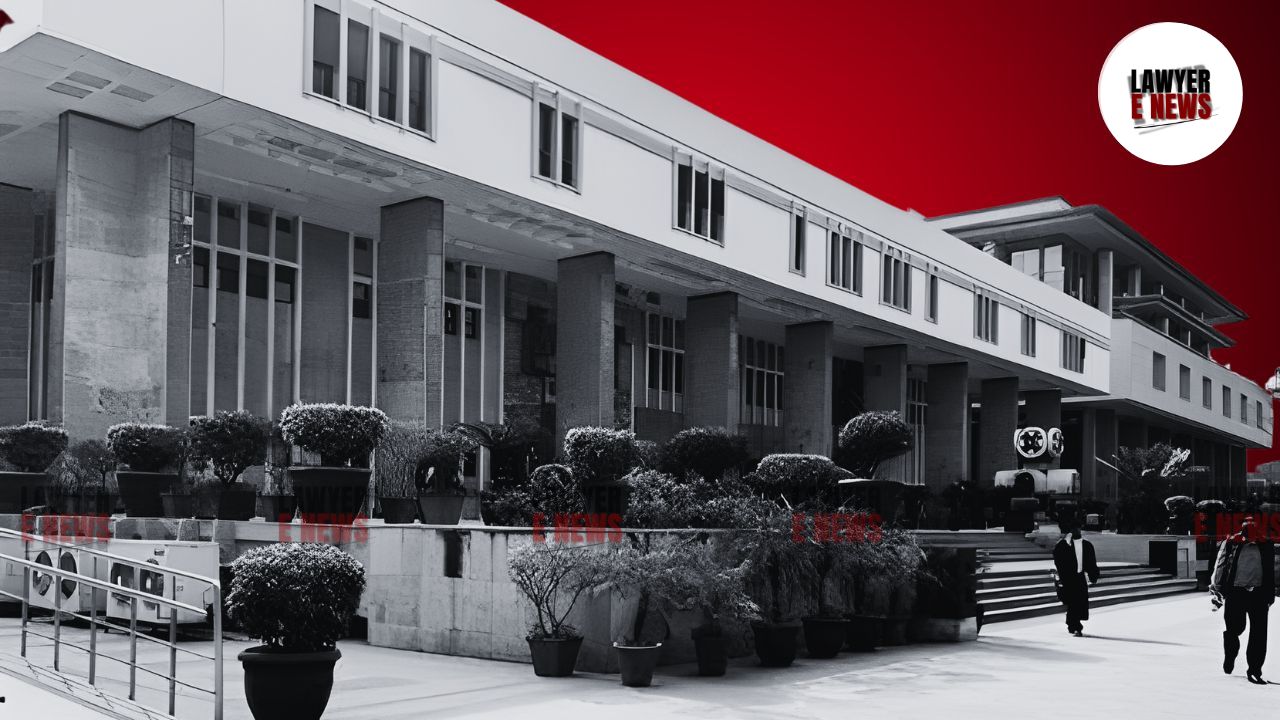
"To compare legal profession with that of trade and business is a far from correct approach and it will totally be misplaced" — Delhi High Court, in the matter of B.K. Sood v. North Delhi Municipal Corporation (NDMC), quashed a criminal complaint pending since 2003 for alleged "misuse" of residential premises under the New Delhi Municipal Council Act, 1994, holding that the use of a residential basement by an advocate for his legal office does not constitute a 'commercial activity', and is not a violation under Section 252 read with Section 369(1) of the NDMC Act.
The decision by Justice Neena Bansal Krishna not only clarifies the legal status of professional use of residential spaces but also underscores the distinct and non-commercial nature of legal practice, bringing long-pending criminal proceedings against the petitioner to a close.
"Lawyer's Office Is Not a Commercial Establishment": Professional Use of Basement Permissible under Bye-Laws and MDP, 2001
The case involved advocate B.K. Sood, who was using the lower ground floor (LGF) basement of his residential premises at Golf Apartments, Sujan Singh Park, New Delhi, as his professional legal office. The NDMC, alleging that the basement was sanctioned only for storage/godown use, initiated Complaint No. 487/2004 under Section 252 of the NDMC Act, citing unauthorized “change of user” for running a commercial office.
The core legal issue revolved around whether a lawyer's professional office within residential premises constitutes “commercial activity” under municipal laws. The court firmly rejected this interpretation.
Referring to Supreme Court decisions in M.P. Electricity Board v. Narayan (2005) 7 SCC 283 and V. Sasidharan v. Peter & Karunakar, AIR 1984 SC 1700, the Court emphasized:
“In legal profession, there is no such kind of buying or selling nor any trading of any kind whatsoever. Therefore, to compare legal profession with that of trade and business is a far from correct approach and it will totally be misplaced.”
It further relied on Bombay High Court's ruling in Sakharam Kherdekar v. City of Nagpur Corporation, which held that:
“The commercial character of business, which is an essential condition of a commercial activity is absent in the lawyer's profession... The client is not his customer; there is a certain fiduciary relation between them.”
Thus, the court concluded unequivocally that the legal profession is sui generis and cannot be categorized as commercial either in spirit or in substance.
Basement Office Not in Violation of MDP or Bye-Laws; No Prima Facie Misuse Found
While NDMC claimed that the use of basement as an office was per se unauthorized, the Court examined the relevant legal and urban planning framework, namely the:
Master Development Plan (MDP), 2001, and
Delhi Building Bye-laws, 1983
Clause 10 of the MDP, 2001 permits professional use of up to 25% of residential premises or 50 sq.m., whichever is less, provided the activity is non-nuisance and skill-based. The Delhi Building Bye-laws (Clause 14.12.1.1(vii)) explicitly permits the use of basements for office or commercial purposes, provided they are air-conditioned.
The Court found that: “There was no misuse of the premises by the Petitioner, who had been running his office in terms of MDP, 2001 read with Delhi Building Bye-Laws, 1983… The prosecution has not been able to even prima facie show that there was any violation.”
Additionally, the Inspection Report dated 27.10.2003, forming the basis of the complaint, failed to establish non-compliance with any requirements, such as air-conditioning, ventilation, height norms, or unauthorized structural alterations. It lacked any mention of these critical factors and thus was deemed legally insufficient to proceed with prosecution.
Quashing Justified as Abuse of Process; 22-Year-Old Criminal Complaint Held Incurably Flawed
Noting the 22-year pendency of the case and the petty, unsubstantiated nature of the allegations, the High Court invoked the principle laid down by the Supreme Court in State of Haryana v. Bhajan Lal, AIR 1992 SC 604, holding that:
“The case being pending for the last more than 22 years, it would be abuse of the process of the law and not serve any interest of justice, if such Complaint is permitted to continue and choke the judicial system.”
It concluded that continuation of criminal proceedings in this context would be "arbitrary, irrational and in violation of Article 14 of the Constitution", and no offence under Section 252 read with Section 369(1) NDMC Act could be made out.
Accordingly, the Court allowed the petition under Section 482 CrPC, and:
“The Complaint No.487/2004 under Section 252 read with Section 369(1) of NDMC Act, 1994 and all consequential proceedings emanating therefrom, are quashed.”
All pending applications were also disposed of.
The Delhi High Court’s judgment is a significant reaffirmation of the non-commercial character of the legal profession, and an important precedent clarifying that professional offices of lawyers in residential areas—when compliant with planning and building bye-laws—do not constitute misuse under municipal laws. The ruling also serves as a caution against frivolous, outdated prosecutions that burden the judicial process without legal merit.
Date of Decision: October 8, 2025





