-
by sayum
19 August 2026 10:42 AM







"The Custodians of Justice Have Turned Into Perpetrators of Violence — These Deplorable Acts of Hooliganism Deserve to Be Deprecated", Supreme Court has ordered the immediate release on bail of toll plaza employees who spent over two months in custody — not because the allegations against them warranted detention, but because members of the District Bar Association, Barabanki physically burned the office furniture of the one advocate courageous enough to file a bail application on their behalf, creating an atmosphere of terror that left the accused without any legal representation.
A Bench of Justice Vikram Nath and Justice Sandeep Mehta, exercising extraordinary jurisdiction under Article 32, transferred the entire criminal proceedings from Barabanki to Tis Hazari Courts, New Delhi, and directed the Bar Council of India to take appropriate disciplinary action against the erring advocates.
The petitioners are contractual employees of M/s. Skylark Infra Engineering Private Limited, permanent residents of Madhya Pradesh, posted for toll collection duty at the Gotona Bara Toll Plaza on the Lucknow-Sultanpur Highway in District Barabanki, Uttar Pradesh.
On 14 January 2026, an advocate named Ratnesh Shukla allegedly refused to pay the requisite toll charges while passing through the toll plaza. A verbal altercation ensued, which escalated into a physical scuffle. An FIR bearing No. 15/2026 was registered at Police Station Haidergarh, District Barabanki for offences under Sections 115(2), 352, 351(3), 109(1), 110, 311 and 3(5) of the Bharatiya Nyaya Sanhita, 2023. The petitioners were arrested and remanded to judicial custody on 16 January 2026.
What Followed: A Bar Association in Revolt
Immediately after the FIR was registered, members of the Bar Association launched violent protests. Most remarkably, the Bar Council of Uttar Pradesh itself wrote to the Chief Minister requesting invocation of the National Security Act against the toll workers — for what the Supreme Court would later characterise as a trivial scuffle.
A formal resolution was passed and circulated within the local bar: no advocate was to represent the accused persons in connection with FIR No. 15/2026.
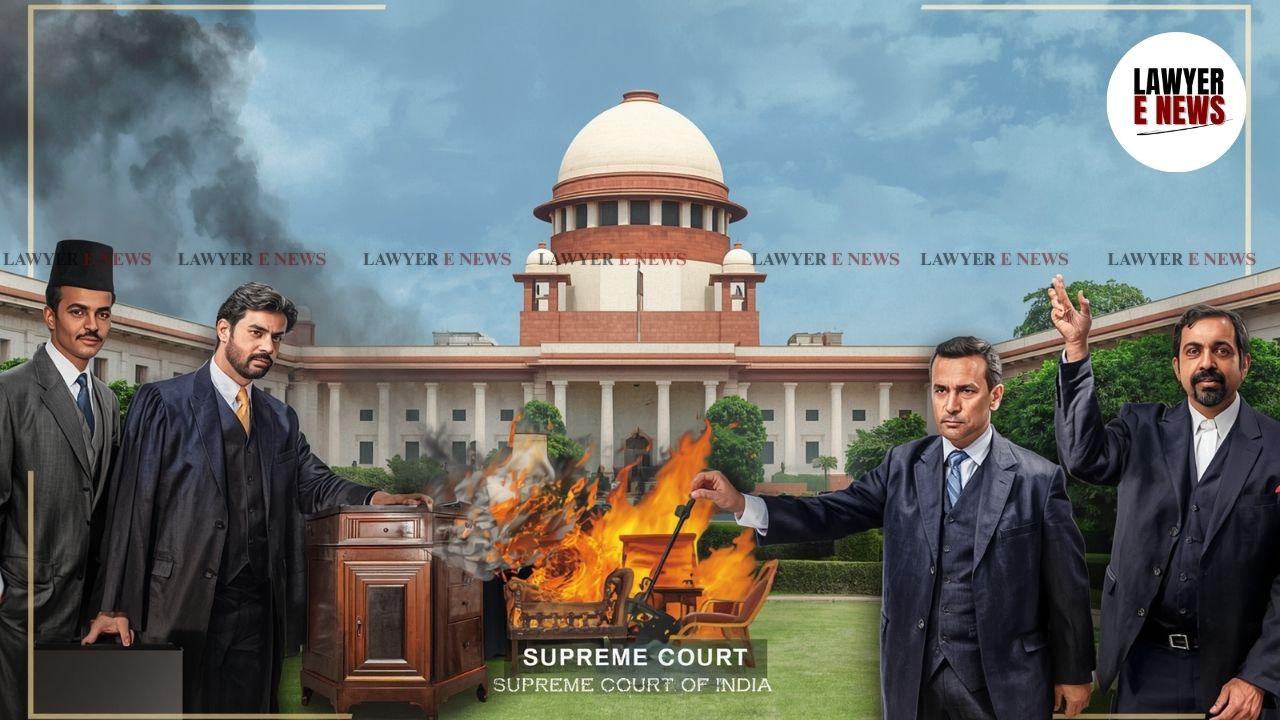
One advocate, Manoj Shukla, chose to stand against the tide. On 5 February 2026, he filed a bail application on behalf of the petitioners. The response was swift and violent. Hundreds of lawyers, led by the District Bar Association President, stormed his office. His tables and chairs were thrown onto the street and set on fire. His effigy was burned. The incident was reported in the Dainik Bhaskar, Lucknow City Edition dated 6 February 2026, the copies of which — along with photographs showing the burning furniture — were placed before the Supreme Court.
After this, no advocate in Barabanki or nearby districts was willing to represent the petitioners. The atmosphere of fear was complete.
"Personal Liberty Curtailed for Over Two Months — Absolutely Unjustified"
The petitioners, having been stripped of all access to legal remedies within the State of Uttar Pradesh, filed a writ petition under Article 32 directly before the Supreme Court. The State of Uttar Pradesh entered appearance but did not deny any of the averments in the petition.
The Court did not wait for a formal reply. Given that the personal liberty of bona fide employees performing their official duties had remained curtailed for more than two months, it proceeded to hear and decide the matter immediately.
On the merits of the bail question, the Court's conclusion was direct. "A bare perusal of the FIR is sufficient to satisfy us that it was not a case wherein the accused-petitioners could have been denied bail," the Court held. It noted that the petitioners were simply performing their duties at a toll plaza, and that the possibility could not be ruled out that the complainant — an advocate — had himself resisted a legitimate demand for toll payment, triggering the altercation.
"Denial of Bail for Over Two Months Is Violative of Article 21"
The Court held that continued incarceration in these circumstances amounted to an unjustified curtailment of personal liberty. "Denial of bail to the petitioners and the curtailment of their liberty for a period exceeding two months is absolutely unjustified and violative of the Fundamental Right of Liberty guaranteed under Article 21 of the Constitution of India," the Court declared, invoking its extraordinary writ jurisdiction under Article 32.
The petitioners were directed to be released forthwith on furnishing personal bonds to the satisfaction of the concerned Magistrate.
Trial Transferred to Delhi — Access to Justice Demands It
On the question of transfer, the Court found no alternative. The hostile environment at Barabanki — with an active resolution prohibiting representation and a demonstrated willingness to use violence against any advocate who dared to appear — made it impossible for the petitioners to receive a fair trial or effective legal representation in Uttar Pradesh.
The entire proceedings arising out of FIR No. 15/2026 were transferred to the Tis Hazari Courts, New Delhi, for all further actions including remand, filing of the result of investigation, and trial. The trial court at Tis Hazari was given liberty to set appropriate additional conditions for bail upon receiving the case file.
On the Safety of the Petitioners
Recognising that the petitioners — who were residents of Madhya Pradesh — faced a genuine risk upon release in Uttar Pradesh, the Court directed the Director General of Police, Uttar Pradesh to be personally responsible for their safety and security, and to ensure that upon release, they were duly escorted to a safe location.
"The Legal Profession Has Been Tainted and Tarnished"
Before parting, the Court reserved its sharpest observations for the Bar. "The legal profession, which was once regarded as a noble profession, has clearly been tainted and tarnished by the acts of hooliganism," the Bench held. It acknowledged a sentiment of fraternity among lawyers but was emphatic that no sentiment — however understandable — could justify burning a colleague's furniture for doing his professional duty.
"We can understand the sentiment of fraternity amongst lawyers but that, by no means, can justify the acts of violence and lawlessness which ensued when a brave lawyer came forward to defend the accused," the Court stated.
The Court directed a copy of the order to be forwarded to the Bar Council of India for appropriate disciplinary action against the advocates involved, and to the Director General of Police, Uttar Pradesh for compliance.
Date of Decision: 17 March 2026