-
by sayum
26 October 2026 4:04 PM







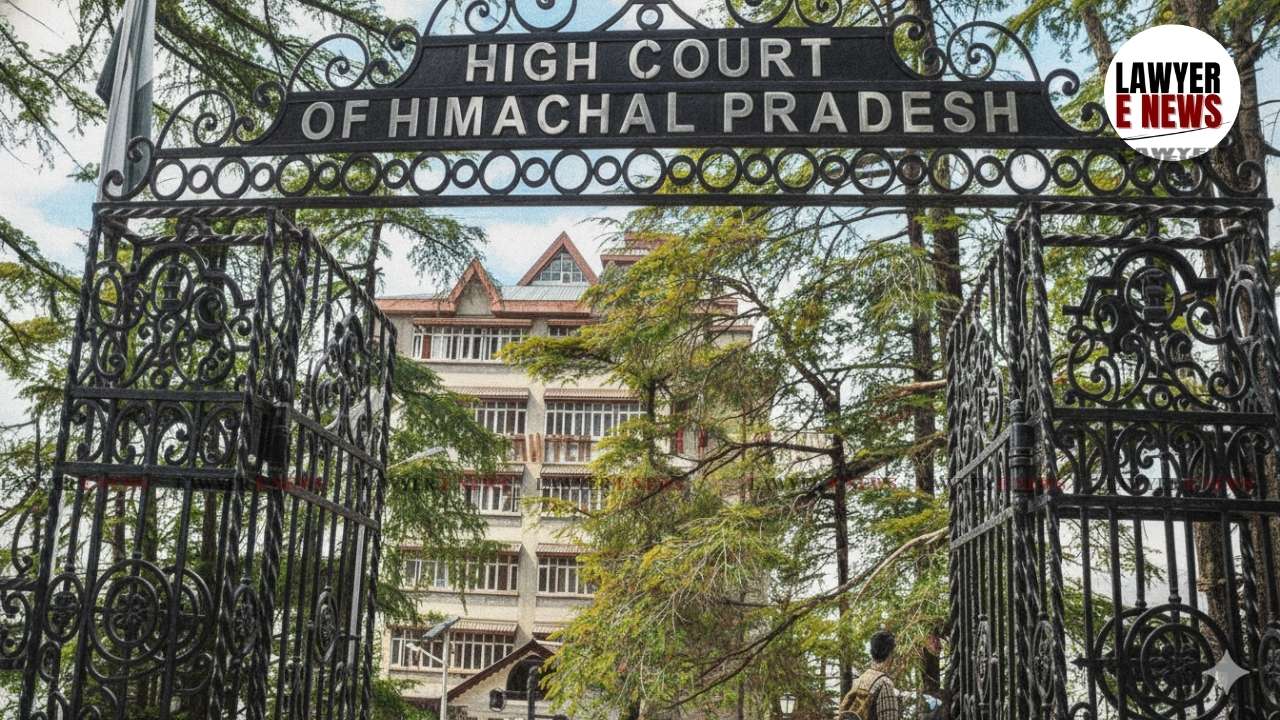
"The entire suit land is a big chunk of land, and in the absence of any identification of the structure and the other part of the suit land, the plaintiffs cannot be granted the discretionary relief of injunction qua the entire suit property." Himachal Pradesh High Court, in a ruling delivered on September 22, 2026, held that a prayer for interim injunction under Order 39 Rules 1 & 2 of the Code of Civil Procedure (CPC) cannot be granted over an entire large tract of land unless the specific portion under dispute is clearly identified and the tripartite test of prima facie case, balance of convenience, and irreparable loss is satisfied.
The bench of Justice Romesh Verma observed that in the absence of clear identification of the disputed structure and its location within the larger suit property, a blanket order of status quo is legally unsustainable.
The petitioners filed a suit for a permanent prohibitory injunction to restrain the defendants from occupying or demolishing an old house situated on a 9-15 bigha land parcel classified as abadi deh. The trial court initially granted a status quo order, which was subsequently set aside by the First Appellate Court. The plaintiffs challenged this appellate judgment before the High Court under Article 227 of the Constitution, arguing that they had successfully made out a prima facie case based on photographic evidence.
The primary question before the court was whether the trial court acted within its jurisdiction in granting an injunction over the entire suit land without clear identification of the disputed structures. Furthermore, the court was called upon to determine whether the High Court’s supervisory jurisdiction under Article 227 should be invoked to restore an interim injunction order passed by the trial court.
Failure to Identify Suit Property
The Court noted that the trial court’s direction to maintain status quo over the entire 9-15 bighas was erroneous and failed to undergo necessary judicial scrutiny. Because the plaintiffs failed to specifically demarcate the structure in question from the rest of the large suit property, the discretionary relief of injunction could not be extended to the entire area.
"The learned First Appellate Court has rightly come to the conclusion that in the absence of identification of the suit land over such a large chunk of land, the plaintiffs are not entitled to any relief."
Strict Application of Tripartite Test
The Court emphasized that for an injunction to be granted, the plaintiff must meet the tripartite test. Mere photographs are insufficient to establish a prima facie case, especially when the defendants have raised a substantive plea of family partition and possession. The determination of possession in such complex family disputes requires independent evidence rather than broad injunction orders.
Court Explains Limitations of Article 227
The Court clarified that its supervisory jurisdiction under Article 227 is not an extension of appellate power. Citing Shri Digant vs M/s P.D.T. Trading Co. and M/s Garment Craft vs Prakash Chand Goel, the Court reaffirmed that the High Court cannot reappreciate evidence or substitute its own findings of fact for those of the lower court unless there is a grave dereliction of duty or a flagrant violation of law.
"The High Court exercising supervisory jurisdiction does not act as a court of first appeal to reappreciate, reweigh the evidence or facts upon which the determination under challenge is based."
No Jurisdictional Error Found
The Court found that the First Appellate Court had correctly identified the controversy and applied the relevant legal principles. There was no jurisdictional error, illegality, or perversity in the appellate judgment that warranted intervention. The offer made by the defendants to furnish a security bond to compensate the plaintiffs if they ultimately succeed in the suit further mitigated the need for an interim injunction.
The High Court dismissed the petition, maintaining that the findings of the First Appellate Court were sound. It clarified that these observations are strictly for the purpose of the current petition and shall not prejudice the trial court during the final adjudication of the suit on its merits.
Date of Decision: 22 September 2026