-
by sayum
19 August 2026 1:58 PM







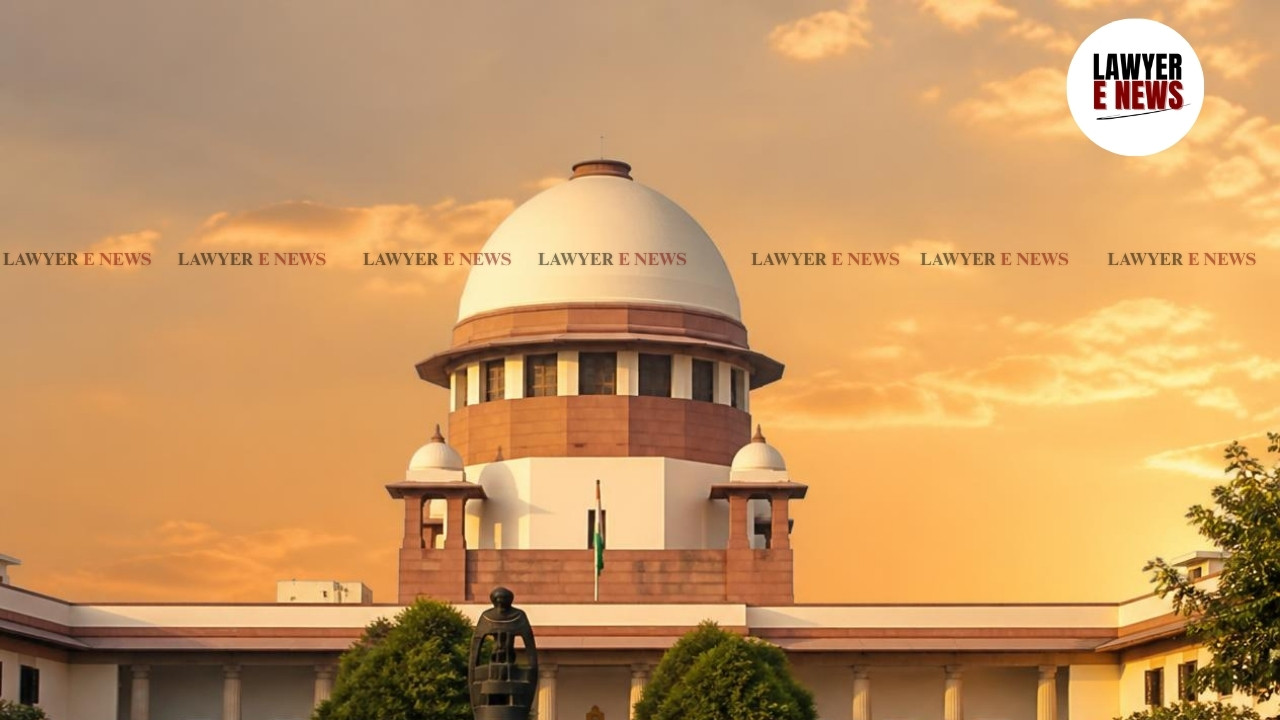
"The element of mens rea cannot simply be presumed or inferred; it must be evident and explicitly discernible", In a ruling that sharply defines the boundaries of criminal liability for abetment of suicide, the Supreme Court has held that the mere existence of an alleged illicit relationship between an accused and the wife of the deceased — without any proximate act of instigation — is wholly insufficient to sustain a charge under Section 306 of the Indian Penal Code. Quashing the charge framed against the appellant and discharging him from the criminal proceedings, the Court made it clear that mens rea in abetment of suicide cannot be presumed; it must be explicitly discernible from the material on record.
A bench of Justice K.V. Viswanathan and Justice Atul S. Chandurkar delivered the judgment on April 16, 2026, in a criminal appeal filed against the Chhattisgarh High Court's refusal to quash the charge.
On 07.10.2024, the body of one Komal Sahu was found hanging from a Babool tree in village Dharampura, District Kabirdham, Chhattisgarh. The post-mortem confirmed the cause of death as asphyxia. A Special Investigation Team was constituted, and after investigation, a final report was filed on 05.12.2024. The SIT found no evidence of murder and concluded that Komal had died by suicide. Based on witness statements alleging that the appellant Balaji Jaiswal had illicit relations with Komal's wife Revati Bai, and that Revati Bai had insulted Komal in front of the appellant on multiple occasions, both Balaji Jaiswal and Revati Bai were named as accused. The Sessions Court framed charges under Section 306 read with Section 34 IPC on 16.12.2024. The Chhattisgarh High Court dismissed the appellant's revision application. Aggrieved, the appellant approached the Supreme Court.
The central question was whether the material on the charge sheet, taken entirely at face value, was sufficient to satisfy the essential ingredients of Section 306 read with Section 107 IPC — specifically, whether any proximate act of instigation or incitement by the appellant could be made out, and whether the absence of such material warranted quashing of the proceedings.
The Law on Abetment of Suicide: Instigation Is the Gravamen
The Court extensively surveyed the settled legal position on Section 306 IPC, drawing upon a consistent line of precedents. Referring to its recent decision in Prakash and Others v. State of Maharashtra (2024), the bench extracted the essential framework: for a charge under Section 306 to be sustained, the accused must have contributed to the suicide through a direct or indirect act amounting to instigation or incitement, and such instigation must reveal a clear mens rea to abet the commission of suicide. Crucially, the act of instigation must also be in close proximity to the act of suicide so as to form a nexus — the suicide must be a direct result of the instigation.
"To bring a charge under Section 306 of the IPC, the act of abetment would require the positive act of instigating or intentionally aiding another person to commit suicide. Without such mens rea on the part of the accused person being apparent from the face of the record, a charge under the aforesaid Section cannot be sustained."
Relying on Ramesh Kumar v. State of Chhattisgarh (2001), the Court recalled the authoritative definition of instigation: "Instigation is to goad, urge forward, provoke, incite or encourage to do an act." A word uttered in the fit of anger or emotion without intending the consequences to follow cannot constitute instigation. Similarly, from Jayedeepsinh Pravinsinh Chavda v. State of Gujarat (2024), the Court reiterated that mens rea cannot simply be presumed or inferred — it must be evident and explicitly discernible from the record.
No Proximate Act of Instigation: Charge Sheet Material Examined
Turning to the facts, the Court methodically examined the entire charge sheet material. What emerged was this: deceased Komal was addicted to liquor; the appellant and Komal used to drink together; Komal's wife Revati Bai would scold Komal when he drank from his own money but did not object when the appellant brought liquor for him; the son of the deceased — in a statement recorded five months after the incident — suspected an illicit relationship between his mother and the appellant; neighbours and family members made general allegations about the affair.
Critically, the last meeting between the appellant and the deceased was on the night of 05.05.2024, where the two consumed liquor together between 9:00 PM and 10:00 PM, with no adverse incident recorded. The body of Komal was found on the morning of 07.05.2024. There was no suicide note. There was no material whatsoever indicating any act of instigation or incitement by the appellant, either on the day of the suicide or in the immediate period preceding it.
"Except such statements and general allegations of illicit relationship between Revati Bai and the appellant, there is no material whatsoever to indicate any instigation or incitement at the instance of the appellant that could lead to Komal committing suicide."
The Court held that no proximity between the last meeting of the appellant and the deceased, and the act of suicide, had been established. The requirements of Section 107 IPC were simply not satisfied.
Illicit Relationship Alone Is Not Enough
The Court addressed the State's primary argument — that the appellant's alleged affair with Revati Bai and her acts of humiliating the deceased in the appellant's presence amounted to abetment — and firmly rejected it. Even proceeding on the assumption that an illicit relationship existed, the Court held that the clear mens rea to abet the commission of suicide by Komal was entirely absent. There was no allegation that the appellant had instigated Komal to commit suicide, or that he had in any way aided any act or omission to bring about the suicide. There was equally no material to infer that Komal had been left with no other option but to commit suicide.
"Even if we proceed on the premise that there were illicit relations between the appellant and the wife of the deceased, the clear mens rea to abet the commission of suicide by Komal is absent."
Courts Must Be Extremely Careful in Section 306 Prosecutions
The Court invoked the caution sounded by the Supreme Court in Madan Mohan Singh v. State of Gujarat (2010), that in prosecutions under Section 306 IPC, much more material is required because the main person — the deceased — is not available for cross-examination. Unless there is specific allegation and material of a definite nature, and not imaginary or inferential material, it would be hazardous to require an accused to face trial.
"It would be hazardous to ask the appellant/accused to face the trial" in the absence of specific and definite material, the Court underscored.
High Court Erred in Not Quashing Proceedings
Applying the principles from R.P. Kapur v. State of Punjab (1960) and State of Haryana v. Ch. Bhajan Lal (1990) — the twin pillars of the law on quashing — the Court held that where the allegations in the charge sheet, even accepted entirely at face value, do not prima facie constitute the offence alleged, continuation of proceedings amounts to abuse of the process of law. The High Court had failed to apply this standard and had erroneously dismissed the revision application.
The Court also distinguished Dammu Sreenu v. State of A.P. (2009) relied upon by the State, noting that it arose from a challenge to conviction based on evidence led at trial — a categorically different legal situation from a pre-trial challenge to the framing of charge.
Setting aside the High Court's order, the Supreme Court quashed the charge framed against the appellant in Sessions Case No. 80 of 2024 and discharged him from the proceedings. The Court clarified that the trial against the second accused, Revati Bai, shall proceed uninfluenced by any observations made in this judgment.
The ruling reinforces the principle that abetment of suicide demands proof of a positive, proximate act of instigation with evident mens rea — and that an extramarital affair, however reprehensible morally, is not in itself a criminal act constituting abetment of the deceased partner's suicide.
Date of Decision: April 16, 2026