-
by sayum
28 August 2026 10:07 AM







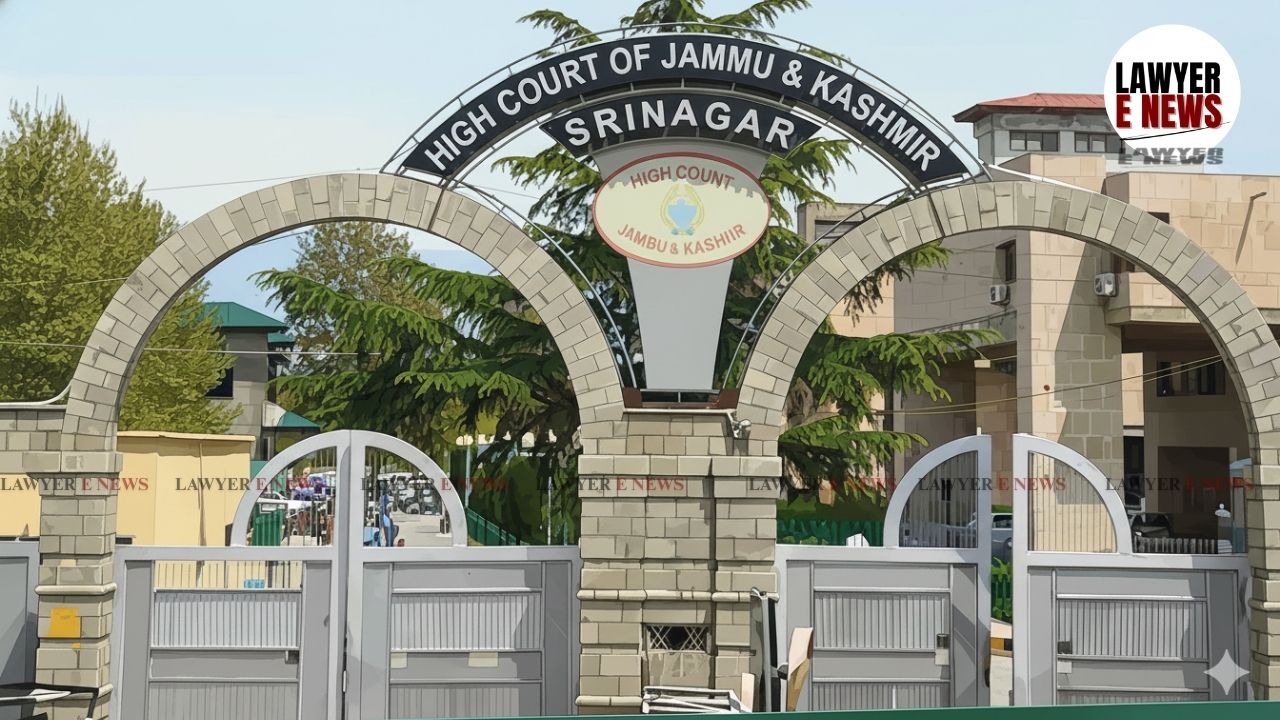
“Trial Court Misstepped Into Unchartered Territory—Should Have Followed Chapter XV CrPC Once It Relied On Affidavit and Statement”: High Court of Jammu & Kashmir and Ladakh at Jammu decisively held that a Magistrate cannot take cognizance under Section 190(1)(b) CrPC by relying on additional evidence provided by the complainant after the police submits a closure report. If the Magistrate considers such evidence, the proceeding must shift from a State case to a private complaint, and the procedure under Chapter XV CrPC must be strictly followed.
The Court ruled,
“The Magistrate has fallen in grave error of law in taking cognizance under Section 190(1)(b) CrPC, because he not only relied upon the statement of the complainant but also the additional material in the shape of affidavit of an independent witness.”
The case originated from FIR No. 53/2016, registered under Sections 376/341 RPC on a written complaint by the prosecutrix. The petitioner Ali Haider Shah was arrested but subsequently released under Section 169 CrPC, after four successive Investigating Officers found no substance in the allegations. A closure report (final report no. 03/2017) was filed before the Judicial Magistrate, Mendhar.
Instead of accepting the closure, the Magistrate issued notice to the complainant, recorded her statement, and also admitted an affidavit from one Haji Manzoor Hussain, before issuing process against the petitioner, taking cognizance under Section 190(1)(b) CrPC.
This order was challenged by the petitioner on the ground that once the Magistrate relied on evidence beyond the police report, it was obligatory to treat the proceeding as a private complaint under Section 190(1)(a) and follow Sections 200 and 202 CrPC.
“Closure Report Rejection Must Not Be a Backdoor for Improper Cognizance”: Court Reiterates Vishnu Kumar Tiwari Principles
Justice Rajesh Sekhri, while allowing the petition, dissected the legal options available to a Magistrate upon receiving a closure report and noted:
“If Magistrate intends to consider the protest petition or rely upon the statement of the complainant or any additional material in the form of evidence, the case cannot be continued as a State case and should be treated as a private complaint.”
The Court referred to and relied heavily upon the Supreme Court’s judgment in Vishnu Kumar Tiwari v. State of U.P., AIR 2019 SC 3482, particularly paragraphs 42–46, which establish that:
The Magistrate may accept, reject, or order further investigation on a closure report.
If new evidence is considered, such as statements or affidavits by the complainant, then the protest petition must be treated as a complaint and the procedure under Sections 200 and 202 CrPC must be followed.
The Court also relied on Mukhtar Zaidi v. State of U.P., 2024 (4) SCR 665, where the Supreme Court reiterated the boundaries of judicial discretion in such matters.
“Protest Petition Has Judicial Recognition But Cannot Circumvent Procedural Safeguards”: High Court on Victim's Role and Natural Justice
The judgment underscores that while Protest Petitions are not codified in the Criminal Procedure Code, they have long-standing judicial recognition, backed by landmark precedents like:
Pramatha Nath v. Saroj Ranjan, AIR 1962 SC 876
Bhagwant Singh v. Commissioner of Police, AIR 1985 SC 1285
These cases emphasized the requirement of hearing the informant when a closure report is being considered and mandated notice and participation.
The High Court stated:
“The concept of protest petition is the result of judicial craftsmanship, which gives the victim a role in the criminal justice system. Though not contemplated by the Code, it has the imprimatur of judicial approval.”
But it warned:
“Every protest petition cannot necessarily be treated as a complaint unless it satisfies the requirements of Section 2(d) CrPC.”
“Trial Court Usurped Powers of Investigating Agency—Must Now Treat Evidence as Private Complaint”
The core illegality identified was the trial court’s reliance on the statement of the prosecutrix and the affidavit of an independent witness, which it treated as quasi-evidentiary, while still proceeding under Section 190(1)(b) as if it were acting on a police report alone.
The High Court was unequivocal: “The learned trial court misdirected itself and embarked upon an unchartered territory. Once it relied upon evidence beyond the police report, it ought to have invoked Section 190(1)(a) and followed Chapter XV CrPC.”
Justice Rajesh Sekhri quashed the Magistrate's order dated 08.08.2017, setting aside the cognizance and issuance of process against the petitioner. However, the trial court was given liberty to proceed afresh—but only in accordance with the procedure under Chapter XV CrPC, treating the materials as a private complaint.
“The learned trial court shall be at liberty to proceed in accordance with the provisions and procedure laid down under Chapter XV CrPC.”
Date of Decision: 18 September 2025