-
by sayum
19 August 2026 10:42 AM







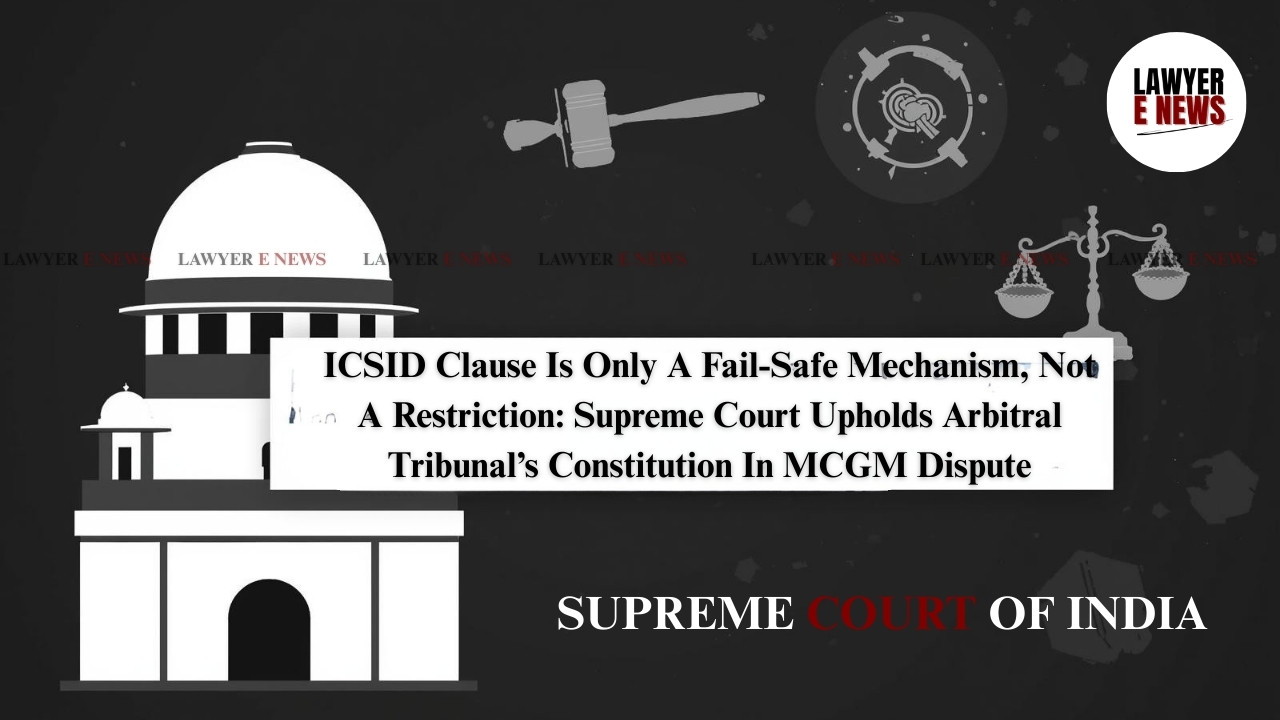
“If Arbitrators Fail To Appoint Within 30 Days, Parties May Approach ICSID — But Power Of Co-Arbitrators Does Not Automatically Cease”, Supreme Court of India recently reaffirmed the principle of minimal judicial interference in arbitral awards, holding that where an arbitral tribunal interprets an arbitration clause in a reasonable and commercially sensible manner, courts exercising jurisdiction under Sections 34 and 37 of the Arbitration and Conciliation Act, 1996 cannot substitute their own interpretation merely because another view may be possible.
On 11 March 2026, a Bench of Justice J.K. Maheshwari and Justice Atul S. Chandurkar dismissed appeals filed by the Municipal Corporation of Greater Mumbai (MCGM) challenging the constitution of the arbitral tribunal. The Court upheld the arbitral award and affirmed the Bombay High Court’s refusal to set aside the award.
The Court clarified that a contractual provision permitting the Secretary General of the International Centre for Settlement of Investment Disputes (ICSID) to appoint a presiding arbitrator after expiry of thirty days is merely an enabling safeguard to prevent deadlock, and does not extinguish the authority of the co-arbitrators to appoint the presiding arbitrator if the parties themselves do not invoke that mechanism.
Background of the Case
The dispute arose from a consultancy agreement dated 18 September 1995 executed between the Municipal Corporation of Greater Mumbai (MCGM) and M/s R.V. Anderson Associates Limited, a Canadian engineering consultancy firm. The contract pertained to consultancy services for upgrading sewerage operations and maintenance services under a project funded by the World Bank.
The contract work was completed in June 2001 and the respondent submitted its final report. Subsequently, disputes emerged regarding payment of outstanding dues claimed by the consultancy firm. After attempts at settlement failed, the respondent invoked arbitration in August 2005 in accordance with the arbitration clause contained in the agreement.
Each party appointed its nominee arbitrator. The arbitration clause provided that the two arbitrators would jointly appoint a third arbitrator who would preside over the tribunal, and if they failed to do so within thirty days, the Secretary General of ICSID could appoint the presiding arbitrator upon request by either party.
Eventually, after a series of developments including resignation of previously appointed presiding arbitrators, the two nominee arbitrators appointed Mr. Anwarul Haque of Singapore as the Presiding Arbitrator. The tribunal conducted proceedings and ultimately passed an award on 5 June 2010 directing MCGM to pay substantial amounts in US dollars and Indian rupees along with interest.
MCGM challenged the award under Section 34 of the Arbitration and Conciliation Act, alleging that the arbitral tribunal had been improperly constituted because the presiding arbitrator was appointed beyond the thirty-day period mentioned in the arbitration clause. The challenge was rejected by the Single Judge of the Bombay High Court, and the Division Bench dismissed the appeal under Section 37. Aggrieved, MCGM approached the Supreme Court.
Court’s Examination of the Arbitration Clause
The Supreme Court closely examined Clause 8.3(b) of the agreement, which governed the appointment of the presiding arbitrator. MCGM argued that once the thirty-day period expired after appointment of the second arbitrator, the co-arbitrators lost the authority to appoint the presiding arbitrator, and the only permissible method thereafter was appointment through the Secretary General of ICSID.
Rejecting this interpretation, the Court held that the clause must be read in a practical and commercially sensible manner. The Court observed that the clause merely grants the parties the option to approach ICSID if the co-arbitrators fail to appoint the presiding arbitrator within thirty days. It does not state that the co-arbitrators lose their authority to make such appointment after the expiry of the said period.
The Bench explained that the arbitration clause had been drafted with a “fail-safe” mechanism to prevent stalemate in the constitution of the tribunal. The ICSID mechanism would come into operation only if a request is made by either party. Since neither party invoked this mechanism, the authority of the co-arbitrators to appoint the presiding arbitrator remained intact.
The Court emphasized that interpreting the clause in the manner suggested by MCGM would lead to commercial absurdity, as it would leave the arbitration process suspended indefinitely unless one of the parties approached ICSID.
Limited Scope of Judicial Interference in Arbitral Awards
The Supreme Court reiterated that the scope of interference under Section 34 of the Arbitration Act is extremely limited, and the scope becomes even narrower in an appeal under Section 37.
The Court reaffirmed the settled principle that arbitrators are the masters of contractual interpretation, and if the tribunal adopts a plausible interpretation of the contract, courts should not interfere.
The Bench observed that the arbitral tribunal’s interpretation of the arbitration clause was not only plausible but consistent with the intent of the parties, and therefore there was no justification for setting aside the award.
Conduct of the Parties and Acquiescence
The Court also examined the conduct of MCGM during the arbitration proceedings and found that it raised no objection to the appointment of the presiding arbitrator for a considerable period.
The record showed that three different individuals were successively appointed as presiding arbitrator by the co-arbitrators, and at none of those stages did MCGM object to the process. The corporation even participated in the preliminary meeting of the arbitral tribunal before raising an objection for the first time.
The Supreme Court observed that such conduct clearly indicated that MCGM had accepted the contractual procedure for appointment of the presiding arbitrator and only challenged it later after the arbitration proceedings had progressed.
The Court cautioned that arbitration law does not permit parties to strategically delay objections and later challenge the process merely because the outcome is unfavourable.
The Bench remarked that a party cannot “keep a jurisdictional ace up its sleeve” and deploy it at a later stage to derail the arbitral process.
Supreme Court Upholds the Arbitral Award
After analysing the arbitration clause, the conduct of the parties and the limited scope of judicial review, the Supreme Court concluded that the arbitral tribunal had been validly constituted and that the interpretation adopted by the tribunal was legally sound.
Finding no patent illegality or jurisdictional defect in the award, the Court dismissed the appeals filed by the Municipal Corporation of Greater Mumbai and upheld the judgments of the Bombay High Court.
The judgment reiterates the judiciary’s consistent stance in favour of arbitral autonomy and finality of arbitral awards. By holding that the ICSID appointment provision was only a contingency mechanism and not a restrictive clause, the Supreme Court reinforced the principle that commercial contracts must be interpreted pragmatically to ensure that dispute resolution mechanisms remain workable and effective.
Date of Decision: 11 March 2026