-
by sayum
04 August 2026 1:39 PM







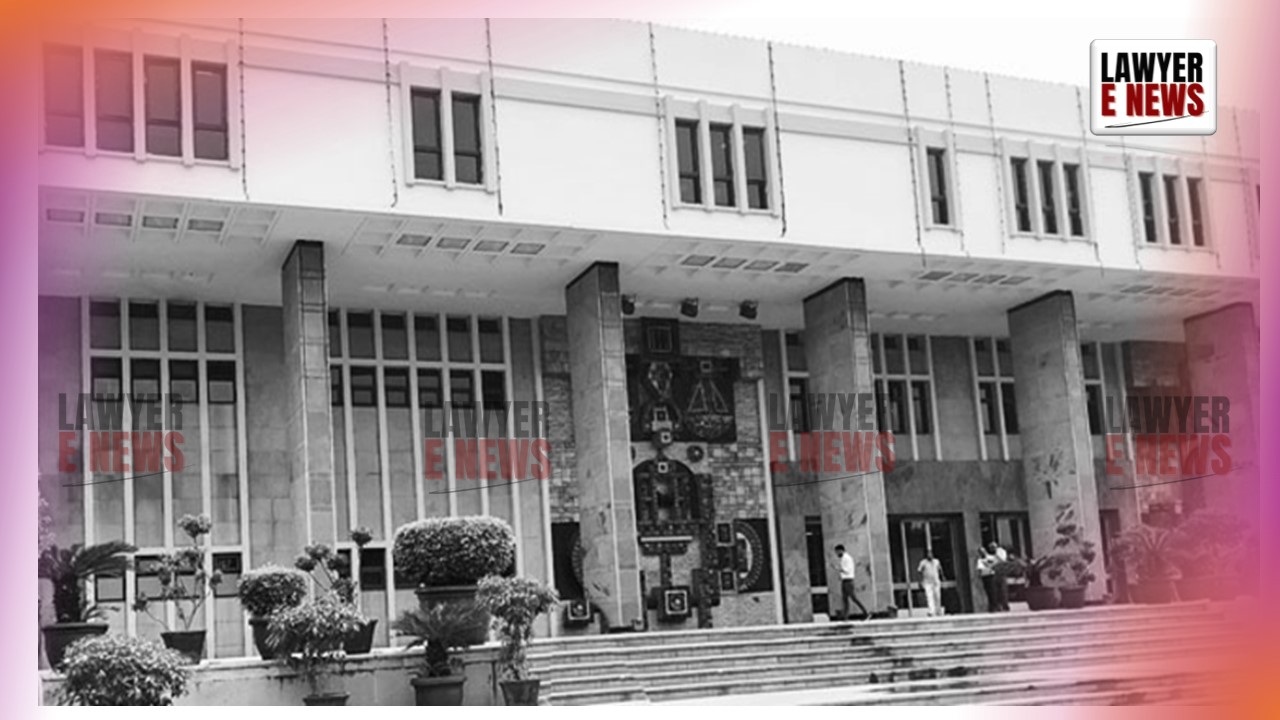
"When Pleadings Disclose Market Value, Non-Mention of a Specific Line Cannot Defeat Jurisdiction" - Delhi High Court dismissed a petition challenging the maintainability of a commercial trademark infringement suit, firmly stating that “hyper-technical interpretations” cannot override the substantial compliance with the Commercial Courts Act, 2015.
Justice Saurabh Banerjee, delivering a detailed and reasoned judgment, emphasized that when pleadings clearly disclose the market value exceeding the statutory threshold of ₹3 lakhs, a narrow plea based on the absence of a specific sentence cannot oust the jurisdiction of a Commercial Court.
In a stern message to litigants attempting to derail proceedings on technical grounds, the Court declared, "Justice delayed through bureaucratic maneuvering is justice denied in its cruelest form."
The case arose when M/s Deep Chand Arya Industries instituted a suit before the Commercial Court at Tis Hazari, Delhi, seeking protection of their registered trademark "KRANTI" against alleged infringement by M/s Kranti Soap Pvt. Ltd..
Upon completion of pleadings, the Trial Court framed issues on December 9, 2024, and evidence recording commenced. Nearly two months later, the defendants sought to frame additional issues, arguing that the plaint did not explicitly state that the claim value was above ₹3 lakhs, thus allegedly violating Sections 6 and 12 of the Commercial Courts Act, 2015.
The Trial Court, rejecting the challenge, held that the suit was properly valued at ₹95,03,500/- and satisfied all statutory requirements.
Aggrieved, the defendants approached the High Court under Article 227 of the Constitution.
At the heart of the challenge was whether the absence of an explicit line stating that the suit value exceeded ₹3 lakhs could render the suit non-maintainable before the Commercial Court, despite full valuation and payment of court fees.
Justice Saurabh Banerjee made it unequivocally clear: "An extremely narrow and hyper-technical interpretation sought to be given to Sections 6 and 12 of the Commercial Courts Act cannot be accepted, especially when requisite pleadings referring to commercial disputes and market value exist."
The Court critically noted that Order XIV Rule 5 CPC governs framing of additional issues based on material propositions arising from pleadings. The mere technical omission of a sentence could not create a substantial material proposition requiring fresh issues.
Emphasizing the holistic reading of pleadings, the Court observed: "Pleadings must be read as a whole, not dissected into isolated technicalities to defeat substantive justice."
In reliance on the Delhi High Court’s Division Bench ruling in Pankaj Ravjibhai Patel v. SSS Pharmachem (P) Ltd., the Court reiterated that the Commercial Courts Act, 2015 must be read harmoniously with the Court Fees Act, 1870 and the Suits Valuation Act, 1887, and not interpreted in isolation to produce absurd results.
It was strongly reaffirmed that: "The Commercial Courts Act intends to streamline adjudication of commercial disputes, not to erect insurmountable procedural hurdles to obstruct justice."
Finding no merit in the petitioners' arguments, the High Court dismissed the petition, reiterating that the valuation disclosed in the plaint was sufficient, the Trial Court had acted correctly, and no interference under Article 227 was warranted.
Justice Banerjee concluded with an important reminder:
"Jurisdiction under Article 227 is supervisory, not appellate. It cannot be exercised in the cloak of an appeal in disguise."
He further emphasized that only a grave miscarriage of justice or flagrant violation of law could justify interference — neither of which was remotely present in this case.
Thus, the petition was dismissed with parties left to bear their own costs.
The judgment reinforces that commercial litigation must be decided on merits and substance, rather than allowing technical arguments to derail rightful adjudication, especially in intellectual property disputes.
Date of Decision: April 25, 2025