-
by sayum
05 November 2026 2:10 PM







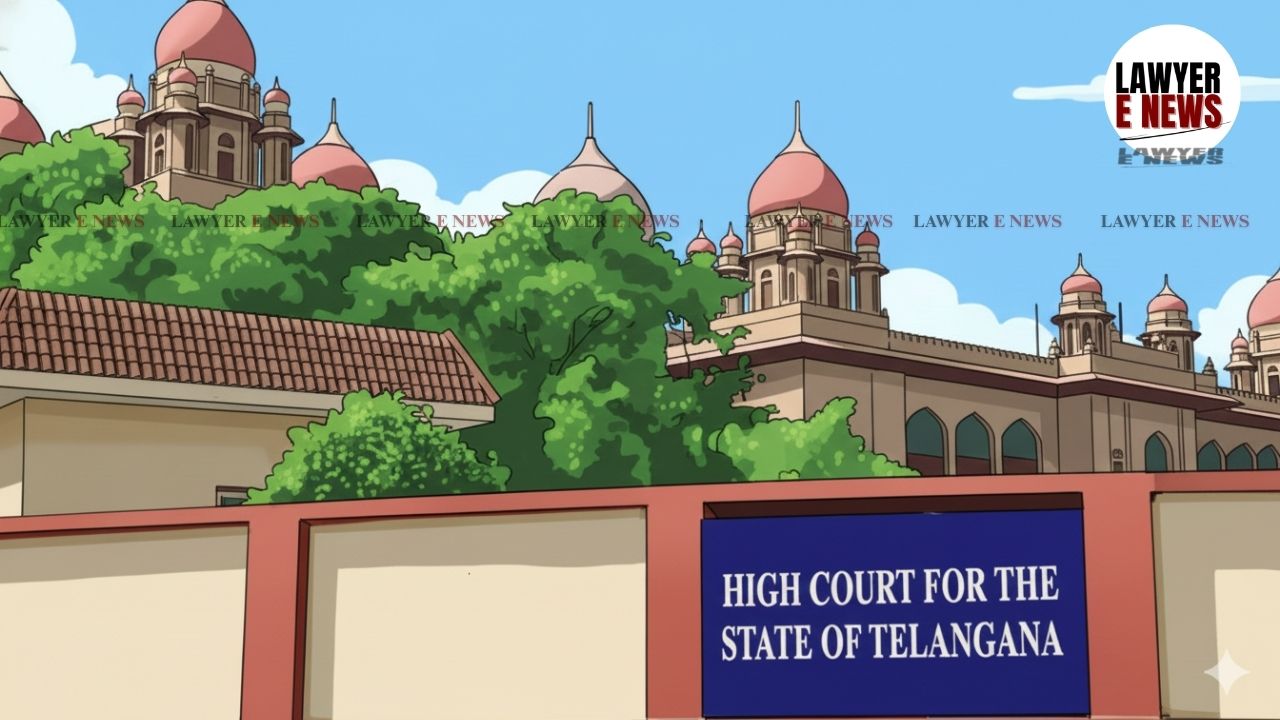
"A graveyard is meant for the people of the village, and the place chosen has to be convenient for all the villagers and not for the convenience or choice of any person, including the Sarpanch." Telangana High Court, in a significant ruling delivered on October 6, 2026, held that a writ court exercising jurisdiction under Article 226 of the Constitution of India cannot undertake ground evaluations to select or fix the location for public amenities such as crematoriums.
A single bench of Justice Vakiti Ramakrishna Reddy observed that while Gram Panchayats are statutorily mandated to maintain burial and cremation facilities, they cannot unilaterally abandon Government land earmarked by the District Collector to construct a facility on private land gifted by a village head without lawful approvals.
The controversy originated from the proposed construction of a "Vaikunta Dhamam" (crematorium) under the State's 'Palle Pragathi' rural development programme in Mudigunta Village, Mancherial District. After earlier allocations were entangled in litigation, the District Collector allotted Government land in Survey No. 124, but demarcation was halted when the sitting Sarpanch raised a boundary dispute concerning her adjoining land. Subsequently, the Sarpanch purchased land in Survey No. 96 and purported to gift a portion of it to the Gram Panchayat to proceed with the construction, prompting adjacent agricultural landowners to invoke the writ jurisdiction of the High Court to halt the construction and demand execution at the Collector-allotted site.
The primary questions before the High Court were whether Government land allotted by the District Collector for a graveyard could be discarded in favour of private land without an order of the competent authority, and whether Survey No. 96 was suitable and accessible without infringing on the property rights of adjoining agricultural landowners. The bench was also called upon to determine whether the High Court itself could select and fix the appropriate site for a village crematorium under Article 226 of the Constitution.
Right To Dignified Burial And Last Rites Emanates From Article 21
Justice Reddy underlined that providing a proper place for cremation and burial is not a mere civic amenity but a fundamental aspect of human dignity. The bench invoked the jurisprudence laid down by the Supreme Court in Pt. Parmanand Katara v. Union of India, which held that the right to dignity and fair treatment under Article 21 of the Constitution extends beyond life to the dead.
The bench reiterated that villagers are legally entitled to have an accessible and appropriate place for the final rites of deceased persons. While Sections 52 and 81 of the Telangana Panchayat Raj Act, 2018 cast a bounden duty on the Gram Panchayat to provide and maintain graveyards, the court held that this duty must be executed strictly on land lawfully available to the local body through due process.
Gram Panchayat Cannot Unilaterally Override Collector's Allotment
Analyzing the unilateral shift of site from Survey No. 124 to Survey No. 96, the court pointed out that the District Collector's allotment of Government land in Survey No. 124 had never been revoked or varied by any formal order. The Gram Panchayat avoided the allotted land merely due to an alleged boundary dispute raised by its own head and unsubstantiated claims regarding loose, waterlogged soil.
The bench underscored that a boundary dispute raised by an adjoining landowner, even if holding the post of Sarpanch, must be resolved through survey and demarcation by revenue authorities rather than being used as a pretext to abandon public land. The court noted with concern that the Tahsildar had not placed any engineering or technical assessment on record explaining why the Collector's allotted land was unsuitable.
"A boundary dispute between adjoining owners is to be settled by survey and demarcation by the Revenue authorities. It cannot be a ground to give up Government land that has already been handed over to the Gram Panchayat, particularly when the dispute was raised by the head of the Gram Panchayat herself."
No Landowner Can Be Deprived Of Property For Access Road Without Authority Of Law
Addressing the petitioners' grievance that Survey No. 96 is landlocked amidst private agricultural tracts, the court held that unfettered, lawful road access is an indispensable condition for any crematorium. The bench noted that funeral processions cannot be expected to trespass across standing crops or private fields.
The court made it clear that agricultural landowners cannot be coerced into relinquishing their properties or bearing easements for a public facility without formal statutory procedures. Citing the constitutional guarantee under Article 300A, the bench observed that no individual can be deprived of property save by authority of law.
Compliance With Section 123 Transfer Of Property Act Essential For Public Works
The bench also flagged the procedural legality of the Gram Panchayat accepting and constructing upon land acquired through an unregistered gift deed. The court observed that under Section 123 of the Transfer of Property Act, 1882, a valid transfer of immovable property by gift must be effected exclusively through a registered instrument.
Justice Reddy stated that before state funds are expended on creating permanent public structures on private donations, the executive must be satisfied that lawful title and possession have vested in the Gram Panchayat through legally enforceable documentation.
Writ Court Cannot Adjudicate Topography And Select Sites Under Article 226
Declining to issue a mandamus designating either Survey No. 124 or Survey No. 96 as the definitive site, the court held that technical, topographical, and logistical determinations cannot be adjudicated upon conflicting affidavits in writ proceedings.
The court reiterated that neither party holds an indefeasible legal right to compel the administration to select a specific survey number for a village amenity. The primary legitimate interest of private landholders is limited to ensuring that their private lands are not encroached upon or burdened without statutory sanction.
"Whether a site is suitable depends on facts on the ground, such as the nature of the soil, water logging, the approach road, the surrounding lands, and the ownership and possession of the land. These cannot be decided on conflicting affidavits and plans in a writ petition under Article 226 of the Constitution of India, and it is not for this Court to select the site for a graveyard."
District Collector Directed To Conduct Ground Survey And Pass Reasoned Order
Disposing of the writ petition, the High Court directed the District Collector of Mancherial to conduct an exhaustive ground survey after giving formal notice and a hearing to all affected parties, including the petitioners, the Gram Panchayat, and the former Sarpanch. The Collector was instructed to pass a reasoned order within four months identifying a suitable site, evaluating whether Survey No. 124 could be utilized following demarcation.
The court further mandated that until the District Collector passes the final order, no construction activity shall take place in Survey No. 96 or on the agricultural lands belonging to the petitioners. All substantive contentions regarding the private title to Survey No. 96, the validity of the gift deed, and the pending criminal complaint under FIR No. 186 of 2020 were left open for determination before appropriate forums.
In conclusion, the High Court synthesized that while the creation of cremation facilities touches the fundamental guarantee of dignity under Article 21, the location thereof must be determined by revenue and planning authorities through ground verification rather than judicial dictation under Article 226. The ruling reinforces that local bodies cannot bypass statutory land allocations to accommodate private arrangements that compromise surrounding landowners' rights under Article 300A.
Date of Decision: 06 October 2026