-
by sayum
15 August 2026 2:23 PM







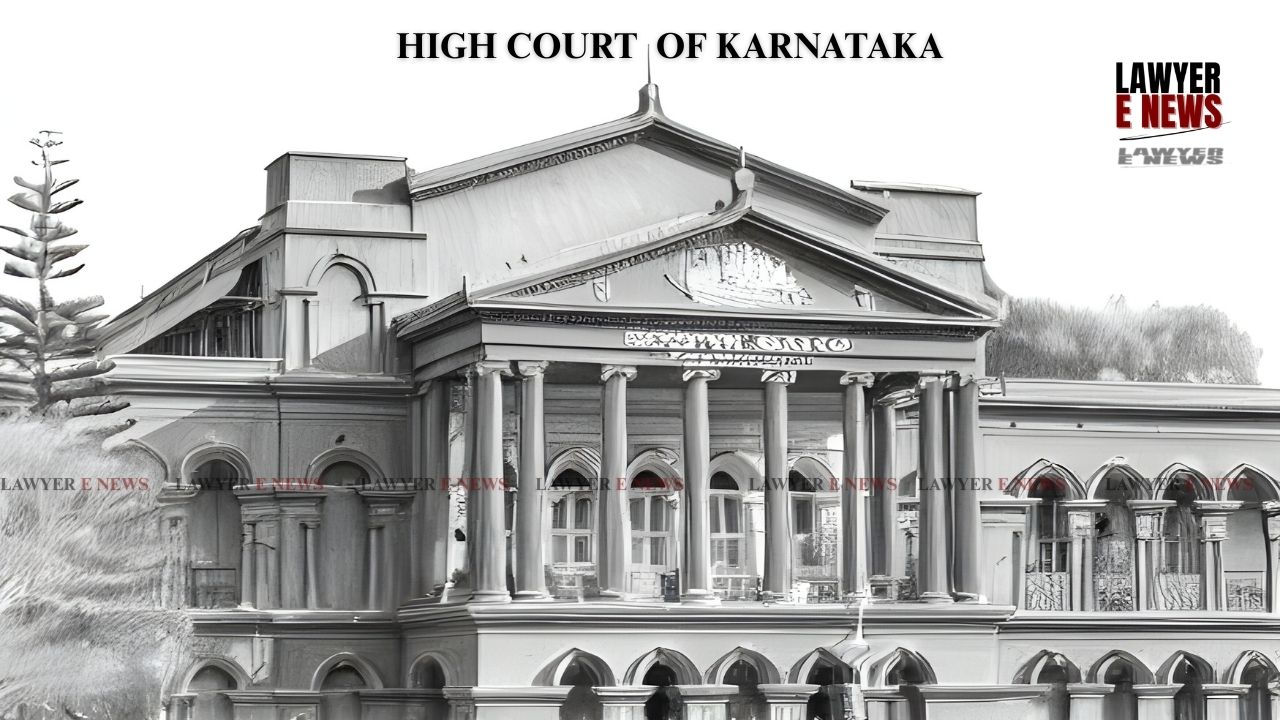
"We find no difficulty in reading down Section 4 of the Civil Courts Amendment Act so as to exclude from its retrospective operation all appeals that stand concluded by final judgments and orders; and all orders passed in proceedings that are pending." High Court of Karnataka, in a significant judgment, has upheld the constitutional validity of the Karnataka Civil Courts (Amendment) Act, 2023, and the Karnataka High Court (Amendment) Act, 2023.
A Division Bench comprising Chief Justice Vibhu Bakhru and Justice C.M. Poonacha held that while the right to an appeal is a substantive right, the choice of the forum where such an appeal is heard is a matter of procedural law. The Court observed that "a change in forum lies in the realm of procedure" and consequently, amendments affecting the forum of appeal are presumed to be retrospective unless the statute indicates otherwise.
The controversy arose following the notification of the 'impugned legislations' on June 19, 2024, which significantly enhanced the pecuniary jurisdiction of Civil Judges and shifted the appellate forum for decrees passed by Senior Civil Judges from the High Court to the District Courts. Petitioners and appellants challenged these amendments, particularly Section 4 of the Civil Courts Amendment Act, which gave the changes retrospective effect from August 28, 2007. They contended that such retrospectivity was "manifestly arbitrary" as it threatened to nullify nearly two decades of concluded High Court judgments.
The litigation involved a writ petition by a litigant (Narayanamma) and a writ appeal by an appellant (Babu Rao) whose pending Regular First Appeals (RFAs) in the High Court were set to be transferred to District Courts due to the 2023 amendments. A Single Judge had earlier partly allowed the challenge, setting aside the retrospective effect to prevent the nullification of past judgments but directing the transfer of pending RFAs. Aggrieved by the transfer and the underlying validity of the Acts, the parties approached the Division Bench.
The primary question before the Court was whether the State Legislature had the competence to enact laws affecting the appellate jurisdiction of the High Court. The Court was also called upon to determine if the forum of appeal constitutes a "vested right" that cannot be altered retrospectively. Furthermore, the Bench examined whether the retrospective operation from 2007, absent a savings clause, rendered the legislation "manifestly arbitrary" under Article 14 of the Constitution of India.
HC Upholds Legislative Competence and Rationality
The Court first addressed the challenge to legislative competence, noting that there was "no cavil" that the State Legislature is empowered to define the frontiers of jurisdiction for courts within the State. Citing the Supreme Court's decision in Jamshed N. Guzdar v. State of Maharashtra, the Bench affirmed that "administration of justice" under Entry 11-A of List III includes the power to confer general jurisdiction on all courts except the Supreme Court.
Court Explains Rationale Behind 'Justice At Doorstep' Policy
The Bench noted that the impetus for the amendments originated from judicial observations in Smt. Thirakavva v. Smt. Ratnavva, where the Court highlighted the "alarming pendency" of First Appeals. The Court observed that shifting these appeals to District Courts serves the goal of "Justice at the doorstep" and ensures speedy disposal. The judges emphasized that "the workload on the High Court gets reduced" and parties gain an additional layer of appeal through a Regular Second Appeal, which was previously unavailable for high-value suits.
Right To Appeal Is Substantive, But Forum Is Procedural
A central pillar of the judgment was the distinction between the right to appeal and the forum of appeal. While acknowledging the principle in Garikapati Veeraya v. N. Subbiah Choudhry that a right of appeal is a vested right accruing at the start of a suit, the Bench relied on the more recent Supreme Court ruling in Neena Aneja v. Jai Prakash Associates Limited. The Court held that "a change in forum lies in the realm of procedure" and that "no litigant has any vested right in the matter of procedural law."
Retrospective Operation Presumed For Procedural Changes
The Bench clarified that once a law is identified as procedural, it is presumed to apply retrospectively to pending actions unless a contrary intention is shown. The Court noted that "it would be incongruous that the pending appeals follow a procedure separate from those that are preferred after the enactment." By virtue of being procedural, the change in the appellate forum naturally governs all cases that have not yet reached finality, regardless of when the original suit was instituted.
Doctrine Of 'Reading Down' Applied To Section 4
The most contentious issue was Section 4 of the Civil Courts Amendment Act, which made the law retrospective from August 28, 2007, without a savings clause. Litigants argued this would render 19 years of High Court decrees void for lack of jurisdiction. Refusing to strike down the provision, the Bench applied the doctrine of 'Reading Down'. The Court held that "it is not the legislative intent to reopen the proceedings that have been finally concluded" and restricted the retrospective operation to only those proceedings that are currently pending.
Court Irons Out The Creases Of 'Ill Drafting'
Relying on the principle from Seaford Court Estates Ltd v. Asher, the Bench stated that a judge must not "fold his hands and blame the draftsman" when a defect appears. The Court found that the 2007 date was chosen to harmonize with previous amendments, but the lack of a savings clause was a "ruck in the texture" of the Act. To preserve the law's validity, the Court read Section 4 restrictively "to exclude the concluded matters as well as the orders passed in the pending proceedings from its retrospective operation."
No Discrimination Between Bengaluru And Other Districts
The petitioners also alleged discrimination, arguing that appeals from the Bengaluru City Civil Court still lie to the High Court, unlike other districts. The Bench dismissed this, noting a "clear distinction" in the cadre of judges. In Bengaluru, District-level judges exercise original jurisdiction under the 1979 Act, whereas in other districts, Senior Civil Judges handle such suits. The Court held this constitutes a "reasonable classification" under Article 14, as the cadre of the trial judge determines the appellate path.
The High Court concluded that the 2023 Amendments are constitutionally valid and that the Single Judge’s decision to entirely set aside the retrospective effect was unnecessary. Instead, the Division Bench "modified" the earlier order by reading down Section 4 to ensure it only affects pending appeals. Consequently, all pending First Appeals from Senior Civil Judge decrees must be transferred to the respective District Courts, while all previously concluded judgments and orders remain fully saved and valid.
Date of Decision: July 8, 2026