
-
by kapil
19 November 2026 10:29 AM







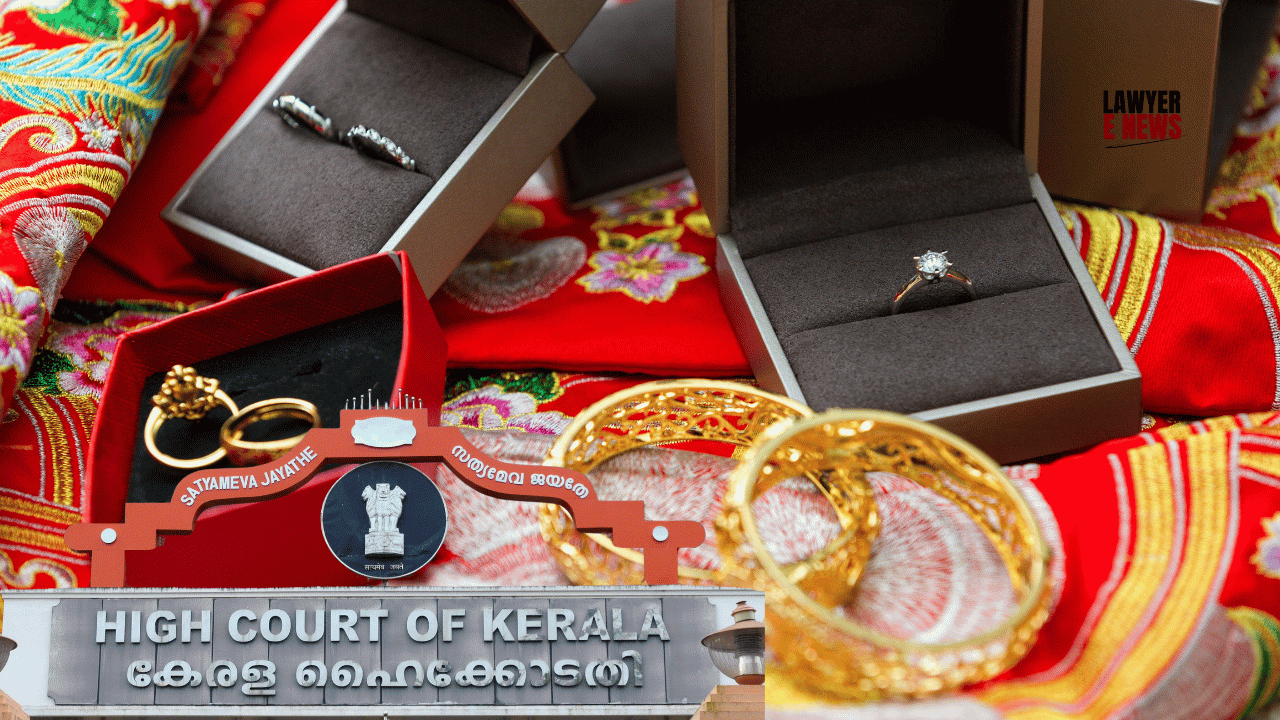
KOCHI: Ruling that Family Courts cannot assume jurisdiction over every financial transaction between in-laws merely because it occurred during the subsistence of a marriage, the Kerala High Court on November 17, 2026, held that independent monetary dealings executed years after marriage fall outside Explanation (d) to Section 7(1) of the Family Courts Act, 1984. A Division Bench comprising Chief Justice Soumen Sen and Justice Syam Kumar V.M. further held that passing a decree for the return of gold ornaments solely by evaluating wedding photographs and speculative financial capacity of the bride's father amounts to a perverse appreciation of evidence.
The appellant husband challenged a decree of the Family Court, Thiruvananthapuram, which had directed him to return 162 sovereigns of gold ornaments or their value, pay ₹42,00,000 towards construction expenses, ₹2,00,000 towards marriage expenses, along with child maintenance. The wife alleged that her father had advanced ₹40,00,000 to the husband between 2010 and 2013 for flat construction by pledging her gold ornaments, while the marriage had been solemnized much earlier in 2002. Aggrieved by the trial court's findings directing recovery against him, the husband approached the High Court in appeal.
Whether a claim for recovery of amounts allegedly advanced by a father-in-law to a son-in-law years after the marriage falls within the jurisdictional scope of Section 7(1) Explanation (d) of the Family Courts Act, 1984?
Whether the entrustment of gold ornaments and their precise quantum can be legally established on a preponderance of probabilities solely on the basis of wedding photographs and oral assertions without proof of physical delivery?
Addressing the jurisdictional threshold under Section 7(1) Explanation (d) of the Family Courts Act, the Bench observed that for a dispute to qualify as an order or injunction in circumstances arising out of a marital relationship, the foundation of the lis must have a direct and proximate nexus with the marriage itself.
Independent commercial causes of action cannot be dragged into Family Courts under Section 7(1)
The Court highlighted that if a cause of action could have existed independently, such as a father-in-law suing a son-in-law before an ordinary civil court for recovery of advanced money, it cannot be brought under the special jurisdiction of the Family Court.
"Merely because a financial transaction or monetary arrangement had been entered into during the subsistence of the marriage, that too at a considerably later point of time, that cannot by itself lead to a circumstance arising out of the marital relationship. If such an interpretation is followed, the same will lead to unduly expanding the scope of the expression and thereby will lead to a situation where transactions that are essentially independent of and have no discernible connection with the marital relationship are brought within its fold."
Noting that the marriage occurred in 2002 while the purported financial advances took place between 2010 and 2013, the Court pointed out that the father-in-law was not even a party to the proceedings, nor had he authorized his daughter to initiate recovery on his behalf. Consequently, the Family Court lacked subject-matter jurisdiction to adjudicate the ₹40,00,000 claim.
Entrustment requires proof of actual physical delivery, not constructive inferences
Turning to the decree directing the return of 162 sovereigns of gold ornaments, the Bench held that the burden of proving actual physical entrustment lies squarely on the claimant-wife, which cannot be discharged by constructive or presumptive assumptions.
"It has been conclusively held in a catena of decisions of authoritative and binding precedents that there cannot be a constructive or presumptive entrustment without actual physical delivery of the same and it must be specifically pleaded and proved by sufficient evidence by the claimant-wife. Merely on the evidence that the bride had worn gold ornaments at the time of marriage, it cannot be held that the ornaments which were worn at the time of marriage were entrusted to the father and mother of the bridegroom."
The Bench criticized the trial court's reliance on wedding photographs to deduce the weight and authenticity of gold, emphasizing that modern imitation jewelry cannot be distinguished from pure gold with the naked eye in photographs.
Preponderance of probabilities cannot degenerate into wild guesswork and conjectures
The Court firmly rejected the rationale that social context adjudication allows a court of fact to bypass the foundational rules of proof under the Indian Evidence Act.
"Preponderance of probabilities cannot be reduced to mere guess work and assumption of any situation on hypothetical criteria without any supportive evidence does not qualify as evidence. Such conclusions cannot be built on mere surmises, conjectures, or hypothetical assumptions and there must be actual material or circumstances on record to weigh."
The High Court observed that the Family Court had engaged in open surmising by presuming that because the wife's father was an 'A class' contractor, he must have gifted 200 sovereigns of gold, while simultaneously ignoring that the bank locker remained in the wife's name and that the husband had produced bank loan records showing independent financing for the construction.
Partly allowing the matrimonial appeal, the High Court set aside the Family Court's decree directing the husband to return 162 sovereigns of gold ornaments or its value, ₹42,00,000 for construction, and ₹2,00,000 towards marriage expenses. The directions regarding child maintenance were retained subject to existing orders and settlements arrived at under Section 125 and Section 127 of the Code of Criminal Procedure, 1973.
Date of Decision: November 17, 2026