
-
by sayum
28 August 2026 2:11 PM







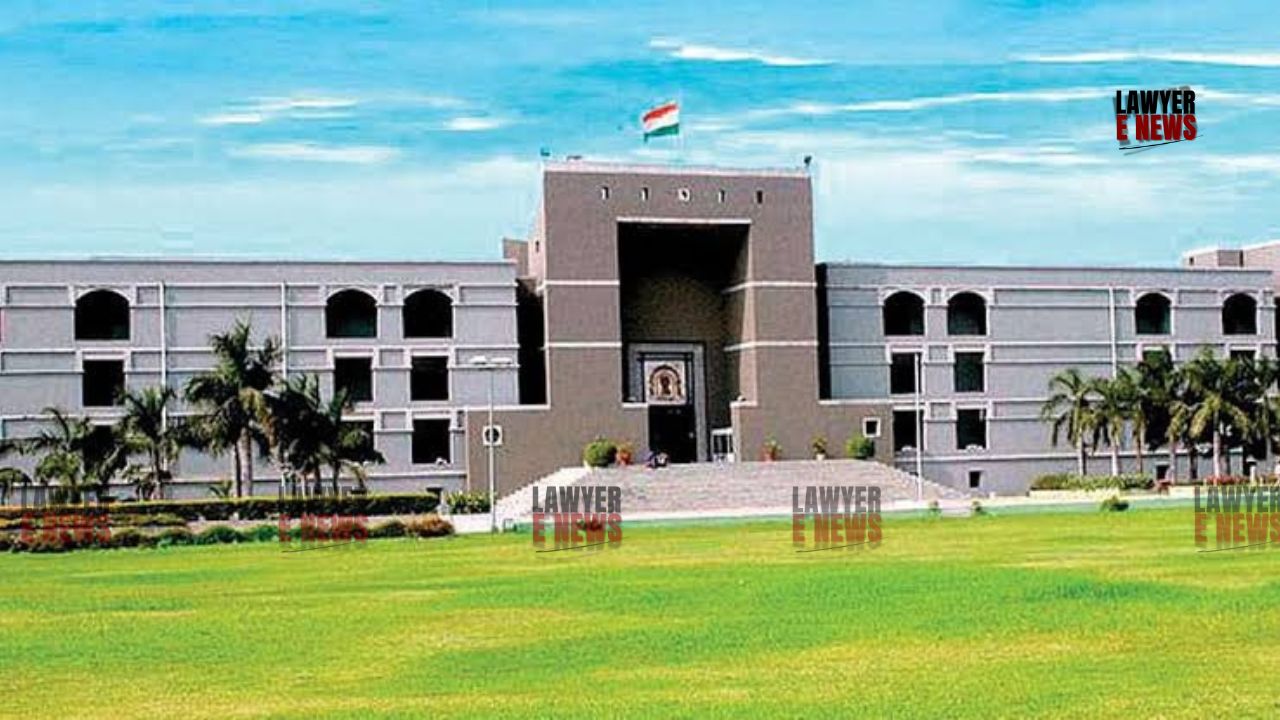
“Settled rights cannot be unsettled merely due to inaction or internal disorganization of a litigant body” — Gujarat High Court, in a sharply worded and significant ruling dismissed a writ petition filed under Article 227 of the Constitution, challenging an appellate court’s refusal to condone a delay of more than six years in filing an appeal. The Court, while rejecting the plea, strongly deprecated the filing of false affidavits by a public body and reaffirmed that public authorities are not entitled to special leniency under the Limitation Act merely due to their status.
The case arose from a permanent injunction decree passed in 2018 by the Trial Court at Palanpur, which declared the respondents as owners of a parcel of “Vada land” and restrained the Gadh Gram Panchayat from interfering with their possession. The Panchayat filed an appeal only in February 2025, accompanied by a delay condonation application which was dismissed by the appellate court on 29 May 2025, leading to the present writ petition.
“False and Incorrect Statements Made on Affidavit Cannot Justify Delay” — Court Slams Panchayat for Misleading Delay Application
The High Court, presided by Justice Maulik J. Shelat, began by affirming that there was no dispute about the petitioner’s knowledge of the trial court’s decree, as they had actively participated in the civil suit, cross-examined the plaintiffs’ witnesses, and had legal representation. Hence, the claim in the delay application that the decree was “ex parte” and “unknown” to the Panchayat until recently was unequivocally false.
"This Court can call upon the petitioner...for filing such false and incorrect affidavit...Nonetheless, the fact remains that there was a false averment made by the petitioner...which requires to be deprecated by this Court," the Judge observed [Para 5.3].
The Court cited extensively from the Supreme Court's ruling in Pundlik Jalam Patil v. Executive Engineer, Jagaon Medium Project, (2008) 17 SCC 448, to reiterate that deliberate falsehood in delay applications is sufficient ground to reject the plea without further inquiry into sufficiency of cause:
“That a party taking a false stand to get rid of the bar of limitation should not be encouraged to get any premium on the falsehood on his part by condoning delay” [Pundlik Jalam Patil, Para 12].
“Law of Limitation Applies Equally to Public Bodies” — No Leniency for Administrative Lapses
The Panchayat’s main justification was that a change in the elected body led to delayed action and that the land was essential for public utility. However, the Court found that no evidence was placed to show when the new body took charge or what actions were taken in the six-year interim. As such, the “administrative procedure” argument fell flat.
Relying on the authoritative principle from Basawaraj v. Special Land Acquisition Officer, (2013) 14 SCC 81, the Court held: “Where a case has been presented beyond limitation, the applicant has to explain the Court as to what was the ‘sufficient cause’...There cannot be a justified ground to condone the delay if the party is found to be negligent or has not acted diligently.”
The Court also quoted K.B. Lal v. Gyanendra Pratap, 2024 (4) SCALE 759, stating: “The discretionary power of a Court to condone delay...is not to be exercised in cases where there is gross negligence and/or want of due diligence on part of the litigant” [Para 6.2].
Thus, the Court emphasized that being a Panchayat or public body does not entitle the petitioner to any special relaxation:
“The law of limitation is the same for citizens and for governmental authorities...It serves no public interest to revive stale claims due to internal disorganization or lethargy” [Para 5.8].
“Delay of Six Years with No Bona Fide Explanation Cannot Be Brushed Aside” — Court Refuses to Disturb Settled Legal Rights
Rebutting the petitioner’s argument that merits of the case warranted reopening the matter, the Court clarified that:
“Merits of the case are not to be considered while adjudicating a delay condonation application unless sufficient cause is first established.”
The High Court drew on the principles from multiple Supreme Court precedents, including:
Esha Bhattacharjee v. Managing Committee of Raghunathpur Nafar Academy, (2013) 12 SCC 649: “Lack of bona fides...is a significant and relevant fact” [Para 6.2].
Shivamma (Dead) by LRs v. Karnataka Housing Board, 2025 INSC 1104: “Length of delay is a relevant factor...It cannot be presumed to be non-deliberate” [Para 6.5].
Ultimately, the Court concluded that gross negligence, absence of due diligence, and false pleadings negate any judicial discretion for condonation.
“There was gross negligence, no due diligence, lack of bona fide having made incorrect/false statement by defendant...thus, it would not constitute any sufficient cause” [Para 9.1].
The High Court dismissed the writ petition, refused to condone the 6 years and 14 days delay, and made it clear that false pleadings and administrative apathy are not sufficient cause under Section 5 of the Limitation Act, 1963. Importantly, it reaffirmed that settled legal rights arising from valid court decrees cannot be unsettled due to institutional disorganization.
“No court could be justified in condoning such an inordinate delay by imposing any condition whatsoever. The application is to be decided only within the parameters laid down...In case there was no sufficient cause...condoning the delay without any justification...amounts to showing utter disregard to the legislature.” [Basawaraj v. SLAO, Para 15].
The ruling serves as a cautionary precedent to public authorities that limitation laws apply uniformly, and negligence compounded by false statements will not be indulged.
Date of Decision: 22 September 2025





