
-
by sayum
28 August 2026 2:11 PM







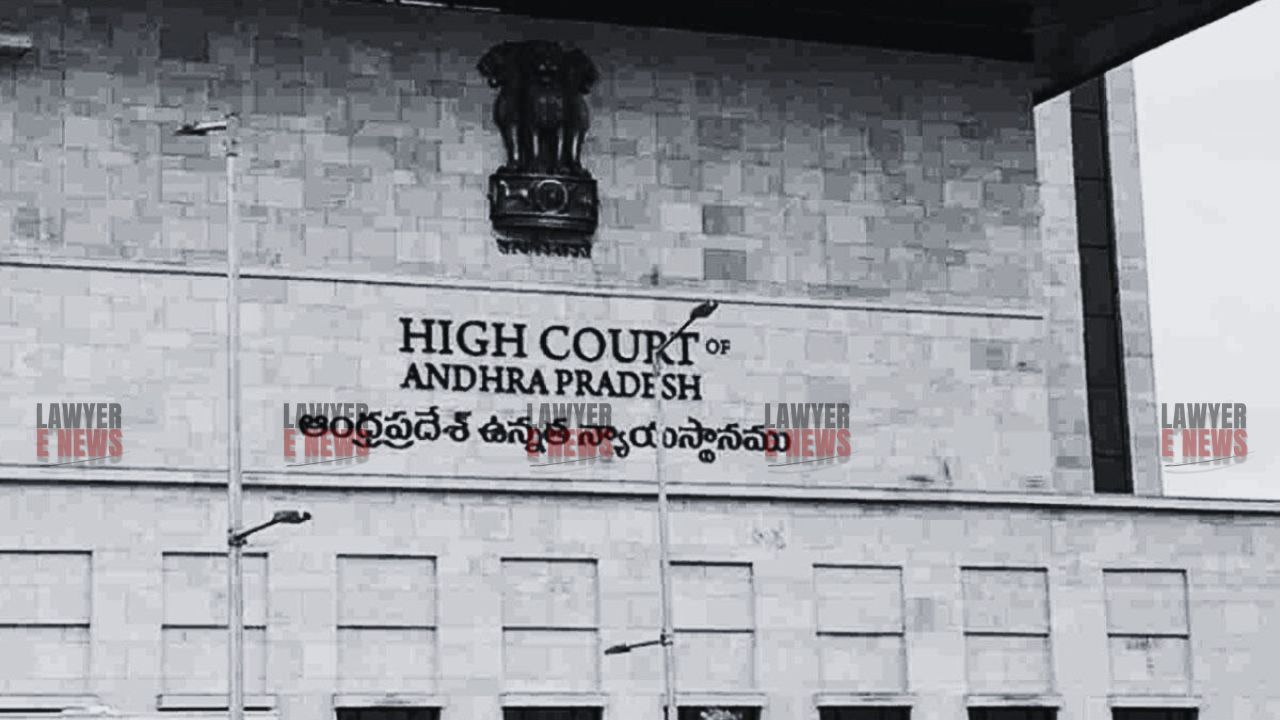
"Custody Beyond 180 Days Without Prosecutorial Request Is Illegal Under Section 36A(4) of NDPS Act" – On 6 October 2025, the Andhra Pradesh High Court granting bail to two accused under the Narcotic Drugs and Psychotropic Substances Act, 1985 (NDPS Act) on the ground that the statutory 180-day period of detention had lapsed without any prosecutorial request for extension. The Court held that such inaction vests an indefeasible right to bail in favour of the accused, even when commercial quantity of contraband is involved.
The judgment was delivered by Dr. Justice Y. Lakshmana Rao in Criminal Petition No. 6135 of 2025, filed under Sections 480 and 483 of the Bharatiya Nagarik Suraksha Sanhita, 2023, seeking bail for Accused Nos. 2 and 3, who were arrested with 112.270 kilograms of ganja.
“Right to Bail Becomes Enforceable Once 180 Days Elapse Without Public Prosecutor’s Request for Extension” – Court Reiterates Statutory Mandate
The case arose out of Crime No. 137 of 2025 registered at Duvvada Police Station, Visakhapatnam Commissionerate. On 7 April 2025, acting on specific intelligence, police intercepted an auto-rickshaw and a Bajaj Pulsar motorcycle near Aganampudi Toll Gate, allegedly found in possession of 112.270 kg of ganja, and arrested three individuals including the petitioners. The contraband and vehicles were seized under a mediators’ report. The accused were booked under Section 20(b)(ii)(C) and Section 25 read with Section 8(c) of the NDPS Act.
The petitioners, Accused Nos. 2 and 3, approached the High Court seeking bail after spending 182 days in judicial custody, arguing that their detention beyond 180 days was unlawful as no extension was sought by the Public Prosecutor as required under Section 36A(4) of the NDPS Act.
Court Observations on Section 36A(4) of the NDPS Act:
The High Court’s analysis focused squarely on the statutory scheme under Section 36A(4) of the NDPS Act, which governs extended detention periods in NDPS cases involving commercial quantities.
The Court clarified that:
“Section 36A(4) of the NDPS Act states that if the investigation is not completed within 180 days, the Petitioners/Accused have an indefeasible right to bail, unless the Special Court extends the period up to one year on the report of the Public Prosecutor, indicating the progress of the investigation and specific reasons for the detention of the accused beyond the initial period.”
In the instant case, the Public Prosecutor failed to submit any such report or application seeking an extension before the trial court. As a result, the accused had a statutory right to be released on bail, the Court ruled.
The State had opposed the bail petition on grounds of gravity of offence, prior criminal antecedents, and potential risk of absconding or witness tampering. However, the Court emphasized that:
“Custody beyond 180 days without an application for extension as contemplated under the NDPS Act is illegal. Bail cannot be denied on apprehensions alone, especially when substantial investigation is complete and all eight witnesses examined so far are official witnesses.”
Role of Petitioners and Status of Investigation:
While acknowledging the seriousness of the allegations and the quantity of ganja seized, the Court noted that:
The petitioners were in custody since 08.04.2025, i.e., over 182 days.
No extension petition was filed under Section 36A(4).
The petitioners have a fixed place of residence and have cooperated with the investigation.
So far, eight witnesses were examined – all official.
There was no evidence of threats or tampering, and no substantial investigative step pending in relation to the petitioners.
Bail Granted with Strict Conditions to Prevent Abuse
While allowing the petition, the High Court imposed stringent conditions to ensure balance between personal liberty and justice:
“This Court is inclined to enlarge the Petitioners on bail with the following stringent conditions…”
The bail conditions included:
Execution of personal bond of ₹50,000 with two sureties each for the like sum.
Weekly appearance before the Station House Officer every Saturday until cognizance is taken.
Prohibition on travel outside Andhra Pradesh without prior permission.
No commission of new offences and strict cooperation with the investigating officer.
No contact or inducement towards any witness or person acquainted with the facts of the case.
The Court made it clear that violation of any condition would entitle the State to seek cancellation of bail.
The ruling reiterates a fundamental statutory safeguard under the NDPS Act that places a duty on the prosecution to justify continued custody in commercial quantity cases beyond 180 days. In the absence of such action, liberty prevails over prosecutorial delay.
This decision is especially notable in the backdrop of increasing reliance on extended detention in NDPS cases and serves as a reminder that procedural safeguards cannot be overridden by mere gravity of allegations.
Date of Decision: 06 October 2025





