-
by sayum
04 August 2026 1:39 PM







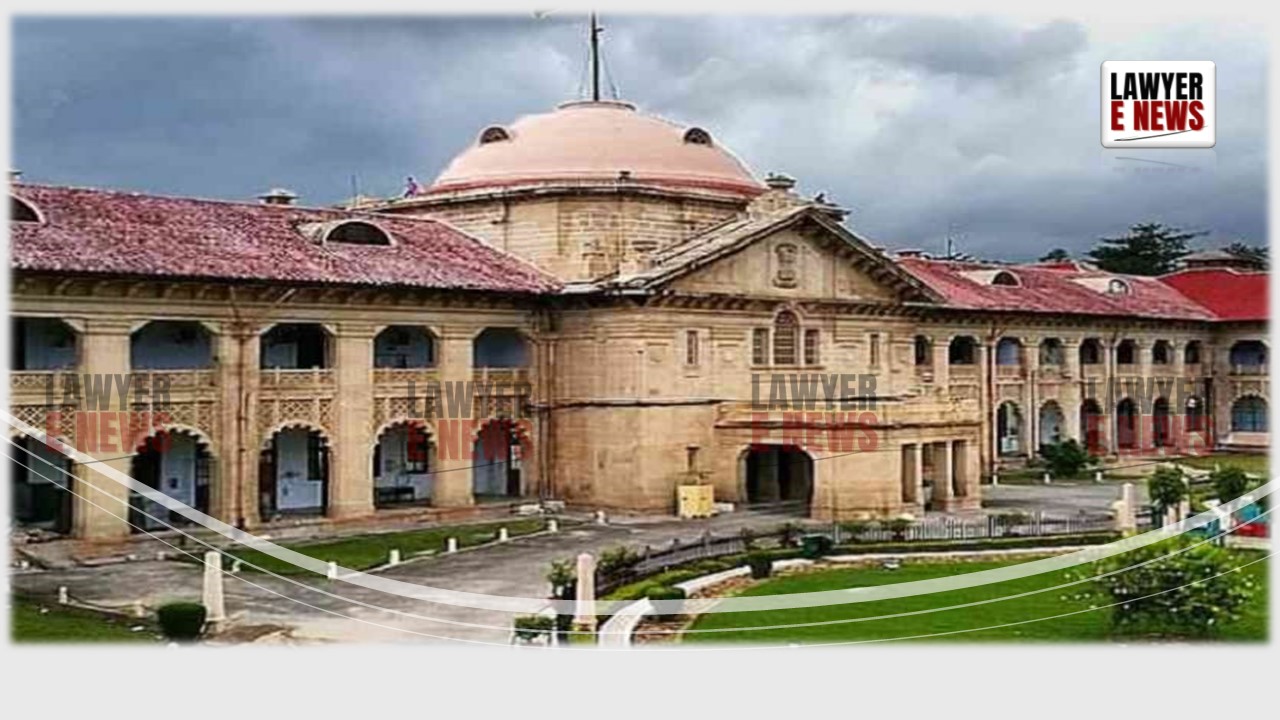
“A trivial omission by a rustic villager cannot be treated as fraudulent suppression” – Allahabad High Court dismissed a Special Appeal filed by the State of Uttar Pradesh challenging the appointment of a Scheduled Caste candidate, Dinesh Kumar, who had failed to disclose a minor pending criminal case in his initial verification form. A Division Bench comprising Justice Siddhartha Varma and Justice Dr. Yogendra Kumar Srivastava upheld the order of the Single Judge, ruling that the omission was not material, not deliberate, and not disqualifying.
The Court, invoking guiding principles laid down by the Supreme Court in Avtar Singh v. Union of India (2016) 8 SCC 471, reiterated that not all non-disclosures amount to suppression and that the background, intent, and nature of the offence must be contextually examined.
Dinesh Kumar, a Scheduled Caste candidate, had applied for the post of Sahayak Samiksha Adhikari under the Uttar Pradesh Public Service Commission’s 2021 recruitment drive. He was declared successful in January 2023 and was required to submit a verification form and undergo medical examination.
In his verification form dated 31 May 2023, Dinesh declared that no criminal case was pending against him. However, upon realising his mistake, he voluntarily submitted an affidavit on 17 July 2023, disclosing pendency of Criminal Case No. 271/2020 arising out of a minor boundary wall dispute. Despite this proactive disclosure, the State denied him appointment via order dated 11 December 2023, citing suppression of facts.
Aggrieved, he approached the High Court in Writ-A No. 817 of 2024, where the learned Single Judge quashed the State's order and directed his appointment. The State’s appeal against that decision culminated in the present Special Appeal, now dismissed.
“Was the Omission Material, Deliberate, and Deceptive?”
The State contended that Dinesh’s failure to disclose the pending case in the verification form amounted to material suppression, affecting his trustworthiness. They relied heavily on the apex court's decision in Rajasthan Rajya Vidyut Prasaran Nigam Ltd. v. Anil Kanwariya (2021) 10 SCC 136, where it was held: “The issue is about the credibility and/or trustworthiness of such an employee who at the initial stage of the employment… made a false declaration… such an employee cannot be relied upon even in future…”
The Bench, however, rejected a mechanical application of that standard and observed:
“We fail to understand why a person would try to deprive himself of his job and would not give an information which he possessed… In the instant case, an information of a trivial nature was not given out in the verification form and subsequently, however, that information was provided.” [Para 8]
Voluntary Disclosure Was Crucial
The Court emphasized that the omission was rectified through a voluntary affidavit, filed before the appointment order was issued:
“From the record, we also find that the petitioner had informed the employers about the pendency of the criminal case and this fact had not been denied by the appellants.” [Para 8]
The offence in question arose from a scuffle over a boundary wall, initially registered under Sections 147, 323, 504, 506 IPC and later Section 325 IPC was added. The trial ended in acquittal. The Court noted:
“The petitioner had in fact never remained in jail and that he was without being arrested released on bail… the parties continue to believe that they were only civil cases.” [Para 7]
The Court accepted that rural ignorance and the civil nature of the dispute explained the omission. It further held:
“Quite often the accused persons are not even aware of the fact that some criminal proceedings were going on… there was every possibility that one of the co-accused was looking after the case.” [Para 8]
Referring to Avtar Singh v. Union of India (2016) 8 SCC 471, the Court quoted extensively from Paragraphs 35–38:
“Suppression of ‘material’ information presupposes that what is suppressed matters — not every technical or trivial matter…” [Para 5 quoting Avtar Singh]
Particularly, the Bench applied Para 38.4.1 of Avtar Singh, which allows employers to condone lapses in cases involving:
“A case trivial in nature… such as shouting slogans at young age or for a petty offence which if disclosed would not have rendered an incumbent unfit for the post in question…” [Para 5 quoting Avtar Singh]
The Bench also cited Ravindra Kumar v. State of U.P. (2024) 5 SCC 264, observing:
“Broad-brushing every non-disclosure as a disqualification will be unjust and the same will tantamount to being completely oblivious to the ground realities…” [Para 6 quoting Ravindra Kumar]
In rejecting the State’s appeal, the Bench reiterated: “The petitioner, who was a Scheduled Caste candidate and was belonging to a village background… there was every possibility after looking at the nature of the case that the petitioner had thought that he was involved only in a civil case.” [Para 8]
Holding that the omission did not constitute a deliberate act of deceit, and that the candidate had acted in good faith, the Court concluded:
“We are in respectful agreement with the view taken by the learned Single Judge… the Special Appeal is thus, accordingly, dismissed.” [Para 9]
In upholding the right to employment for a Scheduled Caste candidate who had failed to disclose a minor and ultimately inconsequential criminal case, the Allahabad High Court underscored a critical constitutional and social message:
“The atmosphere prevailing in rural villages should also be taken into account… minor civil cases are given the colour of criminality and quite often the accused persons are not even aware…” [Para 8]
This judgment reflects a sensitive, contextual, and Constitutionally grounded approach to service jurisprudence — one that balances legal formalism with social realities, especially for marginalized communities.
Date of Decision: 22 May 2025