-
by sayum
06 August 2026 1:57 PM







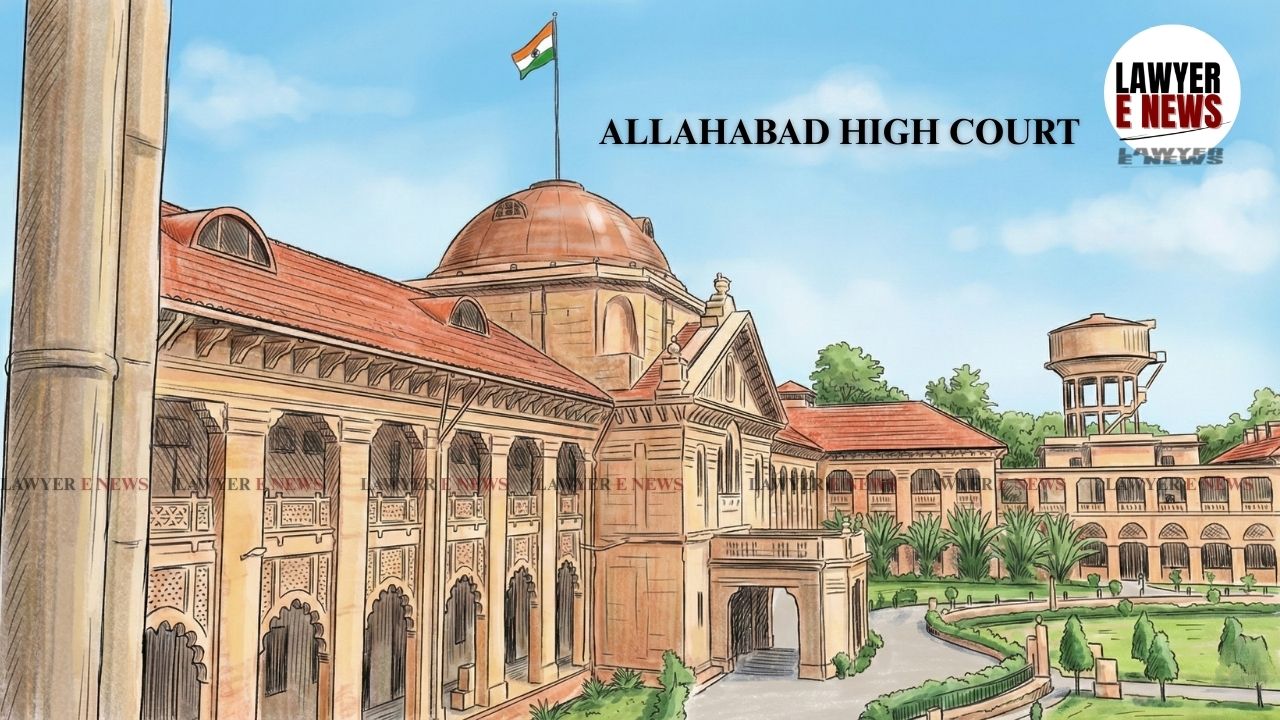
At Pleading Stage, Triable Issues Cannot Be Shut Down by Jurisdictional Objections – In a notable ruling on 25 September 2025, the Allahabad High Court, exercising its civil appellate jurisdiction under Section 96 CPC, set aside a trial court’s order rejecting a comprehensive property dispute suit under Order 7 Rule 11(d) of the Code of Civil Procedure. The Court held that when a suit involves multiple immovable properties—some claimed to be commercial, industrial, and residential—rejection of the entire plaint solely on the ground that some lands may be agricultural is unjustified and legally unsustainable.
Justice Sandeep Jain allowed the First Appeal filed by Smt. Shikha Agrawal against the rejection of her suit by the Civil Judge (Senior Division), Ghaziabad, and ruled:
“Even if some of the disputed properties are agricultural in nature, the whole plaint cannot be rejected under Order 7 Rule 11 CPC, because for the remaining properties—which are commercial, residential and industrial—the civil court retains full jurisdiction.” [Para 28]
Referring to binding Supreme Court precedents, the High Court concluded that the trial court had committed a grave procedural illegality by pre-emptively rejecting the entire suit without allowing trial, issue-framing, or evidence to unfold. The order was found to be perverse and contrary to established legal principles.
“Plaint Survives If Even One Relief is Maintainable – Entire Suit Cannot Be Killed at Threshold” – High Court Quotes Sejal Glass and Prabha Jain Rulings
Central to the Court’s reasoning was the consistent position of the Supreme Court that Order 7 Rule 11 CPC is not meant for dissecting a plaint or rejecting it piecemeal unless the entire cause is statutorily barred.
Citing Sejal Glass Ltd. v. Navilan Merchants (2018) 11 SCC 780 and Sri Boyenepally Srijayavardhan v. V. Nirupama Reddy (2025), the Court emphasized:
“If the plaint survives against certain defendants and/or properties, Order 7 Rule 11 will have no application at all, and the suit as a whole must then proceed to trial.” [Para 25]
Further strengthening its reasoning, the Court relied on Central Bank of India & Anr. v. Smt. Prabha Jain & Ors. (2025 INSC 95) to hold:
“Even if one relief survives, the plaint cannot be rejected. The first and second reliefs as prayed for were clearly not barred by Section 34 of the SARFAESI Act and were within the civil court’s jurisdiction.” [Para 26]
The Court firmly held that a mixed nature suit containing reliefs related to residential and commercial properties within urban municipal limits cannot be barred solely because some parts of the land may be recorded as agricultural in revenue records.
“Mere Entry in Revenue Record Doesn’t Determine Usage or Jurisdiction” – High Court Reminds Trial Courts of Evidence-Based Evaluation
The Court noted that the plaintiff’s pleadings clearly alleged the non-agricultural nature and commercial usage of multiple disputed properties including banquet halls, industrial sheds, marriage homes, ancestral buildings, and educational institutions. Several of these were within fully urbanised limits of Ghaziabad and Greater Noida, used for non-agricultural purposes for decades.
The Bench observed: “Whether any property is agricultural or not, or whether it falls under the exclusive jurisdiction of the revenue court under Section 206 of the U.P. Revenue Code, cannot be determined at the stage of Order 7 Rule 11 CPC without evidence.” [Paras 27–29]
It further noted:
“The defendants themselves admitted in their application under Order 7 Rule 11 CPC that the plaintiff never remained in possession of agricultural and non-agricultural properties. This means, even they accepted that some properties were non-agricultural.” [Para 29]
“Summary Rejection of Entire Suit Without Framing Issues is Procedural Misconduct” – Civil Court Has Jurisdiction Over Urban Commercial Disputes
The Court found that the trial court failed to appreciate the complex and mixed character of the properties—many of which were urban, leased, or already developed—and summarily applied Section 206 of the U.P. Revenue Code, 2006, to bar jurisdiction.
Justice Sandeep Jain cautioned:
“Several properties are involved in the instant case. It was appropriate that the trial court decided the whole issue on merits, after framing issues and adducing the evidence of both the parties. In rejecting the plaint summarily, the trial court committed a grave error.” [Para 30]
Rejecting the trial court’s reliance on khatauni entries and the absence of a declaration under Section 143 of the UPZA & LR Act, the Court ruled that:
“Entries in revenue records are not conclusive proof of ownership or usage. A civil court cannot be ousted merely because a property appears in khatauni unless such issue is tried and found on evidence.”
“Right of Urban Daughters Can’t Be Denied by Labeling All Properties as Agricultural” – Plaintiff Entitled to Seek Partition and Injunction
The suit, filed by Smt. Shikha Agrawal, sought declaration and injunction over her 1/2 share in several properties left behind by her deceased father Satyaprakash Garg, including:
A three-storeyed ancestral house and godown in Nayaganj, Ghaziabad
Banquet halls and marriage homes in village Dasna (on Ghaziabad–Hapur Road)
Commercial land and college property at Hindon Civil Airport Road
Industrial sheds and premises in Greater Noida’s Surajpur industrial zone
A residential plot in village Sadarpur surrounded by colonies like Govindpuram and Kailashpuram
The plaintiff also pleaded that the properties had been fraudulently sold or leased by her brother Sanjeev Garg (now deceased), without partition and by falsely claiming himself as sole heir. She had earlier filed a mutation case under Section 33B of the Revenue Code, which had been rejected. But she claimed that mutation entries cannot defeat her title, nor can they oust civil court jurisdiction.
“Disputed Nature of Land Requires Trial, Not Rejection” – Questions of Usage and Possession Need Evidence
The Court held that questions about whether land is still agricultural or has lost its character due to development, construction, or commercial usage are matters of fact, and thus:
“Such issues must be determined after evidence and not at the preliminary stage. Order 7 Rule 11 CPC is not a provision to decide complicated factual controversies.” [Para 30]
Allowing the appeal, the High Court passed the following directions:
“The impugned judgment and decree of the trial court dated 3.12.2022 is set aside. Defendants' application under Order 7 Rule 11 CPC stands dismissed. O.S. No. 782 of 2021 is restored to its original number.” [Para 31]
“The trial court is directed to decide the suit on merits, in accordance with law, within six months, without granting unnecessary adjournments.” [Para 32]
“District Judge, Ghaziabad shall monitor the progress of the suit and submit fortnightly reports to this Court.” [Para 32]
“Registrar Compliance is directed to communicate a copy of this order to the District Judge, Ghaziabad within 24 hours.” [Para 33]
Any interim relief earlier granted stood vacated.
This judgment reaffirms the critical procedural principle that Order 7 Rule 11 CPC must be applied sparingly and only when the bar is apparent from the plaint itself. The Allahabad High Court has sent a strong signal against pre-emptive dismissal of complex civil suits based on jurisdictional or factual objections that require adjudication through evidence.
By restoring the suit, the Court has also protected the rights of female heirs and underscored the importance of civil court jurisdiction in matters involving ownership, succession, and urban immovable properties, especially in a time where land-use transformation in urban areas often blurs the lines between agricultural and non-agricultural property.
Date of Decision: 25 September 2025