-
by sayum
07 October 2026 6:40 AM







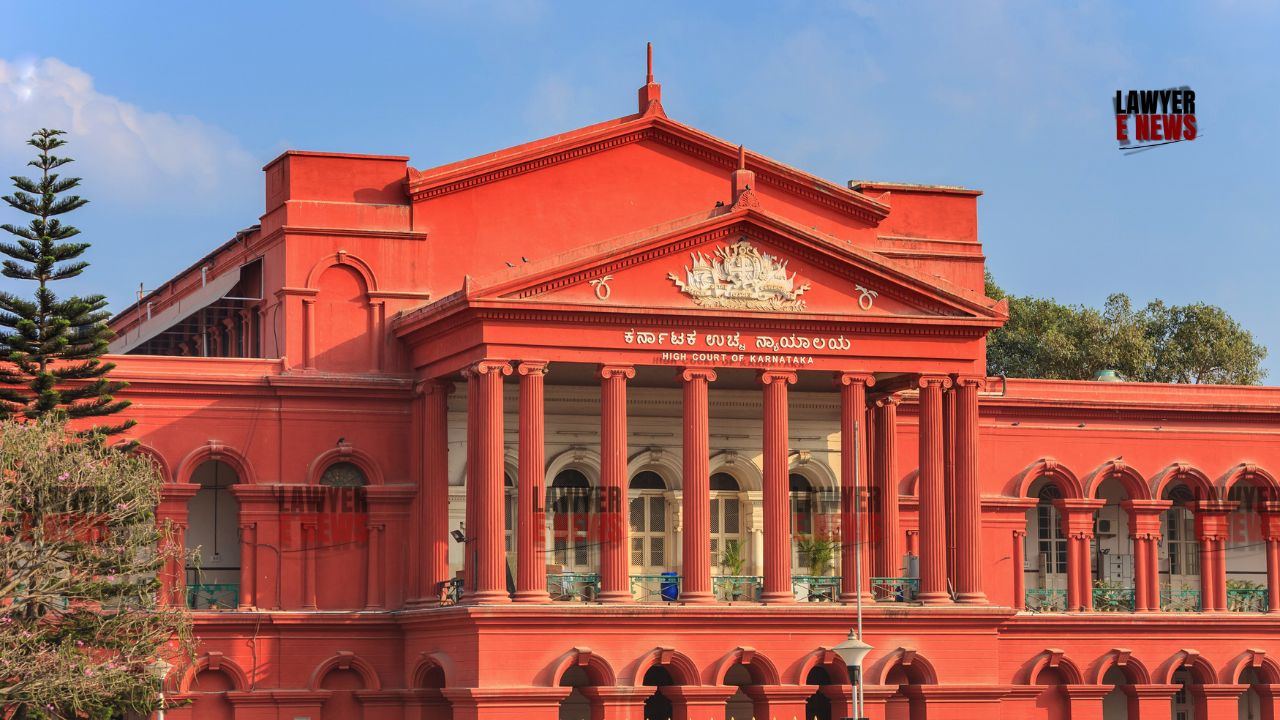
"The use of the expression 'or any other qualification considered equivalent by the Bar Council of India' is significant. The rule itself therefore contemplates that, in an appropriate case, a qualification other than a conventional Bachelor's Degree may be considered equivalent for the purpose of undertaking the three-year law course," Karnataka High Court.
Karnataka High Court, in a significant ruling dated September 2, 2026, held that a State Bar Council cannot summarily reject an enrolment application based solely on the absence of a traditional Bachelor’s degree without first evaluating whether the applicant’s educational credentials qualify as an "equivalent qualification" under Rule 4(a) of the Rules of Legal Education, 2008. A bench of Justice Suraj Govindaraj observed that authorities must adhere to the statutory mandate under Section 26(2) of the Advocates Act, 1961, by referring disputed cases to the Bar Council of India (BCI) for a reasoned opinion rather than unilaterally denying the right to practice.
The petitioner, a former Central Government employee who superannuated in 2023, sought enrolment as an advocate after obtaining a three-year LL.B. degree from Bangalore University in 1997. Despite having completed the law course and being awarded the degree after prior judicial intervention regarding his eligibility, the Karnataka State Bar Council rejected his enrolment application on the ground that he did not possess a foundational Bachelor’s degree as required by the Rules of Legal Education.
The primary legal issue before the court was whether the State Bar Council’s rejection was sustainable without assessing the "equivalence" of the petitioner's Master's degree under Rule 4(a) of the Rules of Legal Education. The court was also tasked with determining whether the failure to follow the consultative process mandated by Section 26(2) of the Advocates Act vitiated the rejection order.
Court Explains Scope Of Rule 4(a)
The court noted that Rule 4(a) of the Rules of Legal Education, 2008, explicitly provides for a three-year law degree course undertaken after a Bachelor’s degree or "any other qualification considered equivalent by the Bar Council of India." The bench emphasized that this provision is not an absolute bar against non-conventional degree holders. Rather, it creates a mechanism for the BCI to recognize alternative academic attainments as satisfying the eligibility criteria for professional legal education.
Non-Adherence To Section 26(2) Of The Advocates Act
Under Section 26(2) of the Advocates Act, if an Enrolment Committee of a State Bar Council proposes to refuse an application, it is statutorily obligated to refer the matter to the Bar Council of India with a statement of grounds. The High Court found that in the present case, the State Bar Council had failed to make such a reference, thereby bypassing the BCI's authority to determine the validity of the petitioner’s educational qualifications.
Equivalence Is A Regulatory Determination
The bench clarified that it is not for the High Court to declare whether a Master's degree is "equivalent" to a Bachelor's degree in the abstract. Instead, that determination falls squarely within the domain of the competent regulatory body. The court remarked that the legal profession is a regulated one protected under Article 19(1)(g) of the Constitution, and regulatory authorities must strictly follow the procedural framework when limiting an individual’s right to pursue a livelihood.
"The rejection of the petitioner's application by respondent No.1 cannot be sustained in its present form. The matter requires reconsideration in accordance with Section 26(2) of the Advocates Act, 1961 and Rule 4(a) of the Rules of Legal Education, 2008."
Consideration Of Past Educational History
The court underscored that the petitioner had been permitted to complete his LL.B. course nearly three decades ago, with the university having conferred the degree upon him. These historical facts, including the circumstances under which he was admitted to the law course, cannot be ignored or treated as irrelevant by the Bar Council when assessing his current eligibility for enrolment as a senior citizen.
Setting aside the impugned rejection order, the High Court directed the Karnataka State Bar Council to reconsider the application. The Council was ordered to forward the petitioner’s file, along with the grounds for its proposed refusal, to the Bar Council of India. The BCI was directed to examine the issue of equivalence and pass a reasoned order within two months, ensuring that the petitioner's long-standing academic credentials are given due regulatory consideration.
Date of Decision: 02 September 2026