-
by sayum
15 August 2026 2:23 PM







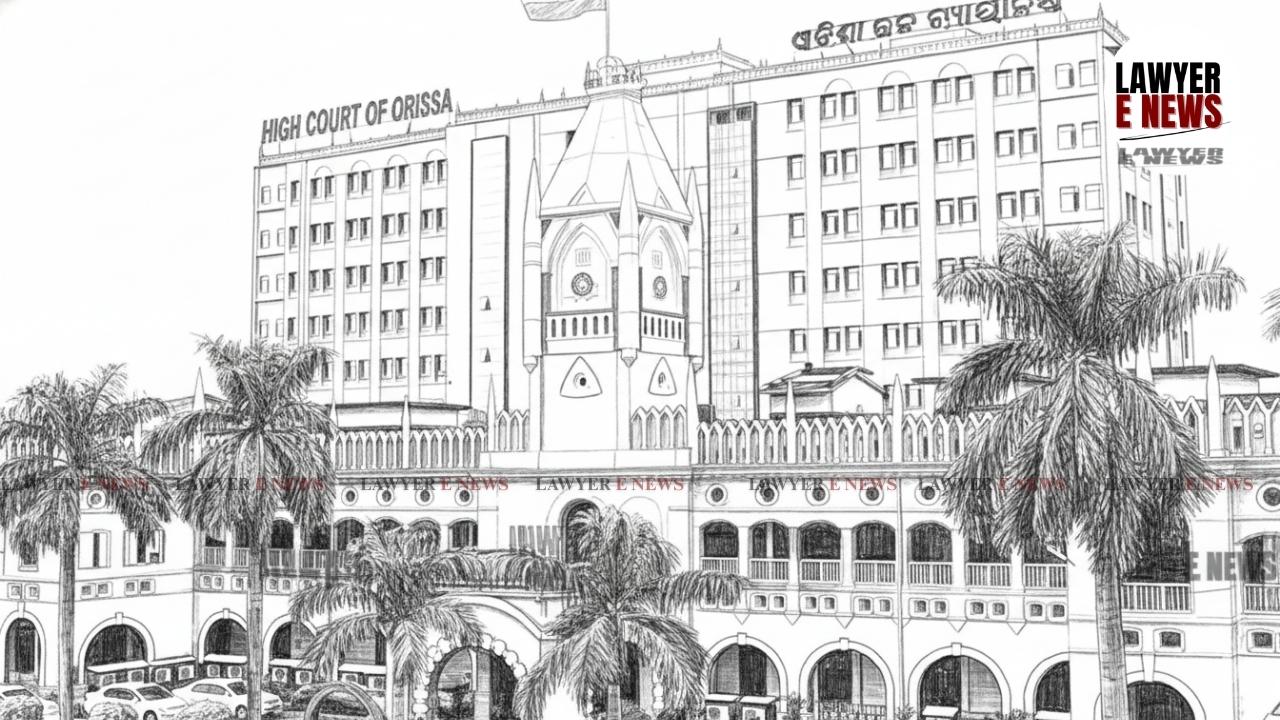
"It is well settled that dying declaration can be accepted if it is proved that the same was voluntary and truthful and most importantly, the victim was in a fit state of mind." Orissa High Court, in a significant judgment dated July 7, 2026, has set aside the life imprisonment of a man convicted of murder, observing that a written note cannot be treated as a reliable dying declaration if the victim's physical and mental capacity to write it is shrouded in doubt.
A Division Bench comprising Justice Manash Ranjan Pathak and Justice Sashikanta Mishra held that circumstantial evidence, including unverified fingerprints and delayed identification, failed to form a complete chain of guilt. The Court noted that the prosecution failed to prove the victim was in a "fit state of mind" to identify his assailants in writing.
The appellant, Mohan Kumar Senapati, was convicted by the Additional Sessions Judge, Nabarangpur, in 2003 for the murder of a motorcyclist in 1999. The prosecution’s case rested on four primary circumstances: the deceased allegedly wrote the name ‘B.B. Driver’ (the appellant’s nickname) on a piece of paper before dying, the appellant’s fingerprints were found on the motorcycle, he was seen near the spot, and he was locally known by that name.
The primary question before the Court was whether the written note marked as Exhibit-6 could legally be sustained as a dying declaration under Section 32 of the Indian Evidence Act. The Court also examined whether the fingerprint evidence was admissible in the absence of an expert's testimony and if the identification of the accused for the first time in court carried any evidentiary weight.
Court Questions Victim's Capacity To Author Written Note
The Bench expressed deep suspicion regarding the piece of paper where the deceased had allegedly written ‘B.B. Driver’. It noted that while the informant (P.W.1) initially stated the injured person could not write and only gestured, another witness (P.W.8) claimed to have provided a paper on which the victim wrote the name with "much difficulty".
The Court observed that the medical evidence suggested the victim was gasping for breath and struggling for life, making the subsequent act of writing highly improbable. The bench noted that if the victim's condition was deteriorating, he could not have gained the capacity to write after initially being unable to do so.
"The question is, how could he subsequently do so when in all human probability, his condition must have deteriorated. This creates a reasonable doubt."
Absence Of Handwriting Comparison Vitiates Dying Declaration
The Court highlighted a critical investigative lapse, noting that the prosecution never proved the handwriting on the note belonged to the deceased. No admitted handwriting samples of the deceased were produced or compared with the disputed note (Exhibit-6).
The Bench emphasized that merely because the appellant was known as ‘B.B. Driver’, the existence of a note with that name does not automatically implicate him. The Court held that the prosecution must prove with certainty that the document was actually authored by the declarant while in a fit state of mind.
"Most importantly, it was never proved that the hand writing found in Exhibit-6 was that of the deceased by comparing his admitted writing with it."
Fingerprint Evidence Inadmissible Without Expert Examination
Regarding the recovery of the appellant's palm prints from the motorcycle's dickey, the High Court found the evidence "unacceptable". It was noted that the prosecution failed to establish who lifted the fingerprints, how they were preserved, or why a fingerprint expert was not examined during the trial.
The Bench held that forensic evidence of this nature requires a strict chain of custody and professional validation to be used as a basis for conviction. In the absence of such procedural safeguards, the presence of fingerprints could not be used to link the appellant to the crime.
"Prosecution never proved who lifted the fingerprints and by whom was it examined. The fingerprint expert was also not examined."
First-Time Identification In Court Deemed Weak Evidence
The High Court dismissed the testimony of a witness who claimed to have seen the appellant near the crime scene. The Bench noted that the witness identified the accused for the first time in the courtroom, years after the incident, without any prior Test Identification (T.I.) Parade being conducted.
Following settled legal principles, the Court reiterated that identification for the first time in court is generally a "weak piece of evidence" unless corroborated by other reliable factors. Furthermore, the Court found it "improbable" that a person who had committed a gruesome murder would remain near the spot instead of fleeing.
"P.W.2 identified the accused for the first time in the Court, which as per settled position of law is a weak piece of evidence."
The High Court concluded that the trial court's findings were unsustainable in law as the chain of circumstantial evidence was broken at multiple points. It observed that once the dying declaration and fingerprint evidence were discarded, there was nothing left to connect the appellant to the offence under Section 302 of the IPC. Consequently, the appeal was allowed, the conviction was set aside, and the appellant was ordered to be set at liberty.
Date of Decision: 07 July 2026