-
by sayum
27 August 2026 3:32 PM







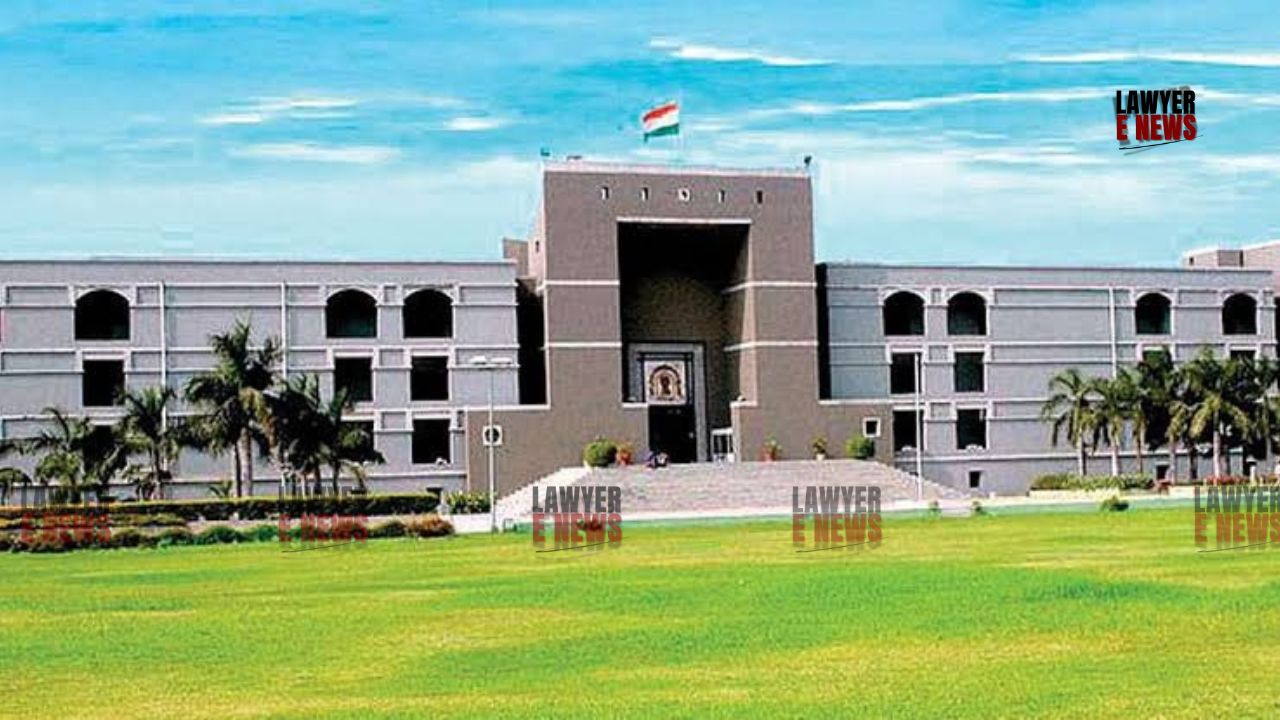
“Once The Appellate Court Exercises Its Discretion To Order Deposit, The Minimum Quantum Becomes Mandatory — ‘May’ Must Be Read As ‘Shall’ In Substance,” Gujarat High Court in a reportable judgment delivered by Hon’ble Mr. Justice R.T. Vachhani, dismissed a criminal revision filed by Mahadev Enterprise through Pruthvi Sanjaybhai Solanki & Another challenging the order of the 8th Additional Sessions Judge, Rajkot, which directed the applicants to deposit 20% of the compensation amount awarded by the trial court while suspending the sentence in an appeal under Section 148 of the Negotiable Instruments Act, 1881.
In R/Criminal Revision Application No. 1409 of 2024, the petitioners argued that the direction to deposit the amount was not mandatory, contending that Section 148 NI Act used the word “may”, thereby granting discretion to the appellate court, and that such a condition could not be imposed after suspension of sentence had already been granted under Section 389(3) Cr.P.C.
Rejecting both arguments, the High Court ruled that the statutory scheme of Section 148 NI Act reflects a legislative intent to ensure that deposit of at least 20% compensation is the norm and that appellate courts retain jurisdiction to direct such deposit at any stage during pendency of appeal.
“Legislative Intent Makes Deposit A Condition Of Fairness — ‘May’ In Text, But ‘Shall’ In Substance”
The core issue before the Court was whether the appellate court’s direction to deposit 20% of the compensation amount was sustainable in law. Justice Vachhani, after examining the statutory language and recent Supreme Court precedents, answered in the affirmative.
Referring to the Supreme Court’s landmark ruling in Muskan Enterprises & Anr. v. State of Punjab & Anr., 2024 INSC 1046, the Court observed:
“The legislature’s use of both the verbs ‘may’ and ‘shall’ in Section 148(1) of the NI Act is deliberate. While ‘may’ vests discretion in the appellate court to order a deposit, the term ‘shall’ mandates that once such discretion is exercised, the quantum cannot be less than 20% of the fine or compensation awarded by the trial court.”
The Court reiterated that this interpretation had been consistently upheld by the Supreme Court in Surinder Singh Deswal @ Col. S.S. Deswal v. Virender Gandhi [(2019) 11 SCC 341] and most recently harmonized in Muskan Enterprises with Jamboo Bhandari v. Madhya Pradesh State Industrial Development Corporation Ltd.
“The purpose of Section 148 NI Act is to protect the rights of the complainant and ensure partial realization of compensation during the prolonged pendency of appeals. The provision intends to curb dilatory tactics by convicted persons who continue to enjoy liberty without complying with the monetary obligations imposed upon them.”
“Power To Order Deposit Exists Throughout Pendency Of Appeal — Not Limited To Time Of Suspension”
The petitioners’ contention that such a direction could be passed only at the stage of suspending sentence was squarely rejected. Justice Vachhani clarified that the appellate court’s jurisdiction to invoke Section 148 continues until final disposal of the appeal, and therefore, the order to deposit passed subsequently was neither irregular nor without jurisdiction.
“The appellate court is empowered to direct the deposit of compensation at any time during the pendency of the appeal. The absence of the words ‘on application of complainant’ or ‘at the time of suspension’ in the provision is immaterial — the discretion can be exercised suo motu, whenever deemed appropriate to secure the ends of justice.”
The Court underscored that the legislative objective behind the 2018 amendment introducing Section 148 was to strengthen the credibility of negotiable instruments and ensure timely recovery to the payee, particularly where the appeal against conviction remains pending beyond the prescribed sixty-day period.
“Deposit Mandatory In Ordinary Course — Exemption Only In Exceptional Cases With Recorded Reasons”
The Court harmonized the seemingly divergent views in Muskan Enterprises and Jamboo Bhandari, holding that:
“Ordinarily, the deposit of 20% is mandatory. However, in exceptional circumstances — such as grave financial hardship or deprivation of the right of appeal — the appellate court may, for reasons recorded in writing, relax this requirement.”
In the present case, the petitioners neither produced any exceptional circumstances nor demonstrated undue hardship that would justify exemption. The Court observed that the appellate court had provided sufficient opportunity to comply and that the direction was “just and fair.”
Justice Vachhani emphasized:
“Section 148 does not operate as a punitive measure but as a mechanism of equitable balance — to ensure that while the convict enjoys suspension of sentence, the complainant is not left remediless and deprived of the fruits of litigation.”
“Appellate Courts Must Exercise Discretion Judiciously, But The Rule Is Deposit”
In conclusion, the Court held that the appellate court had correctly exercised its discretion under Section 148 NI Act. The reasoning of Justice Vachhani was anchored in the principle of purposive interpretation:
“The expression ‘may’ in Section 148(1) cannot be interpreted mechanically. The legislative context, purpose, and scheme of the NI Act compel the reading of ‘may’ as ‘shall’ in substance. Once discretion is invoked to order deposit, the minimum 20% threshold becomes mandatory.”
Holding that the impugned order of the appellate court was “within jurisdiction, reasoned, and in consonance with the law declared by the Supreme Court,” the High Court dismissed the criminal revision and discharged the rule.
“Section 148 Seeks To Balance Equity Between Drawer And Payee — No Right To Appeal Without Responsibility”
Summing up, the judgment reiterated the object of Section 148 as a balancing mechanism between the rights of the accused-appellant and the complainant, ensuring that the latter is not forced into another prolonged cycle of litigation without any interim relief.
“The right to appeal is not an unbridled right to postpone restitution. It carries with it a corresponding duty to comply with statutory conditions designed to protect the opposite party’s legitimate interest.”
Date of Decision: 22 September 2025