-
by sayum
28 August 2026 2:11 PM







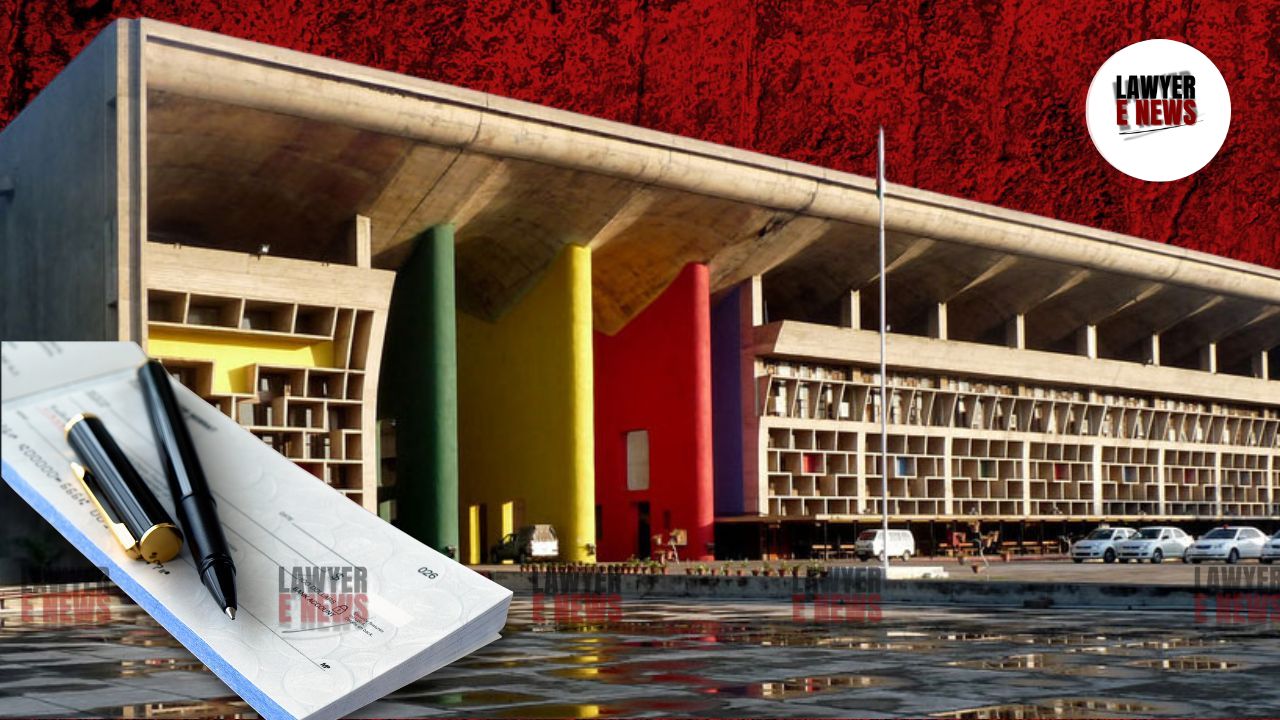
“Discretion Under Section 148 NI Act Must Be Judiciously Exercised—Not Mechanically Imposed” – Punjab and Haryana High Court, through Justice Sanjay Vashisth, delivered a significant ruling in Shahbaj Singh vs. Punjab and Sind Bank and Another , holding that imposition of a mandatory 20% compensation deposit as a pre-condition for suspension of sentence under Section 148 of the Negotiable Instruments Act, 1881, is not automatic or absolute, and must be supported by judicial reasoning.
The Court set aside the impugned order dated 19.05.2025 passed by the Additional Sessions Judge, Fazilka, which had directed the petitioner to deposit 20% of the cheque amount—₹4,09,152—as a condition for suspension of sentence after conviction under Section 138 of the NI Act. The High Court remanded the matter to the appellate court for fresh consideration in light of binding Supreme Court precedents and clarified that “the suspension of sentence shall continue” in the interim.
“The Word ‘May’ in Section 148(1) is Not Decorative—It Confers Discretion Which Must Be Applied Judicially”
The case arose from a conviction dated 07.04.2025 passed by the Judicial Magistrate First Class, Abohar, sentencing petitioner Shahbaj Singh to 1 year and 6 months of rigorous imprisonment and directing payment of compensation equal to the dishonoured cheque amount. Upon appeal, the Appellate Court suspended the sentence but made it conditional on the deposit of 20% of the compensation amount, invoking Section 148 of the NI Act.
Challenging this condition, the petitioner argued financial hardship and lack of any reasoning in the appellate court’s order, contending that such a requirement was not mandatory and had been misunderstood by the court below.
“Judicial Discretion Cannot Be Reduced to a Rubber Stamp” – High Court Slams Absence of Reasoning in Conditional Bail Order
The High Court held that the Appellate Court erred in mechanically imposing the 20% deposit condition, ignoring the principles laid down by the Supreme Court in Jamboo Bhandari v. MP State Industrial Development Corporation Ltd. (2024) and Muskan Enterprises v. State of Punjab (2024). In both decisions, the Apex Court clarified that Section 148(1) of the NI Act uses the word ‘may’, not ‘shall’, which leaves the requirement of deposit to the court’s discretion, based on the facts and only in non-exceptional cases.
Justice Vashisth categorically held: “The object of Section 148 of the Act is not mandatorily to be followed. The direction to pay or deposit 20% of the compensation amount is to be passed by the concerned Court after examining the facts and circumstances of the case.”
Referring to the rulings in Muskan Enterprises, the Court emphasized that judicial satisfaction, based on the merits of the conviction order, is necessary before compelling an accused to make such a deposit.
“Imposition of 20% Deposit Cannot Override the Right of Appeal” – Exceptional Cases Must Be Recognized and Reasoned
The Court noted that the Supreme Court in Jamboo Bhandari had overruled the rigid interpretation earlier seen in Surinder Singh Deswal v. Virender Gandhi (2019) and restored balance by declaring that:
“Normally, appellate courts will be justified in imposing the condition of deposit as provided in Section 148. However, where such a condition would amount to deprivation of the right of appeal, the exception must be allowed, and reasons must be recorded.”
The Punjab and Haryana High Court observed that no such reasons were recorded in the present case, and hence, the order could not stand:
“The learned Court below has not appreciated the facts of the case and other circumstances of the petitioner, as per the mandate of the Hon’ble Supreme Court in Jamboo Bhandari.”
“Judicial Mechanism Cannot Be Weaponised to Frustrate Appeal” – Larger Bench to Settle Whether Deposit is Directory or Mandatory
Justice Vashisth also took note of the reference made to a Larger Bench in two pending petitions (CRM-M-779-2025 and CRM-M-8498-2025), where the issue of whether Section 148’s deposit requirement is mandatory or merely directory is under adjudication.
“Until these two petitions are finally decided… the operation of the impugned order dated 19.05.2025 would be kept in abeyance,” the Court clarified.
Thus, in addition to remanding the matter for reconsideration, the High Court ensured interim protection for the petitioner, maintaining the suspension of sentence without enforcing the deposit condition.
“Literal Reading of ‘May’ as ‘Shall’ Would Lead to Absurdity” – Court Reaffirms Muskan Enterprises Ruling on Statutory Interpretation
In one of the most significant portions of the judgment, the High Court invoked the principle of purposive construction, echoing the Supreme Court’s position in Muskan Enterprises, where it was held:
“Reading ‘may’ as ‘shall’ in sub-section (1) of Section 148 would denude the Appellate Court of a limited discretion conferred by the legislature… This would be a travesty of justice.”
Justice Vashisth reaffirmed that “may means may, and shall means shall”, asserting that any order under Section 148 must reflect not just the amount to be deposited but the reasoning why deposit is warranted in the first place.
The Punjab and Haryana High Court’s ruling reinforces a critical aspect of bail jurisprudence under the Negotiable Instruments Act: judicial discretion must be exercised, not eliminated, when dealing with financial penalties accompanying suspension of sentence.
By setting aside the order dated 19.05.2025 and remanding the case to the Appellate Court for a fresh hearing, the Court has ensured that procedural fairness and the right of appeal are not sacrificed at the altar of mechanical statutory application.
As Justice Vashisth concluded: “The Appellate Court shall re-examine the case in view of the law laid down by the Hon’ble Supreme Court in Jamboo Bhandari and Muskan Enterprises and after granting opportunity to the petitioner to make submissions regarding exceptional circumstances.”
Date of Decision: 19th September 2025