-
by sayum
15 August 2026 2:23 PM







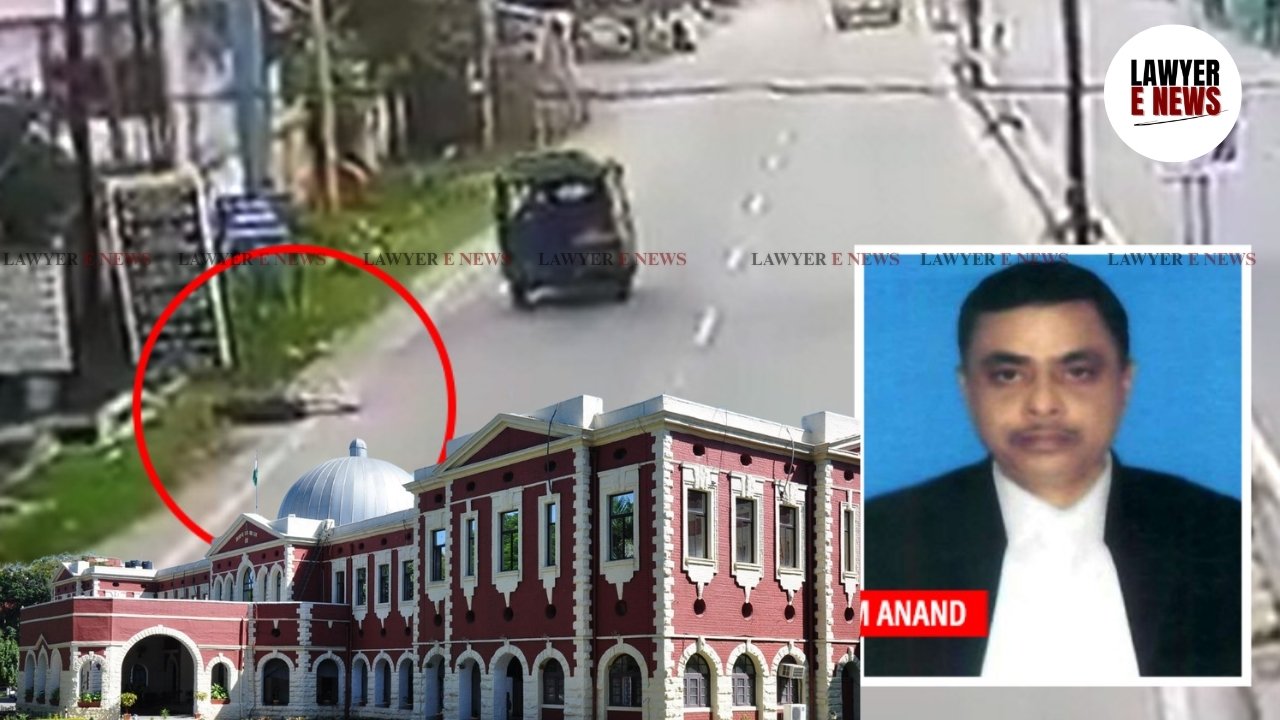
"The concatenation of events as evinced from the testimony of the witnesses and the various reports of the experts as well as the CCTV footages, convincingly proves the devious and deceptive manner in which the objective of the appellants were executed." Jharkhand High Court, in a significant judgment dated July 14, 2026, upheld the conviction and life imprisonment awarded to two individuals for the murder of Additional District & Sessions Judge Uttam Anand.
A division bench of Justice Rongon Mukhopadhyay and Justice Pradeep Kumar Srivastava observed that the deliberate act of swerving a vehicle to hit a pedestrian on a vital part of the body squarely falls under the definition of murder under the Indian Penal Code.
The case pertains to the death of Judge Uttam Anand, who was struck by a stolen auto-rickshaw during his morning walk on July 28, 2021, in Dhanbad. While initially registered as a hit-and-run accident, a viral CCTV video of the incident suggested a deliberate act, prompting the state government to hand over the investigation to the Central Bureau of Investigation (CBI). The trial court subsequently convicted the driver, Lakhan Kumar Verma, and his associate, Rahul Kumar Verma, under Sections 302/34 and 201/34 of the IPC.
The primary question before the court was whether the collision was a result of a mechanical failure or a deliberate, intentional act to cause death. The court was also called upon to determine if the ingredients of Section 300 IPC "Thirdly" were satisfied and if common intention under Section 34 IPC was established between the two appellants.
CCTV Analysis Disproves Accidental Collision Theory
The court relied heavily on technical evidence, specifically the analysis of CCTV footages which captured the movement of the offending auto-rickshaw. The bench noted that the footage showed the vehicle suddenly veering towards the left side of the road where the Judge was walking, despite the road being empty.
"The auto-rickshaw was seen changing the path from the middle of the road specifically towards the deceased and returned back to the original path after hitting the deceased," the court observed.
Forensic Reconstruction Proves Driver Had Full Control
Rejecting the defense's claim that the vehicle hit a stone and veered uncontrollably, the High Court cited the reports of forensic experts from the CFSL and NFSU. The 3D digitization and crime scene recreation proved that the driver had full control and intentionally changed the path at a 21-degree angle to hit the victim.
"At no point of time, he exhibited any sort of attempting to turn or swerve away from the deceased, no attempts at sudden breaks, sudden turning or wobbling of vehicle," the bench remarked.
Application of Section 300 IPC "Thirdly"
The court delved into the legal requirements for murder, specifically the "Thirdly" clause of Section 300 IPC. It noted that the prosecution successfully proved the presence of a bodily injury, its nature, the intention to inflict that specific injury, and that the injury was sufficient in the ordinary course of nature to cause death.
"Section 300 'Thirdly' demonstrates an intentional hit which caused a blow to a vital part of the body (head) with the vehicle which is murder," the court held.
Motive Becomes Irrelevant In Face Of Direct Evidence
Addressing the appellants' argument regarding the lack of motive, the court clarified that motive loses its significance when direct ocular and technical evidence is overwhelming. The bench placed reliance on the Supreme Court's ruling in Chandan v. State (NCT of Delhi) to emphasize that ocular testimony inspiring confidence does not require proof of motive.
"Motive will be compelled to take a back seat when faced with a deluge of direct evidence as in the present case," the bench noted.
Common Intention Established Under Section 34 IPC
The court affirmed the culpability of the second appellant, Rahul Kumar Verma, under Section 34 IPC. It highlighted that both appellants had stolen the vehicle together on the preceding night and remained together throughout the commission of the act, including the subsequent attempt to camouflage the vehicle's identity by defacing the number plates.
"The subsequent acts prove beyond any reasonable doubt the cohesiveness in the chain of circumstances making the appellant no. 2 equally and effectively responsible for such distressing and shocking act of murder," the court stated.
The High Court concluded that the execution of the act was an "affront to the judiciary" and raised serious concerns regarding the safety of judicial officers. Finding no rationale to interfere with the trial court's findings, the bench dismissed the appeal and maintained the sentence of rigorous imprisonment for life without remission or commutation till their last breath.
Date of Decision: 14 July 2026