-
by sayum
31 July 2026 8:03 AM







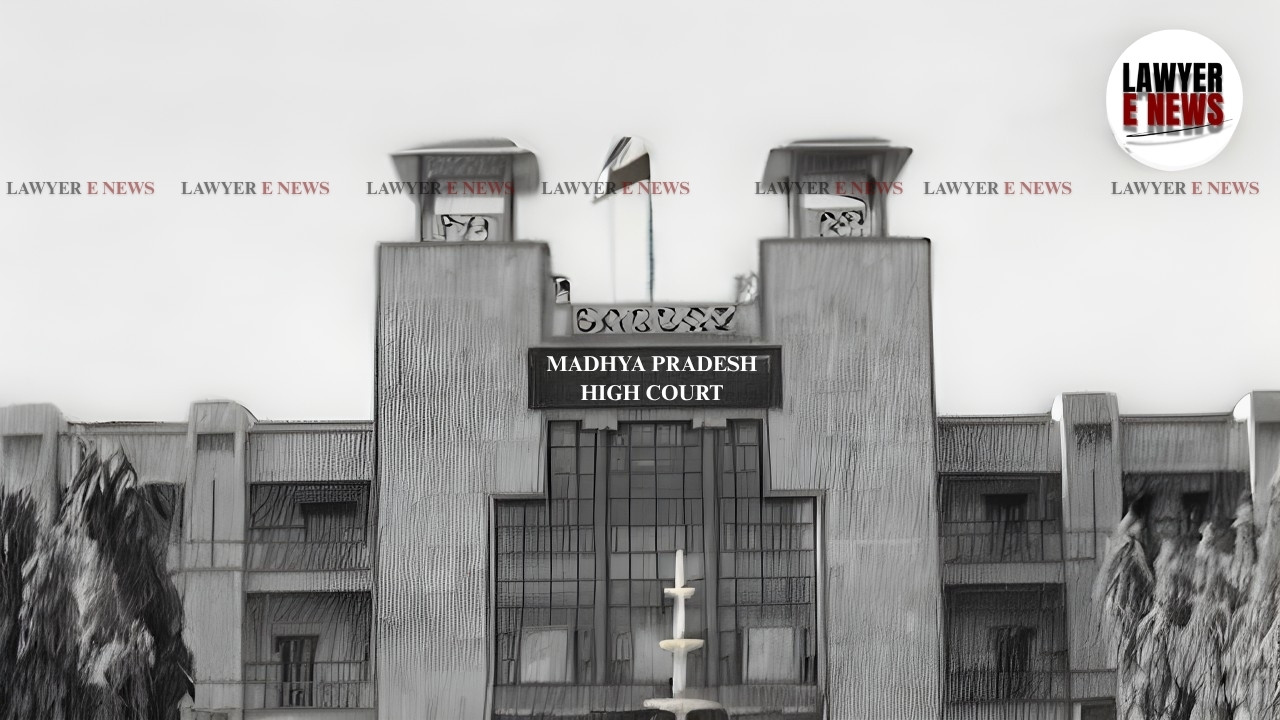
"The recovery of the Lathi from an open place after a lapse of nine days from the date of the incident raises a serious doubt." Madhya Pradesh High Court, in a significant ruling, held that the delayed recovery of an alleged murder weapon from an open, accessible space severely undermines the credibility of the prosecution's case.
A division bench of Justice Vivek Agarwal and Justice Avanindra Kumar Singh observed that such infirmities, coupled with the failure to produce crucial electronic evidence, render the chain of circumstantial evidence entirely incomplete.
The appellants, Dayalu alias Mukesh and Rajesh, were convicted under Section 302 of the Indian Penal Code, 1860, and sentenced to life imprisonment by the Sessions Judge, Dindori, for the alleged murder of Shivram Dheemar. The deceased's body was discovered near a dam on June 1, 2020, and the prosecution primarily relied on the "last seen" theory alongside a subsequent weapon recovery. The appellants challenged this conviction, arguing that the investigation was inherently defective and the conviction was recorded solely on uncorroborated police memorandums.
The primary question before the court was whether the delayed recovery of a weapon from an open space, days after the initial crime scene search, could constitute reliable circumstantial evidence. The court was also called upon to determine if the failure to produce call detail records to corroborate telephonic conversations was fatal to the prosecution's narrative.
Delayed Recovery From Open Space Creates Suspicion
The High Court critically examined the prosecution's reliance on the recovery of a bamboo stick (Lathi) at the instance of the appellant, Rajesh. The bench noted that while the incident occurred on the intervening night of May 31 and June 1, 2020, the weapon was allegedly recovered on June 10, 2020. The judges emphasized that this delayed recovery from an open place, known as Khargahna Bandhan, fundamentally weakened the prosecution's narrative.
Prior Searches Yielded No Weapon
Expanding on the investigative infirmities, the bench pointed out that the very same spot had been searched extensively on the day the deceased's body was discovered. While other articles and a blood-stained stone were seized from the area on June 1, the bamboo stick was conspicuously absent. The court highlighted that the seizure memo contained no mention that the weapon had been concealed in a location inaccessible to the police during their earlier recovery proceedings.
Testimonies Contradict Police Claims
The court found further reasons to disbelieve the weapon recovery based on the testimony of prosecution witnesses. A police driver, examined as a witness (PW-8), admitted during cross-examination that he had not seen the appellant retrieve the stick. Instead, the witness voluntarily stated that the weapon was already kept at the police station. The bench observed that this evidence suggests the weapon "was not actually produced by the appellant Rajesh from the place shown in the seizure memo," thereby creating a severe doubt regarding the prosecution story.
Medical Evidence Fails To Corroborate Memorandums
Addressing the disclosure statements relied upon by the trial court, the bench found a stark disconnect between the police memorandums and the forensic findings. The appellant allegedly confessed to assaulting the deceased with a Lathi and pushing him off a fifteen-foot bridge. However, the postmortem report revealed only a single external lacerated wound. The court noted it was highly improbable that a person pushed from such a height would have sustained only a single injury, rendering the memorandum untrustworthy.
"Last Seen" Theory Weakened By Missing Call Records
The prosecution's "last seen" theory was completely dismantled by the bench due to a glaring lack of corroborative evidence. The court noted that while the deceased allegedly spoke to his father hours before his death, he never mentioned being in the company of the accused. The bench strongly criticized the investigating agency for failing to produce call detail records to substantiate these telephonic conversations. The judges remarked that the investigation "appears to be not only defective but also suffers from serious infirmities."
Conjectures Cannot Replace Conclusive Proof
Relying on the Supreme Court's landmark judgment in Sharad Birdhichand Sarda v. State of Maharashtra (1984) 4 SCC 116, the High Court reiterated the fundamental principles governing circumstantial evidence. The bench emphasized that the mental distance between "may be" and "must be" is long and divides vague conjectures from sure conclusions. The court firmly concluded that the trial court committed a grave error in elevating mere conjectures to the status of conclusive findings without substantive evidence on record.
The High Court concluded that the prosecution completely failed to establish a complete chain of circumstances to conclusively prove the guilt of the accused. Consequently, the court allowed the appeals, set aside the impugned judgment of the Sessions Court, and ordered the immediate release of the appellants.
Date of Decision: 14 July 2026