-
by sayum
10 November 2026 6:44 PM







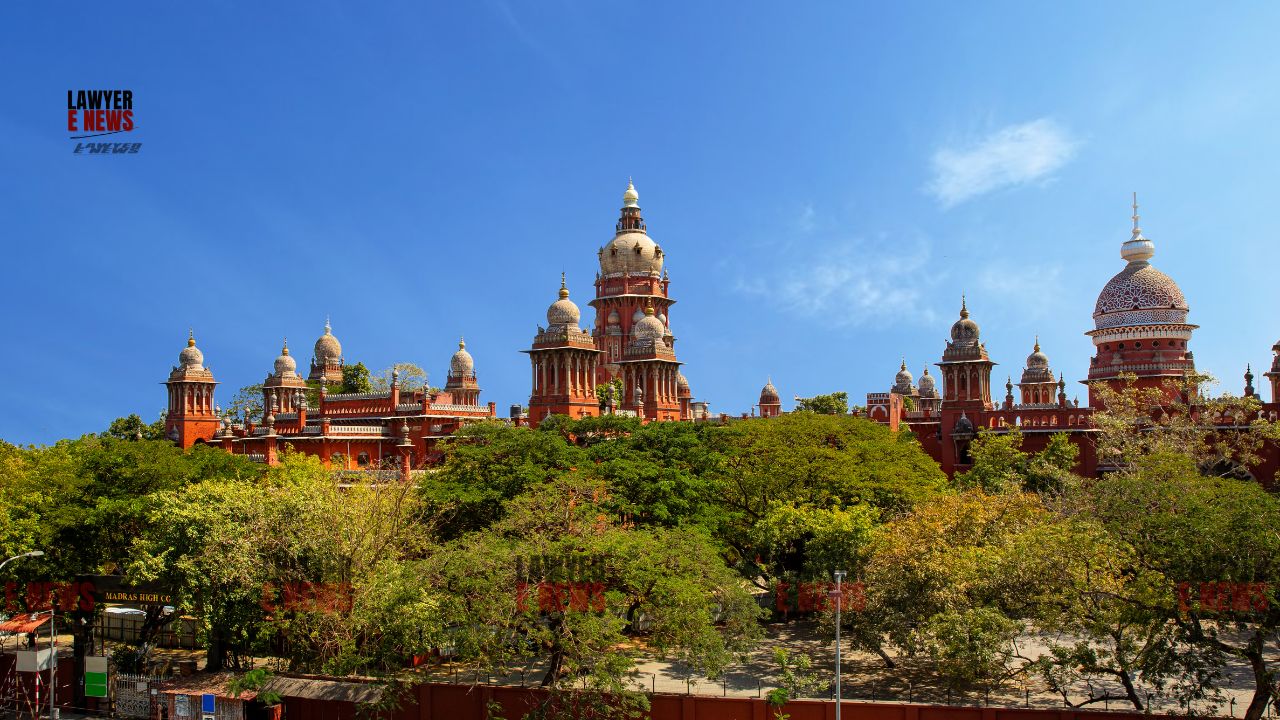
"In a suit for declaration of title and possession, the burden of proof is on the plaintiff to establish her case irrespective of defendants to prove their case or not. In the absence of establishment of the plaintiff’s own title, the plaintiff must be nonsuited even if the title set up by the defendants is found against them." Madras High Court held that while a plaintiff in a suit for declaration of title and recovery of possession must discharge the burden of proving their own case, the existence of other independent evidence can sustain the decree even if certain documents are found inadmissible.
A bench of Justice P. Dhanabal observed that while the "weakness of the defendant's case cannot be a ground to grant relief to the plaintiff," a decree remains sustainable if the plaintiff independently establishes title and property identity through valid title deeds.
The dispute involved the respondent (plaintiff) seeking declaration and recovery of possession of property situated in Survey No. 119/8, which she claimed to have purchased in 1985. The appellant (1st defendant) contested the suit, asserting title to an adjacent property in Survey No. 118, and claimed that the plaintiff had failed to identify the suit property correctly while relying on fabricated revenue documents. Both the trial court and the first appellate court decreed the suit in favour of the plaintiff, leading to the current Second Appeal.
The primary questions before the court were whether the suit was barred by limitation under Article 58 of the Limitation Act, whether the court properly exercised its discretion under Section 34 of the Specific Relief Act, 1963, and whether the reliance placed by the lower courts on Exs.A4 and A6—alleged secondary evidence—rendered the judgment legally infirm.
Court Clarifies Law On Secondary Evidence
The High Court observed that the lower courts erred in admitting Exs.A4 and A6, which were Xerox copies of letters allegedly sent by the Tahsildar. The court held that since these were mere Xeroxes of copies rather than the original letters served upon the parties, they failed to meet the threshold of secondary evidence. "The copy itself is secondary evidence and there cannot be secondary evidence for the secondary evidence," the court remarked.
Independent Proof Of Title Overrides Inadmissible Documents
Despite the inadmissibility of the Tahsildar’s communications, the court refused to overturn the decree. The bench noted that the plaintiff had successfully produced her parental title deeds and that the survey numbers and property boundaries were distinct from those claimed by the defendant. Because the plaintiff’s title was established through primary documentary evidence of purchase, the exclusion of the flawed Exs.A4 and A6 did not invalidate the overall finding of ownership.
Burden Of Proof Remains On The Plaintiff
Relying on the Supreme Court’s precedents in Jagmail Singh v. Karamjit Singh and R.V.E. Venkatachala Gounder v. Arulmigu Viswesaraswami, the High Court reiterated that the plaintiff cannot succeed simply by pointing to the defendant's inability to prove their own title. The court emphasized that the burden of proof is absolute. However, in this case, the court found that the plaintiff had effectively discharged this burden through independent evidence, rendering the defendant's appeal meritless.
Court Addresses Limitation And Specific Relief
Regarding the contention that the suit was barred by limitation, the court observed that since the relief sought included recovery of possession, the suit was maintainable under Article 65 of the Limitation Act. The court clarified that when a plaintiff seeks a declaration of title and consequential recovery of possession, the limitation period is not merely confined to the three-year window under Article 58 if the possession of the defendant is not adverse to the plaintiff. Consequently, the court upheld the concurrent findings of the lower courts and dismissed the appeal.
Date of Decision: 30 September 2026