-
by sayum
19 August 2026 1:58 PM








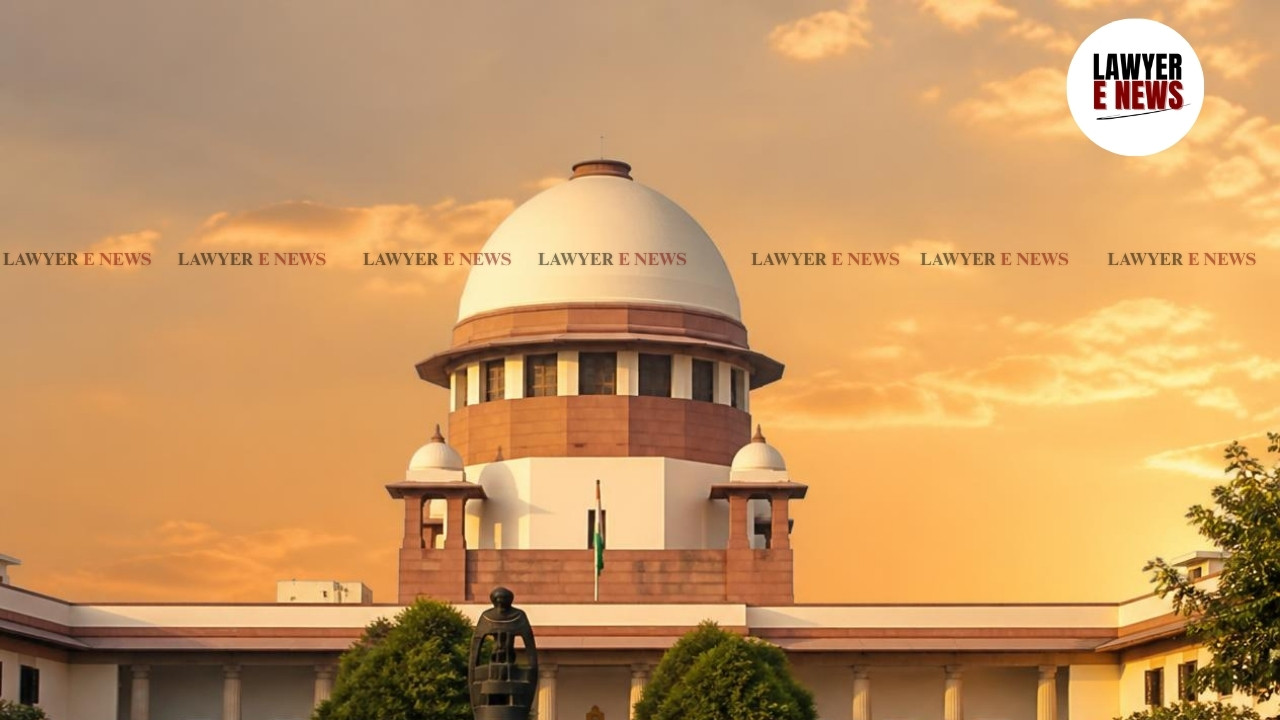
"For amputees, a prosthetic limb would get them closest to the life experienced, before the onset of their disability. The device, apart from empowering them, is integral to their life, giving them confidence and self-belief." Supreme Court, in a significant ruling dated April 21, 2026, held that motor accident victims are entitled to compensation for prosthetic limbs based on the principle of restitutio in integrum, emphasizing that courts are not bound by "abysmally low" government notifications.
A bench of Justices J.B. Pardiwala and K.V. Viswanathan observed that a prosthetic limb is "integral to life" and its cost must reflect "just compensation" under Section 168 of the Motor Vehicles Act, 1988 (MVA).
The appellant, a 32-year-old heavy vehicle driver, suffered a crushed right leg in a 2007 accident involving a Haryana Roadways bus, resulting in a below-knee amputation. While the Motor Accident Claims Tribunal (MACT) and the Rajasthan High Court awarded certain damages, neither provided for the cost of a prosthetic limb or its maintenance. The appellant approached the Supreme Court seeking enhancement and provision for artificial limbs to restore his mobility and dignity.
The primary question before the court was the jurisprudential basis for computing compensation under the head of "Prosthetic Limb" and whether such awards must be limited by government-notified rates. The court also examined whether a driver suffering a leg amputation is entitled to 100% functional disability compensation despite a lack of formal income documentation.
Restitutio In Integrum: Restoring The Victim To Original Position
The Court emphasized that under Section 168 of the MVA, the mandate is to determine "just compensation," which must be rational and equitable. It invoked the principle of restitutio in integrum, noting that the objective of damages is to restore the injured party to their original condition as far as money can provide.
The bench noted that while money cannot renew a shattered physical frame, it can provide the means to procure something tangible to replace what was lost. The Court stressed that for an amputee, a prosthetic limb is the only substitute available, and the law must ensure they can afford a device that empowers them.
"The appliance is so personal to the individual that its indispensability can only be better appreciated by the person disabled."
Courts Not Bound By "Abysmally Low" Government Rates
Rejecting the Insurance Company's reliance on a Government of India notification prescribing low price ranges for limbs, the Court held that claimants have the right to choose private centres for procurement. It ruled that if the chosen treatment is reasonable, the defendant cannot point to cheaper, inferior options to reduce the payout.
The bench observed that the rates in government notifications are often inadequate to cover high-quality prosthetic needs. It held that the basis of assessment must be the test of reasonableness regarding the claimant’s specific needs rather than an objective minimum.
"We have no hesitation in rejecting the rates prescribed in the Government Notification relied upon by the Insurance Company which, in any event, are abysmally low."
Standard Formula For Computing Prosthetic Limb Compensation
Relying on Mohd. Sabeer v. Regional Manager, UPSRTC, the Court applied a standardized formula for prosthetics. It assumed the life span of a claimant to be 70 years and the functional life of a single prosthetic limb to be five years, necessitating periodic replacements.
Since the appellant was 32 at the time of the accident, the Court calculated the need for seven prosthetic limbs throughout his life. It awarded a consolidated sum of Rs. 3,00,000 per limb, totaling Rs. 21,00,000, along with a maintenance cost of Rs. 5,00,000 for the entire period.
"The claimant is entitled to damages to meet her reasonable requirements and reasonable needs arising from her injuries. It is no answer for the defendant to point to cheaper treatment which is also reasonable."
Future Claims Must Be Accompanied By Market Quotations
The Court reiterated the directions laid down in Chandra Mogera v. Santosh A. Ganachari, making it mandatory for future claimants to provide market reality to Tribunals. Henceforth, every claim for a prosthetic limb must be accompanied by price quotations from at least two or three service providers.
This requirement aims to enable Tribunals to make an informed assessment of actual costs. The Court noted that in most cases, no estimates are provided, leading to arbitrary or insufficient awards that fail the test of "just compensation."
100% Functional Disability For Heavy Vehicle Drivers
Regarding income, the Court accepted the appellant’s claim of Rs. 6,000 per month despite the absence of documentary evidence. It noted that such proof cannot be expected from persons in that economic strata. The Court relied on Ramachandrappa v. Royal Sundaram Alliance Insurance to hold that the claim was reasonable for a driver in 2007.
The bench further held that for a heavy vehicle driver, a leg amputation results in 100% functional disability as he can no longer perform his specific vocational duties. Consequently, it applied the multiplier method with 40% future prospects to enhance the loss of future income significantly.
"Merely because the appellant has not produced the documentary evidence, we are not prepared to reject the same. Considering the occupation as driver and the year of the accident, Rs. 6,000/- per month appears to be a reasonable amount."
Final Directions and Enhancement
The Supreme Court allowed the appeal, enhancing the compensation by a total of Rs. 36,20,350 over and above the High Court's award. This includes Rs. 26,00,000 for prosthetics and maintenance, and approximately Rs. 8,20,000 for loss of income and treatment. The Insurance Company was directed to pay the amount within four weeks.
The ruling reinforces the "just compensation" regime by prioritizing the dignity and mobility of accident victims over bureaucratic price caps. By validating the right to high-quality prosthetics and recognizing the total loss of earning capacity for specialized workers like drivers, the Court has broadened the scope of restorative justice in motor accident law.
Date of Decision: 21 April 2026