-
by sayum
04 August 2026 1:39 PM







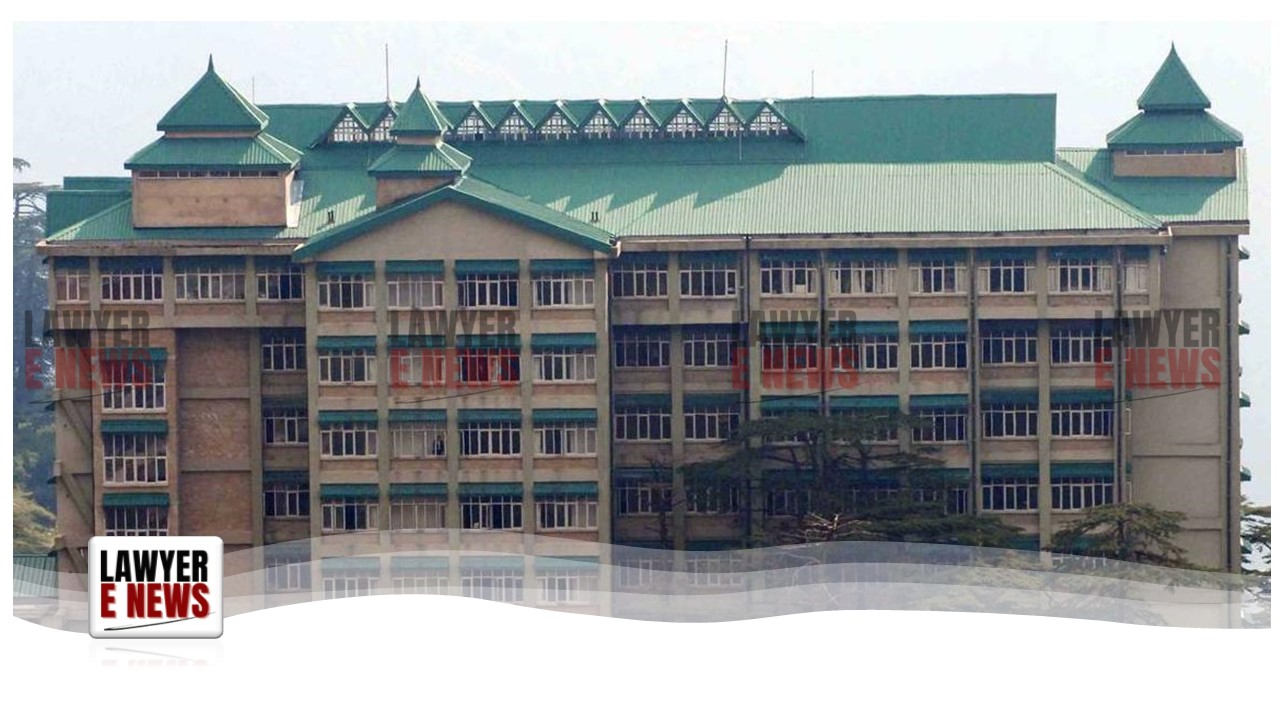
“Absence of Independent Witness Doesn’t Discredit Truthful Co-Worker’s Testimony”— In a noteworthy judgment Himachal Pradesh High Court upheld a finding of rash and negligent driving in the tragic death of a government employee who fell from a moving bus due to sudden braking. While modifying the compensation awarded by the Motor Accident Claims Tribunal (MACT), Shimla, the Court also reaffirmed the emotional aspect of compensation law, holding that loss of consortium is not contingent on financial dependency.
The case—Oriental Insurance Co. Ltd. v. Satya Devi and Others—arose from the death of Surat Ram, a T-mate with the Electricity Department, who fell from a bus at Sanjauli due to negligent driving. The insurer, Oriental Insurance Co. Ltd., had challenged both the finding of negligence and the amount of compensation granted.
“Even a Single Truthful Witness Can Establish Negligence—The Law Doesn’t Require a Crowd”
Oriental Insurance contended that there was no independent witness to establish rash and negligent driving. The Court, however, found this argument entirely unconvincing. Justice Thakur emphasized the natural credibility of the co-worker who witnessed the incident:
“It is not a plausible argument that instead of a person knowing and travelling with deceased, other persons who were strangers were required to be searched and examined… Integrity of PW3 Budhi Ram remained unimpeached.”
The Court further highlighted that PW3’s testimony was not only trustworthy but also corroborated by the FIR and the testimony of the Investigating Officer:
“The said fact is corroborated by PW2 ASI Prem Lal who has proved the copy of FIR Ext.PW2/A… At any point of time it was never suggested to Budhi Ram that he was having any interest in present matter.”
This observation underlines a critical principle in evidence law—that credibility outweighs quantity when it comes to establishing facts.
“Licence Validly Endorsed—Mere Duration Misconception Doesn’t Invalidate It”
The insurer’s argument that the driver’s licence was invalid because it was issued for 20 years was decisively rejected. The Court made it clear that the endorsement for driving transport vehicles was in place, and that the renewals were in accordance with law:
“This statement does not mean that currency of licence was for 20 years. Currency of licence is to be ascertained, verified and proved from the driving licence, copy whereof has been placed on record as Ext.RW2/A.”
“Plea with respect to validity of licence is misconceived and is rejected.”
The Court also pointed out that no such objection was raised during the trial, and both the driver and owner had discharged their burden to show valid licencing.
“Contributory Negligence Can't Be Manufactured on Appeal”
An attempt was made by the insurer to argue contributory negligence on part of the deceased, but Justice Thakur rejected this as an afterthought:
“Though plea has been taken that deceased Surat Ram was liable for contributory negligence but no such plea was ever taken by Insurance Company before the MACT nor any evidence has been led in this regard. Therefore, this plea is not sustainable.”
This reinforces a settled legal principle: new facts or defences cannot be introduced at the appellate stage unless pleaded and proven at trial.
“Compensation Must Reflect Legal Uniformity, Not Hypothetical Retirement Plans”
The High Court recalculated compensation by correcting the deceased's age (from 50 to 55 years) based on the Parivar Register, rather than the postmortem report. Accordingly, the Court applied a multiplier of 11 instead of 13, and granted 15% towards future prospects as per Pranay Sethi’s guidelines:
“Multiplier and future prospects must be uniformly applied… Plea for reducing it based on retirement is untenable.”
Justice Thakur emphasized the rationale behind using standard multipliers:
“Different persons may live for different period… To avoid uncertainty and chaos… the Supreme Court has formulated and approved a uniform formula.”
Accordingly, the monthly loss of contribution was fixed at ₹9,835, and the total compensation (excluding consortium) was recalculated as ₹13,28,220.
“Loss of Consortium Is Emotional, Not Economic—All Children, Even Married Ones, Feel the Void”
One of the most empathetic and legally significant portions of the judgment was the Court’s treatment of loss of consortium. The insurance company argued that married daughters should not receive any compensation as they were not dependent. But the Court separated the concepts of dependency and emotional loss:
“Loss of contribution on account of dependency and loss of consortium being family members/relatives are entirely two different concepts.”
“The dependent legal heirs… shall also be entitled for loss of consortium, whereas other family members who are not dependent… though shall not be entitled for compensation but shall be entitled for loss of consortium.”
Quoting from Magma General Insurance Co. Ltd. v. Nanu Ram, Justice Thakur awarded ₹40,000 as consortium to each of the six claimants, including four married daughters:
“Consortium will be governed by the principles laid down in Pranay Sethi… personal loss of love and affection, guidance, and emotional loss is compensable.”
This interpretation widens the scope of consortium as a human loss, not merely a legal formula.
Modification, Not Denial—Justice Rendered in Both Letter and Spirit
The High Court modified the MACT award, reducing the compensation to ₹13,28,220 plus consortium and interest, but upheld the principal findings regarding rash driving and liability. The Oriental Insurance Co. Ltd. was directed to deposit the full compensation amount by 31 July 2025:
“Respondents No. 1 and 6 shall be entitled for ₹13,28,220 plus ₹40,000 each for consortium. Claimants No. 2 to 5 shall be entitled only for ₹40,000 each for consortium. Interest @7.5% per annum from 25.03.2010 until payment shall be applicable.”
“The impugned award is modified in aforesaid terms and appeal is disposed of accordingly.”
Date of Decision: 20 May 2025