
-
by sayum
26 August 2026 1:49 PM







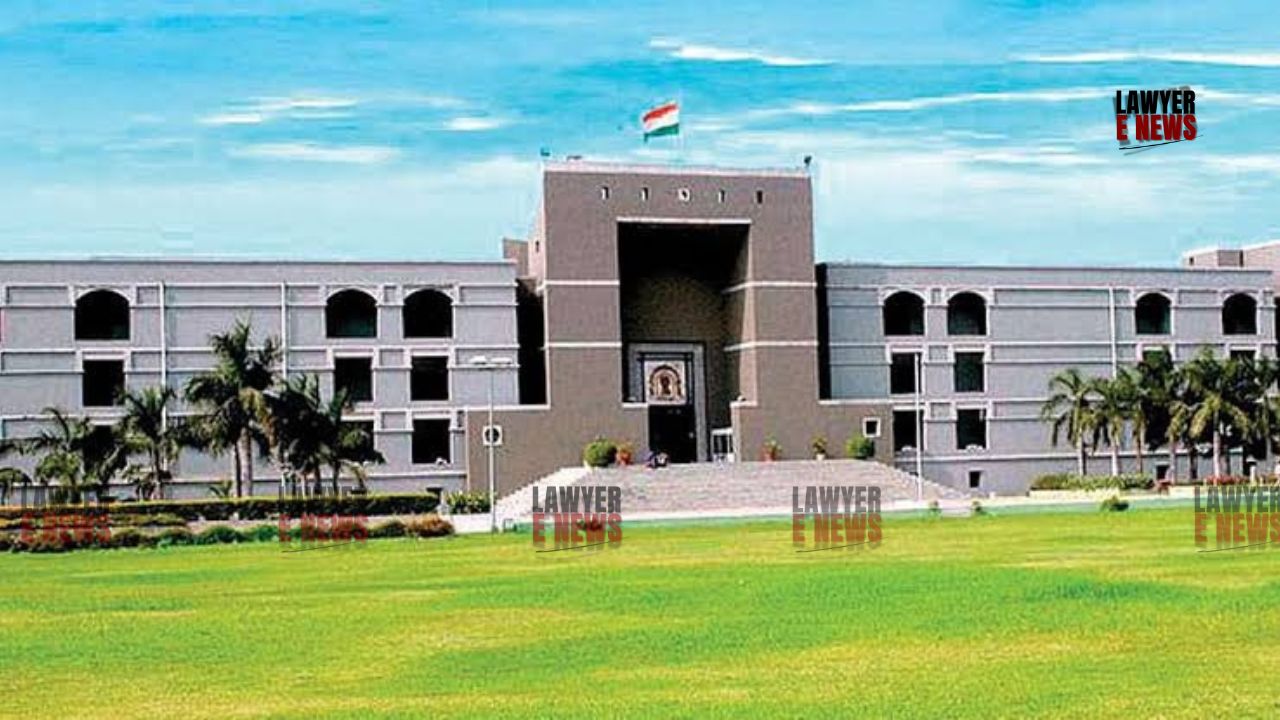
“A Judge, Like Caesar’s Wife, Must Be Above Suspicion” — In a recent Judgment Gujarat High Court upholding the premature retirement of a 53-year-old Additional District Judge under Rule 21 of the Gujarat State Judicial Service Rules, 2005, and dismissing a constitutional challenge that questioned the validity of the Notification issued in the Governor’s name without his alleged “personal satisfaction.” The Division Bench comprising Justice A.S. Supehia and Justice L.S. Pirzada ruled that the Governor is not required to act personally in such matters and that judicial service carries standards far beyond those of ordinary government service.
The Court held that the Notification dated 18.07.2016 was constitutionally valid, based on the aid and advice of the Council of Ministers, following the recommendation of the High Court, and thus not vitiated by any legal infirmity. It was categorically observed that “The Governor acts on the aid and advice of the Council of Ministers under Article 163 unless expressly required to act in discretion. There is no requirement for personal evaluation by the Governor in compulsory retirement matters.”
“Compulsory Retirement Is Not Punishment — No Hearing Required, Even One Adverse Entry Can Justify Exit”: High Court Reiterates Limits of Judicial Review
The primary issue before the Court was whether a judicial officer could be prematurely retired under Rule 21 without the Governor's personal decision-making, and whether the procedure adopted by the High Court on its administrative side breached constitutional mandates or principles of natural justice. The High Court resoundingly answered both in the negative, holding that subjective satisfaction of the Full Court, supported by the recommendation of a judicial committee, was adequate to invoke Rule 21, and that “compulsory retirement is not a punitive action — natural justice principles are inapplicable.”
The petition by ADJ Jayeshkumar Acharya was accordingly dismissed, with the Court refusing to interfere in what it deemed an administrative, non-stigmatic, and constitutionally compliant decision of the High Court.
The petitioner was compulsorily retired at age 53 through a government Notification dated 18.07.2016, which listed him among 18 judicial officers retired in public interest. This decision followed a report submitted by a Committee of three High Court Judges, appointed pursuant to a communication dated 14.10.2008 from the Chief Justice of India, directing all High Courts to undertake reviews of judicial officers who had attained the age of 50, 55, or 58 years, in line with the Supreme Court’s judgment in All India Judges’ Association v. Union of India (2002) 4 SCC 247.
The petitioner’s ACRs from 2001 to 2015 revealed mostly “just adequate” or “adequate” gradings, with a disputed “poor” entry for the second quarter of 2012. He contended that he had been unfairly assessed, and that the Governor had not personally applied his mind to the High Court’s recommendation, thereby rendering the Notification unconstitutional and illegal.
The Court Observed: “If the Order Is Issued in the Name of the Governor, It Is Constitutionally Immune”
On the issue of Governor’s role, the Court dismissed the argument that personal satisfaction or direct intervention of the Governor was mandatory. Referring to Articles 163 and 166 of the Constitution and the Gujarat Government Rules of Business, 1990, the Court held:
“The Governor is not required to apply personal mind unless the Constitution expressly requires him to act in discretion. The business of the Government is conducted by Ministers, and once an order is authenticated under Article 166(2), it is immune from judicial scrutiny.”
Citing State of M.P. v. Dr. Yashwant Trimbak (1996) 2 SCC 305, the Court emphasised: “An order expressed in the name of the Governor and duly authenticated cannot be questioned in any court on the ground that it is not made or executed by the Governor.”
It added that the Governor’s satisfaction was presumed when the Notification followed established procedure and was issued in the Governor’s name by an authorised officer.
“Judicial Service Demands Unimpeachable Integrity — Full Court’s Administrative Wisdom Not Subject to Judicial Review Without Mala Fides or No Material”
Rejecting the petitioner’s argument that he was not given a hearing before the decision was taken, the Court reiterated a well-established legal position:
“Compulsory retirement is not a punishment. It implies no stigma and is based on administrative assessment of suitability in public interest. Therefore, principles of natural justice do not apply.”
Referring to R.C. Chandel v. High Court of M.P. (2012) 8 SCC 58, the Court observed: “A single uncommunicated adverse remark or a perception of doubtful integrity based on cumulative inputs is sufficient to justify compulsory retirement of a judicial officer.”
The Court found no procedural illegality in the evaluation process undertaken by the Committee of Judges or the Full Court. It held that the “subjective satisfaction” of the High Court regarding the officer’s utility and integrity, once exercised in accordance with Rule 21, cannot be second-guessed unless it is shown to be mala fide, arbitrary, or based on no material.
“Even Promotion or Selection Grade Doesn’t Erase Past Record — Utility in Judicial System Is Key”
The petitioner had argued that he had been graded “excellent” in 2015 and had no pending vigilance inquiries. However, the Court rejected the submission that later performance erased previous assessments. It noted:
“Promotion or grant of a higher scale does not wipe out adverse entries which remain on record and continue to hold the field. The entire service record is relevant.”
Quoting from R.C. Chandel, the Court stated: “In assessing potential for continued useful service of a judicial officer, the High Court is required to take into account the entire service record. Overall profile is the guiding factor. Those of doubtful integrity or wanting in utility are not entitled to benefit of service.”
“No Stigma, No Punishment — Compulsory Retirement Is an Administrative Measure in Public Interest”
Summarising the legal position, the Court reaffirmed that: “An order of compulsory retirement is not a penalty; it neither casts stigma nor inflicts civil consequences of the nature that warrant a hearing. The purpose is to weed out the inefficient and preserve institutional integrity.”
Relying on High Court of Judicature for Rajasthan v. Bhanwar Lal Lamror (2021) 8 SCC 377, the Court reiterated that unless there is complete lack of material, breach of procedure causing prejudice, or manifest arbitrariness, courts cannot substitute their views for that of the Full Court of the High Court.
“Judicial Review Is Permissible Only on Very Limited Grounds — Not for Re-evaluating High Court’s Administrative Wisdom”
Dismissing the petition, the Court concluded:
“We find no infringement of any rule or constitutional provision. The Notification issued in the name of the Governor is valid. The opinion formed by the Full Court is based on service records and is immune from interference unless tainted by mala fides or procedural impropriety.”
The Court summed up the legal threshold in no uncertain terms: “The credibility of the judicial system is dependent upon the judges who man it. For a democracy to thrive and rule of law to survive, justice system and the judicial process have to be strong, and every Judge must discharge his functions with integrity, impartiality, and intellectual honesty.”
Accordingly, the writ petition was dismissed, the rule was discharged, and no order as to costs was passed.
Date of Decision: 30 September 2025





