-
by sayum
19 August 2026 1:58 PM








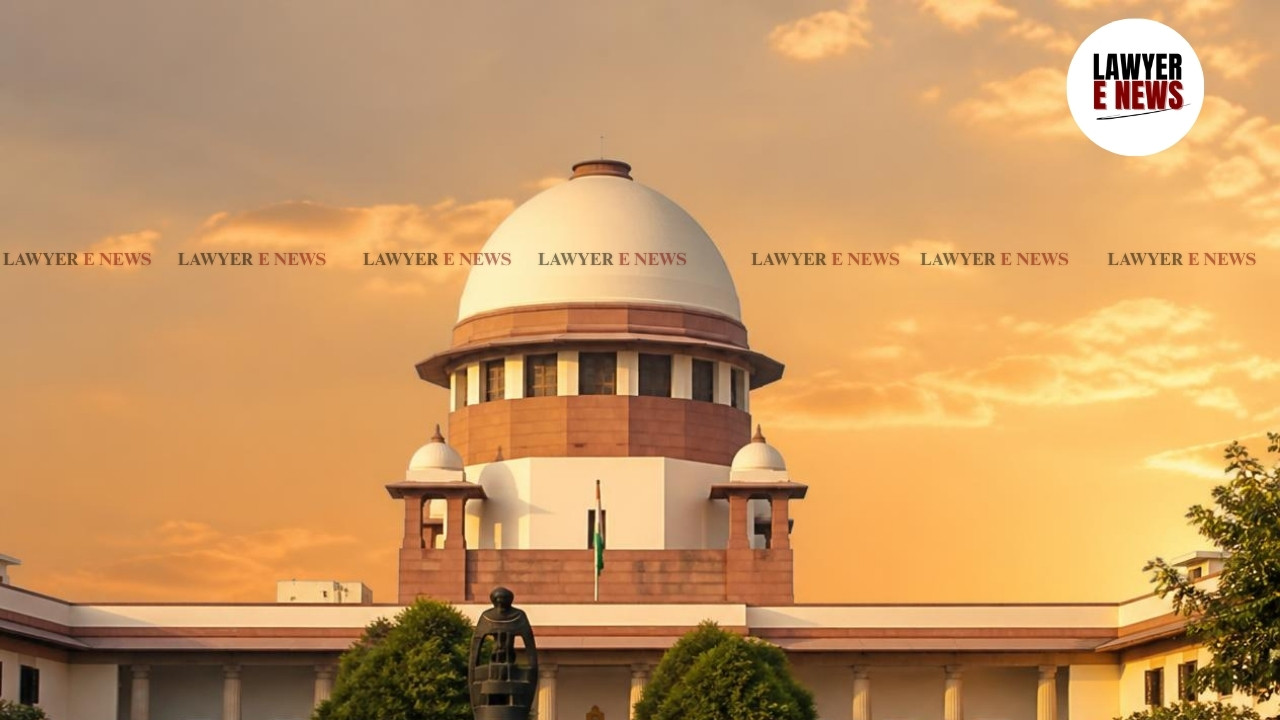
"Nature of this power is not administrative in the ordinary sense but partakes the character of a legislative function, involving the declaration of municipal limits and the constitution of local bodies for governance of specified areas." Supreme Court, in a significant ruling dated April 22, 2026, held that the specification and alteration of municipal limits under Section 3 of the Maharashtra Municipal Corporations (MMC) Act is a legislative function that cannot be challenged in a civil suit.
A bench of Justice Prashant Kumar Mishra and Justice K.V. Viswanathan observed that once such a determination is made by the State in exercise of statutory power, its validity cannot ordinarily be the subject matter of adjudication before a Civil Court. The Court emphasized that such actions fall within the domain of public law rather than private civil disputes.
The Unchgaon Village Panchayat instituted a civil suit against the Kolhapur Municipal Corporation after the latter issued a public notice asserting that several survey numbers of the village fell within municipal limits and contained unauthorized constructions. While the Civil Court initially assumed jurisdiction and granted an interim injunction, the Bombay High Court reversed this finding, holding that the dispute involved legislative functions under the MMC Act. The Panchayat challenged this reversal before the Apex Court, asserting that the lands remained under its administrative control.
The primary question before the Court was whether a Civil Court has the jurisdiction to entertain a suit seeking to declare the extension of municipal limits as illegal. The Court was also called upon to determine whether the statutory bar under Section 149 of the Maharashtra Regional and Town Planning (MRTP) Act applied to the Corporation’s notice regarding unauthorized constructions.
Power To Alter Municipal Limits Is Legislative In Nature
The Court analyzed Section 3 of the MMC Act, which empowers the State Government to specify larger urban areas and alter municipal limits. The bench noted that this power is distinct from ordinary administrative actions because it involves the constitution of local bodies and the declaration of governance boundaries.
The bench observed that such determination of limits is made by the State Government in exercise of statutory power. It held that the nature of this power partakes the character of a legislative function. Consequently, its validity cannot be questioned in a civil suit designed for the determination of civil rights inter se parties.
"Once such determination is made in exercise of statutory power, its validity or legality cannot ordinarily be the subject matter of adjudication before a Civil Court by way of a suit seeking declaration and injunction."
Statutory Bar Under Section 149 Of The MRTP Act
The Court further noted that the Corporation had issued the impugned notice in its capacity as a planning authority under the MRTP Act. This notice alleged that certain constructions were unauthorized and liable for demolition. The bench highlighted that Section 149 of the MRTP Act expressly provides finality to such orders and notices.
The Court held that insofar as the action is taken under the framework of the MRTP Act, the jurisdiction of Civil Courts is expressly barred. This bar applies to all matters which the authorities under the Act are empowered to determine, making the Panchayat's suit legally unsustainable on a secondary ground.
Mixed Questions Of Fact Do Not Confer Jurisdiction
The Panchayat had argued that since there were disputes regarding which survey numbers were included in the municipal limits, these were "mixed questions of fact and law" requiring a full trial. The Supreme Court rejected this reasoning, stating that the threshold question of jurisdiction is decided by the nature of the reliefs, not the complexity of facts.
The bench explained that the existence of disputed questions of fact does not, by itself, confer jurisdiction where the subject matter lies outside the domain of the Civil Court. If the adjudication involves examining the validity of statutory determinations relating to municipal limits, the Civil Court’s jurisdiction is effectively excluded.
"The existence of disputed questions of fact does not, by itself, confer jurisdiction where, in law, the subject matter of the dispute lies outside the domain of the Civil Court."
Belated Challenge To Decades-Old Notifications
The Court scrutinized the evidence, including the testimony of the Deputy Sarpanch, which indicated that the inclusion of the lands was traceable to notifications from as far back as 1945. The bench took a dim view of the Panchayat’s attempt to challenge these arrangements after the lapse of several decades.
The Court observed that the exercise of legislative power attains a degree of finality and cannot be unsettled in collateral civil proceedings. The conduct of the Panchayat in permitting development to subsist for years without timely challenge militated against the grant of any declaratory relief.
"Such belated assertions cannot be entertained so as to disturb a position that has long attained certainty."
Public Law Remedies vs. Civil Suits
The Court concluded that the reliefs sought by the Panchayat were not confined to private civil rights but were directed towards invalidating the assertion of statutory authority. Such challenges, the bench noted, belong to the realm of public law and are not suitable for adjudication in a standard civil suit.
Finding no error in the Bombay High Court's judgment, the Supreme Court dismissed the appeals and vacated the interim status quo order. Consequently, the Court also disposed of a related contempt petition, noting that since the main appeals were dismissed, the interim orders no longer survived.
The Supreme Court upheld the High Court’s view that Civil Courts lack the jurisdiction to interfere with the legislative process of defining municipal boundaries. The ruling reaffirms the statutory finality of actions taken by planning authorities under the MRTP Act and the MMC Act, emphasizing that challenges to such sovereign or legislative functions must be brought under appropriate public law forums rather than civil suits.
Date of Decision: 22 April 2026