-
by sayum
28 August 2026 2:11 PM







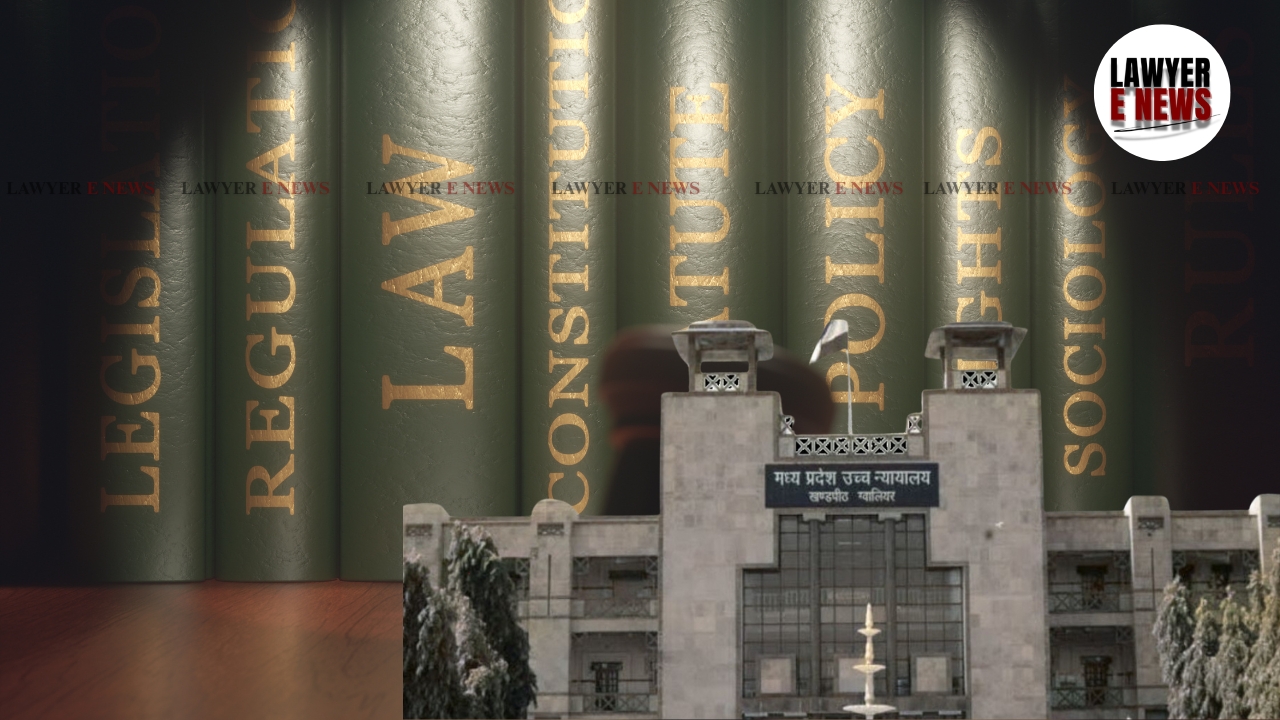
"The mere return of consideration or reversal of transaction does not absolve the commission of forgery or misuse of official position" - Madhya Pradesh High Court, in a detailed and precedent-anchored ruling , refused to quash a criminal FIR registered against a former Mazar manager accused of selling Waqf land on the basis of a forged permission letter. The Bench comprising Justice Vivek Rusia and Justice Binod Kumar Dwivedi held that prima facie allegations of forgery, cheating, and criminal misconduct were made out and warranted investigation and trial.
The Court rejected the plea of good faith and bonafide error, observing that "defences raised by the accused regarding absence of mens rea and cancellation of transaction are not sufficient to wipe out the alleged criminality when forgery and public corruption are involved".
"Section 52A of Waqf Act is No Shield Against IPC and PC Act Prosecution" – Locus of Complainant Upheld in Criminal Fraud on Waqf Property
The primary argument raised by the petitioner, Mr. Shabbir Bhai Palanpurwala, was that the FIR was barred by Section 52A(3) of the Waqf Act, 1995, which requires a complaint by the Waqf Board or an authorised officer to take cognizance. The petitioner, formerly Manager (Mutawalli) of Mazar-e-Najmi Waqf in Ujjain, had executed a sale deed of Waqf property in 2015, allegedly based on a forged permission letter. He later cancelled the sale in 2016 and refunded the consideration to the purchasers, contending the act was committed in bonafide belief.
However, the FIR, registered under Sections 409, 420, 467, 468, 471 & 120B IPC and Sections 13(1)(c), 13(1)(d), and 13(2) of the Prevention of Corruption Act, 1988, alleged deliberate forgery of official documents, misuse of public office, and dishonest misappropriation of Waqf land.
Rejecting the bar under Section 52A of the Waqf Act, the Court held:
“The bar imposed under Section 52A(3) is confined to prosecution for offences under Section 52A itself. It has no application when offences under IPC and the Prevention of Corruption Act are made out.”
Citing the Supreme Court’s landmark ruling in State of NCT of Delhi v. Sanjay, AIR 2015 SC 75, the Court observed:
“When the act of an accused constitutes offences both under a special statute and the Indian Penal Code, prosecution under IPC cannot be barred merely because the special law prescribes a specific procedural condition for offences under that Act.”
“Forgery Alleged on Consent Letter – Expert Report Awaited – Prima Facie Case Cannot Be Stifled”
The FIR was filed after a preliminary inquiry found that the consent letter allegedly issued by the Waqf Board in 2013, forming the basis of the sale, did not bear the signatures of the competent authority, one Akshay Singh, who denied authoring or signing the document. Handwriting samples of the petitioner and others were obtained, and a forensic report was awaited at the time of judgment.
The Court took note of these facts and held:
“The police is investigating the authorship of the forged consent letter. The statement of the then Administrator of Waqf Board clearly denies issuance of such permission. These are not frivolous allegations.”
The Court thus concluded that the FIR disclosed a prima facie case of forgery, which warranted full investigation and prosecution, especially given that the petitioner, as a public servant under Section 101(2) of the Waqf Act, held a fiduciary duty over trust property.
"Forged Document, Not Fraudulent Intent, Is the Offence" – Court Clarifies Scope of Forgery and Cheating
Rejecting the petitioner’s contention that he acted in good faith and did not benefit personally from the transaction, the Court relied on Sheila Sebastian v. R. Jawaharaj, AIR 2018 SC 2434, and Hari Sao v. State of Bihar, AIR 1970 SC 843, but held that such defences were not tenable at the FIR stage.
“The question whether the petitioner had a dishonest intention or not is a matter of trial. At this stage, the FIR contains allegations of forgery of a public document and misuse of position. These cannot be brushed aside merely because the transaction was later reversed.”
The Court underlined that Section 464 IPC, which defines forgery, does not require personal gain or financial enrichment—the act of making a false document with intent to deceive is enough.
"Inherent Powers Under Section 528 BNSS Must Be Used Sparingly" – Court Refuses to Prejudge Criminal Allegations
Reiterating settled jurisprudence from Bhajan Lal, Amit Kapoor, and Supriya Jain, the Court observed:
“Defences like good faith, reversal of transaction, or lack of personal benefit cannot be evaluated at the stage of FIR quashing. If a prima facie case is disclosed, the trial must proceed.”
Citing para 102 of State of Haryana v. Bhajan Lal (1992 Supp (1) SCC 335), the Bench reaffirmed that FIRs should only be quashed where:
Allegations do not disclose any offence,
FIR is manifestly absurd or improbable, or
Proceedings are clearly mala fide.
It held that none of these exceptions applied in the present case. Rather, there was a prima facie allegation of using a forged Waqf Board consent letter to sell trust property, which squarely attracted offences under IPC and the Prevention of Corruption Act.
Petition Dismissed – Alleged Forgery and Criminal Misuse of Trust Property to Be Tried on Merits
Dismissing the petition under Section 528 of the Bharatiya Nagrik Suraksha Sanhita, 2023 (BNSS), the Court held:
“This petition is bereft of merits, fails and is hereby dismissed. However, it is made clear that observations of this court will not debar the applicant from raising appropriate defences at the time of framing of charges.”
The ruling makes it clear that Waqf property, being religious trust property, is subject to strict public oversight, and forgery of consent documents to alienate such property is a serious offence, not mitigated merely by voluntary cancellation or return of money.
The public character of Waqf, the fiduciary role of its managers, and the expectation of utmost good faith require strict judicial scrutiny when allegations of forgery or breach of trust arise.
Date of Decision: 23rd September 2025