-
by sayum
19 August 2026 8:35 AM








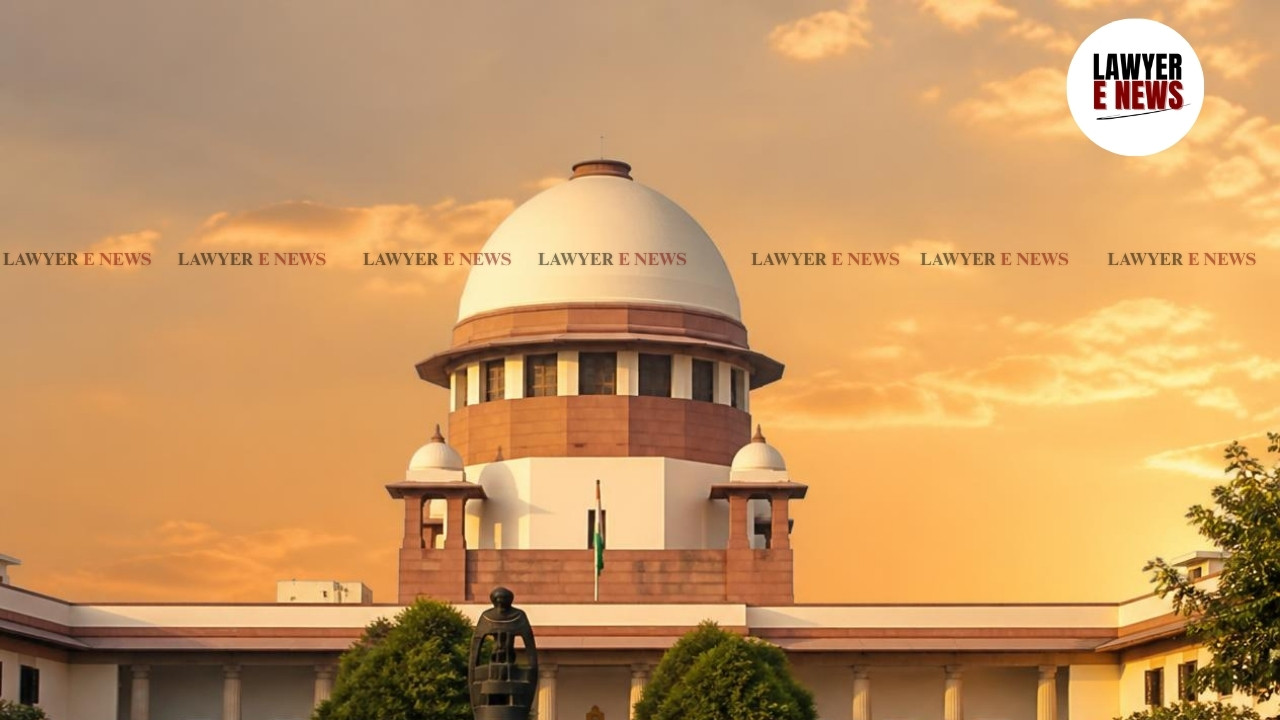
"A transaction which proceeds in violation of the statutory timeline cannot be pressed into service, for divesting the borrowers of their secured assets." Supreme Court of India, in a significant ruling, held that an auction sale under the SARFAESI Act remains "inchoate" and cannot extinguish a borrower's right of redemption if the successful bidder deposits the balance 75% sale consideration beyond the mandatory statutory timeline.
A bench of Justice Dipankar Datta and Justice Satish Chandra Sharma observed that the "raison d'être of proceedings under the SARFAESI Act is not the mechanical completion of a sale, but the lawful realisation of the secured asset."
The dispute arose when the Central Bank of India initiated SARFAESI proceedings against the borrower firm for defaulting on a Rs. 4 crore loan, leading to an e-auction in September 2020. Though the auction purchasers paid the initial 25% bid amount, the confirmation of sale and payment of the balance 75% were stalled for 15 months due to successive interim stay orders by the DRT, DRAT, and High Court. The High Court eventually set aside the sale and allowed the borrowers to redeem the property since they had discharged the entire debt during the pendency of the proceedings, prompting the auction purchasers and the bank to appeal.
The primary question before the court was whether an auction sale under the SARFAESI Act, once confirmed and followed by the registration of a sale certificate, can be annulled in writ jurisdiction. The court was also called upon to determine whether the borrower's right of redemption survives the issuance of a sale certificate when the statutory timelines for the auction deposit were breached.
Strict Adherence To Statutory Timelines
The court scrutinised Rule 9(4) of the Security Interest (Enforcement) Rules, 2002, which mandates that the balance 75% purchase price must be paid within 15 days of confirmation, extendable up to a maximum of three months. The bench noted that the auction purchasers deposited the balance amount roughly 15 months after the auction, far exceeding the statutory outer limit prescribed by the legislature.
Judicial Delays Cannot Defeat Redemption Right
The bench observed that the delay in completing the sale was primarily due to judicial interventions and procedural restraints, not any default by the borrowers. Because the statutory timeline was breached, the sale did not attain legal finality and remained legally incomplete. The court held that such a flawed process cannot irreversibly divest a borrower of their constitutional right to property under Article 300-A of the Constitution of India.
"The failure to receive the balance sale consideration or the delay in deposit of the balance sale consideration, whatever one would like to call it, therefore, inures to the benefit of the borrowers and operates against the finality of the sale."
Bafna Motors Judgment Distinguished
The appellants heavily relied on the Supreme Court's prior ruling in Celir LLP v. Bafna Motors Pvt. Ltd., arguing that a borrower's right to redeem ends upon the publication of the auction notice. However, the bench distinguished Bafna Motors, noting that in that precedent, the sale had attained absolute statutory finality and the entire consideration was deposited strictly within the prescribed timeframe without any judicial interdiction.
"If the process suffers from material irregularities or fails to conform to mandatory requirements, thereby rendering the sale inchoate, the Court would be justified in intervening..."
Survival Of Right To Redemption
Relying on the landmark judgment in Mathew Varghese v. M. Amritha Kumar, the court emphasized that a sale that remains inchoate due to non-compliance with mandatory timelines cannot defeat the equity of redemption. The bench highlighted that the borrowers had been prosecuting their statutory remedies bona fide and had deposited the entire outstanding dues of over Rs. 3.89 crore under judicial supervision.
Disproportionate Deprivation Of Property
The court expressed disapproval of the secured creditor's refusal to return the title deeds despite the borrowers remitting the entirety of the debt along with interest. The bench noted that proceeding with the auction transfer when the debt is fully discharged would result in a highly disproportionate consequence for the borrower, running contrary to the core object of the SARFAESI Act, which is debt recovery, not property deprivation.
Condonation Of Erroneous Statement
The bench also addressed a preliminary objection regarding a misrepresentation made by the borrowers' counsel before the High Court, where it was incorrectly stated that the sale certificate had not been registered. The Supreme Court upheld the High Court's discretion to condone this error, noting that the borrowers filed a prompt corrective affidavit owning responsibility and derived no unfair advantage from the momentary mistake.
Dismissing the appeals, the Supreme Court upheld the High Court's decision to set aside the auction sale and the registered sale certificates. The secured creditor was directed to release the secured assets and return the title deeds to the borrowers, while the auction purchasers were held entitled to a full refund of their sale consideration along with 12% annual interest.
Date of Decision: 01 April 2026