-
by sayum
04 August 2026 1:39 PM







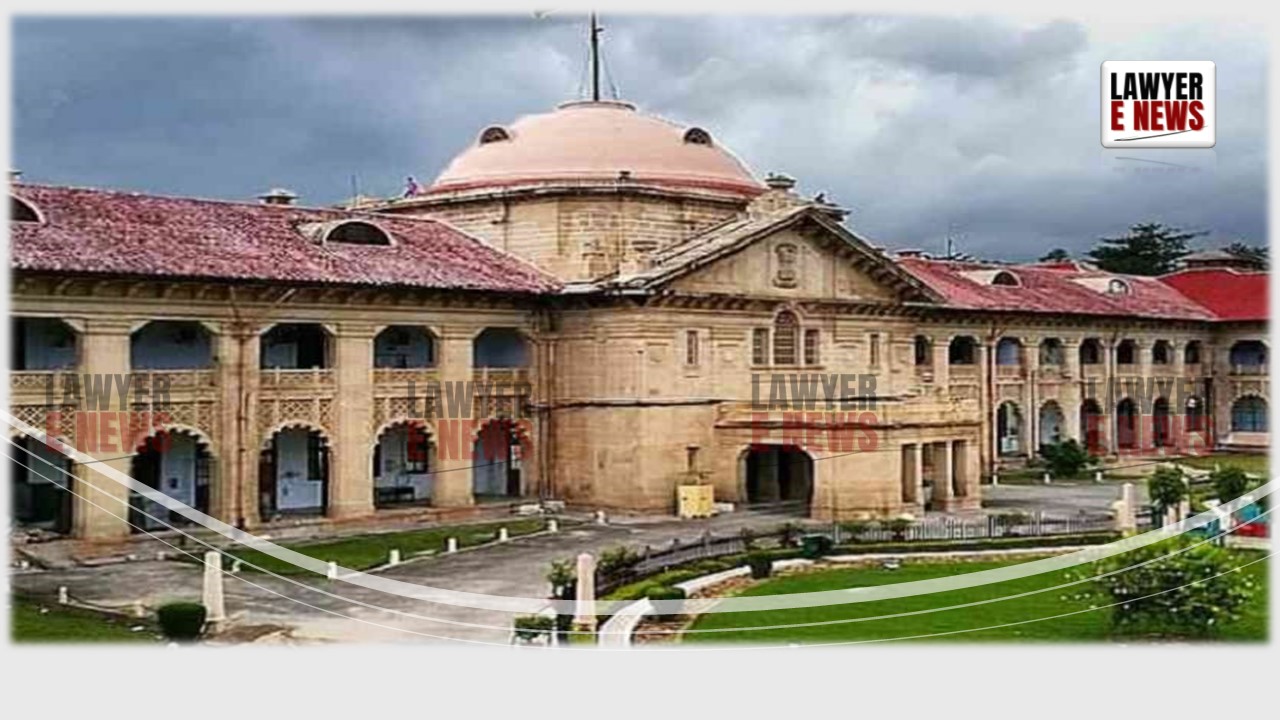
“Certified Standing Orders Are Binding; Clause 19(ii) Operates Automatically — Natural Justice Satisfied Through Show-Cause Notices”, - Allahabad High Court, in a significant service jurisprudence ruling, dismissed a writ petition filed by a clerk-cum-typist of Hindustan Aeronautics Limited (HAL), upholding his termination from service effected under Clause 19(ii) of the Certified Standing Orders. The Court ruled that "continued unauthorized absence beyond 10 days and failure to return or explain justifiably is sufficient to deem a workman as having lost his lien — disciplinary enquiry is not a prerequisite."
In Writ A No. 3653 of 2001, titled Rajendra Prasad Tripathi v. Hindustan Aeronautics Limited, Justice Brij Raj Singh held that the management was within its rights to invoke Clause 19(ii), and emphasized that certified standing orders have statutory force and displace equitable principles of abandonment.
The petitioner, Rajendra Prasad Tripathi, was appointed on 6 July 1982 as a clerk-cum-typist in HAL and confirmed in service on 26 May 1983. According to his version, he fell ill in October 1990 and dispatched multiple letters seeking leave, purportedly sent via Under Postal Certificate (UPC) — however, none were acknowledged by the respondent. Despite sending a fitness certificate dated 4 February 2000, the petitioner never rejoined duty and ultimately filed a writ petition in July 2001, more than ten years after his termination dated 26/28 February 1991.
The termination was effected under Clause 19(ii) of HAL's Standing Orders on the grounds of unauthorized absence exceeding 10 days.
Invocation of Clause 19(ii): Whether Lawful Without Full Disciplinary Enquiry?
The petitioner contended that as a permanent workman, disciplinary procedure under Clause 26 and 27 ought to have been followed, and that Clause 19(ii) was inapplicable.
The Court rejected this argument, clarifying that: “Clause 19(ii) does not carve out an exception for permanent workmen. The petitioner is classified as a workman under Clause 3, and Clause 19(ii) is applicable to all such categories.” [Para 10]
It was noted that HAL had a choice between initiating formal disciplinary proceedings or invoking Clause 19(ii). Relying on National Engineering Industries Ltd. v. Hanuman, the Court observed: “The employer is free to resort to either disciplinary enquiry under Clauses 26/27 or invoke Clause 19(ii) if the circumstances so permit. In this case, the employer exercised a lawful option.” [Para 15]
Termination or Abandonment? The Legal Character of Cessation
A pivotal observation of the Court was the distinction between ‘termination’ and ‘abandonment’. It held: “This is not a case of punitive termination; it is a case of automatic cessation of service due to abandonment. The absence was wilful, continuous, and unexplained.” [Para 17]
The Court referred to Bharat Heavy Electricals Ltd. v. Labour Court, noting: “In cases of abandonment, it is the employee's will that operates, not the employer’s. Such cases do not constitute ‘retrenchment’ and thus fall outside Section 2(oo) of the Industrial Disputes Act.” [Para 17]
Compliance with Natural Justice: Is Show-Cause Sufficient?
The petitioner argued that no formal enquiry was conducted. The Court acknowledged that even where Clause 19(ii) applies, principles of natural justice are implicit: “Even under Clause 19(ii), the employee must be given an opportunity to explain. That was satisfied in this case — several show-cause notices were served.” [Para 20]
Referring to Hindustan Paper Corporation Ltd. v. Purnendu Chakraborty, the Court affirmed: “A literal reading of the clause must yield to the requirement of fairness. Opportunity to respond must be provided. HAL complied with this by issuing repeated communications.” [Para 18]
The Court detailed that notices were sent via telegram on 25 October 1990, and registered letters on 3 November, 21 November, and 1 December 1990, all prior to final action.
Reliability of Evidence: UPCs Are Not Proof of Dispatch
The petitioner relied on Under Postal Certificates (UPC) to claim he had communicated his leave requests and medical documents. The Court, however, rejected this, holding: “The Under Postal Certificates are waste papers in law. They do not establish dispatch, receipt, or delivery.” [Para 21]
It cited Shiv Kumar v. State of Haryana, where the Supreme Court had cautioned: “It is not difficult to get such postal seals at any time. Unless delivery is proved, UPCs have no evidentiary value.” [Para 22]
Delay and Laches: 10-Year Delay Without Explanation Fatal
The Court was particularly critical of the delay, noting that: “The termination occurred in February 1991; the writ was filed only in July 2001 — a delay of more than ten years.” [Para 23]
Referring to Scooters India Ltd. v. Vijai E.V. Eldred, the Court held: “Writs concerning industrial disputes, especially those filed after long delays without plausible cause, must be dismissed on laches alone.”
Accordingly, the writ was held to be barred by delay independently of the merits.
Dismissing the petition, the Allahabad High Court held that:“The impugned termination order was lawfully passed after complying with procedural requirements under Clause 19(ii). No full disciplinary enquiry was required, and the writ is also barred by laches. No interference is warranted.” [Para 24]
The judgment reinforces that Certified Standing Orders have the force of law, and where they prescribe specific remedies, general principles of equity or common law are displaced. It also underlines that abandonment of service is a factual scenario and need not be punished through a formal enquiry — especially when the employee has willfully absented and failed to respond despite notice.
Date of Decision: 23rd May, 2025