-
by sayum
27 August 2026 5:16 AM







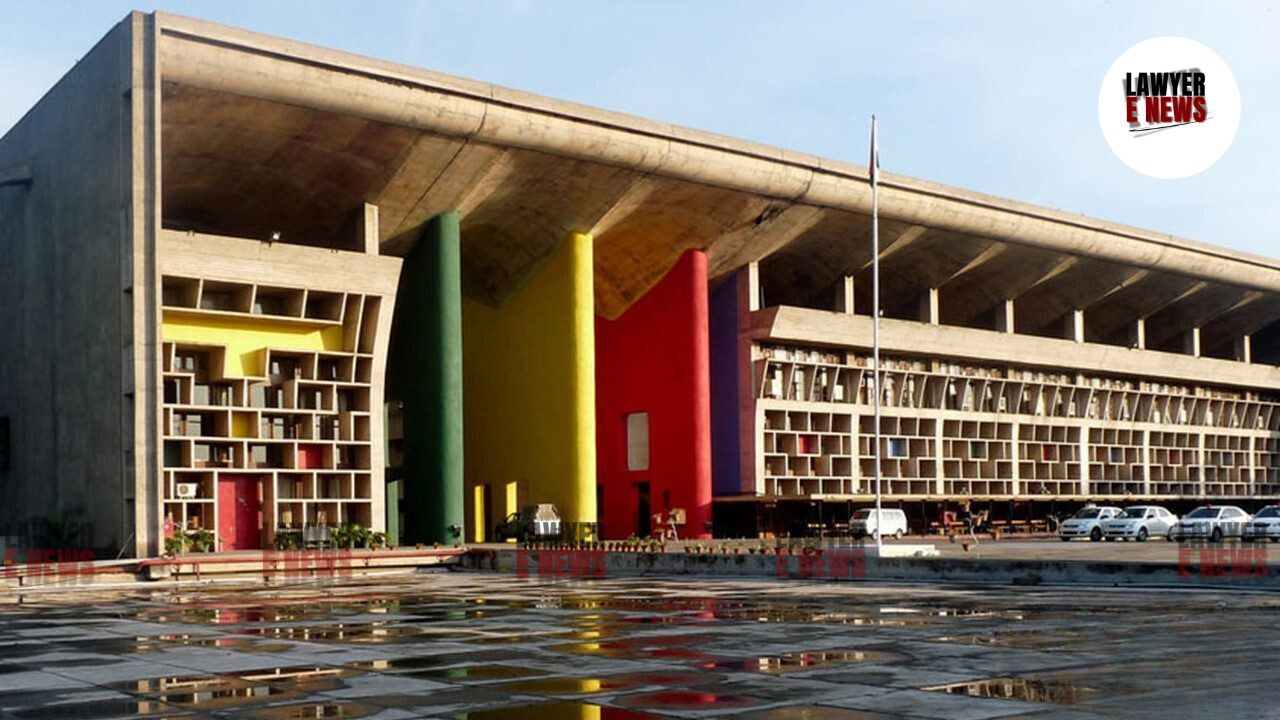
“A Smooth Signature From Trembling Hands And A Pre-Signed Blank Page — Such A Will Cannot Inspire Judicial Confidence,” - Punjab and Haryana High Court at Chandigarh, through Hon’ble Mr. Justice Virinder Aggarwal, delivered a reportable judgment, upholding concurrent findings of the courts below that declared the Will of Late Sh. Satpal Chopra invalid. The appeal, filed under Section 41 of the Punjab Courts Act, 1918, was dismissed with categorical affirmation that when a Will is engulfed in suspicious circumstances, the burden rests heavily upon the propounder to dispel every trace of suspicion.
Justice Aggarwal began by noting that the appellants had challenged the concurrent decrees of the learned Additional Civil Judge (Senior Division), Faridkot, and the learned Additional District Judge, Faridkot. Both courts had found the Will to be forged and invalid while confirming the respondents’ 1/5th ownership share in the inheritance of Late Sh. Satpal Chopra. The High Court, after a detailed scrutiny of the evidence, found no legal infirmity or perversity warranting interference.
“Under Section 41 Of Punjab Courts Act, No Substantial Question Of Law Needs Framing”
Clarifying the legal position, the Court observed that unlike second appeals under Section 100 of the Code of Civil Procedure, appeals before the Punjab and Haryana High Court are governed by Section 41 of the Punjab Courts Act, 1918. In such cases, there is no statutory requirement of framing substantial questions of law. Citing the Supreme Court’s judgments in Pankajakshi (Dead) through LRs v. Chandrika (2016) 6 SCC 157, Kirodi v. Ram Parkash (2019) 11 SCC 317, and Satender v. Saroj (2022) 12 Scale 92, the Court reaffirmed: “It is now well settled that in Punjab and Haryana, second appeals are to be treated as appeals under Section 41 of the Punjab Courts Act, and therefore, no question of law is required to be framed. The High Court can examine both law and fact if the findings below are shown to be perverse or unsupported by evidence.”
“A Will Written On Pre-Signed Blank Paper With Unnatural Signatures Is A Document Of Doubt”
In the heart of the ruling, the Court turned to the central controversy — the alleged Will executed by Late Sh. Satpal Chopra in favour of the appellants. The appellants claimed that the Will had been duly proved by the attesting witnesses in compliance with Section 63 of the Indian Succession Act, 1925 and Section 68 of the Indian Evidence Act, 1872. However, the Court emphasized that formal proof is not enough where circumstances raise legitimate doubts.
“Undoubtedly, the Will has been formally proved through the examination of its attesting witnesses,” observed the Bench. “Nevertheless, it is a well-settled principle that where a Will is engulfed by suspicious circumstances, the onus lies on the propounder to dispel such doubts. Its validity must satisfy the stringent test of judicial conscience.”
A meticulous examination of the Will revealed glaring inconsistencies. Justice Aggarwal recorded that the document was written on a pre-signed blank paper, leaving nearly half of the left margin vacant. The handwriting, the Court noted, began diminutive and compressed, gradually enlarging and spreading toward the end. Significantly, though the scribe and witnesses admitted that Late Sh. Satpal Chopra suffered from trembling hands, the Will contained a “signature in unnaturally smooth and continuous flow.” These discrepancies, the Court remarked, were “not merely technical but go to the root of authenticity.”
“The Propounder Failed To Remove The Cloud Of Suspicion — Courts Below Acted Correctly”
The High Court held that both the Trial Court and the First Appellate Court had meticulously appreciated the oral and documentary evidence, arriving at consistent conclusions. “The concurrent findings are well-reasoned, supported by evidence, and free from perversity,” observed Justice Aggarwal, adding that “the propounders of the Will have manifestly failed to dispel the suspicious circumstances surrounding the execution of the document.”
Referring to the First Appellate Court’s analysis, the High Court endorsed its conclusion that the Will was tainted by material anomalies, rendering it legally untenable. The Bench stated: “The unnatural smoothness of the signature, the inconsistent handwriting, and the use of a pre-signed blank page cumulatively demonstrate that the Will was not executed in the normal course of free will. It fails the test of authenticity and cannot be given legal recognition.”
“A Will Must Speak With The Voice Of The Testator, Not With The Pen Of Convenience”
Emphasizing the sanctity of testamentary documents, the Court noted that the law attaches solemnity to a Will because it represents the final expression of a person’s volition. “But when that document betrays signs of fabrication, inconsistency, or manipulation,” the Court said, “it ceases to speak with the voice of the testator and begins to echo the designs of those who stand to benefit.” In such a case, the Court added, judicial conscience cannot permit enforcement.
Consequently, the appeal was dismissed, affirming the declaration that the Will of Late Sh. Satpal Chopra was invalid and that the respondents were entitled to their one-fifth share in the inheritance. The Court also disposed of all pending miscellaneous applications connected with the main case.
The judgment serves as a clear reaffirmation of the principle that “suspicion, however slight, if not completely dispelled, is fatal to the proof of a Will.” It underscores the responsibility of the propounder to establish not just formal compliance but the genuineness of intention, the soundness of mind, and the authenticity of execution.
Date of Decision: 8 October 2025