-
by sayum
28 August 2026 12:24 PM







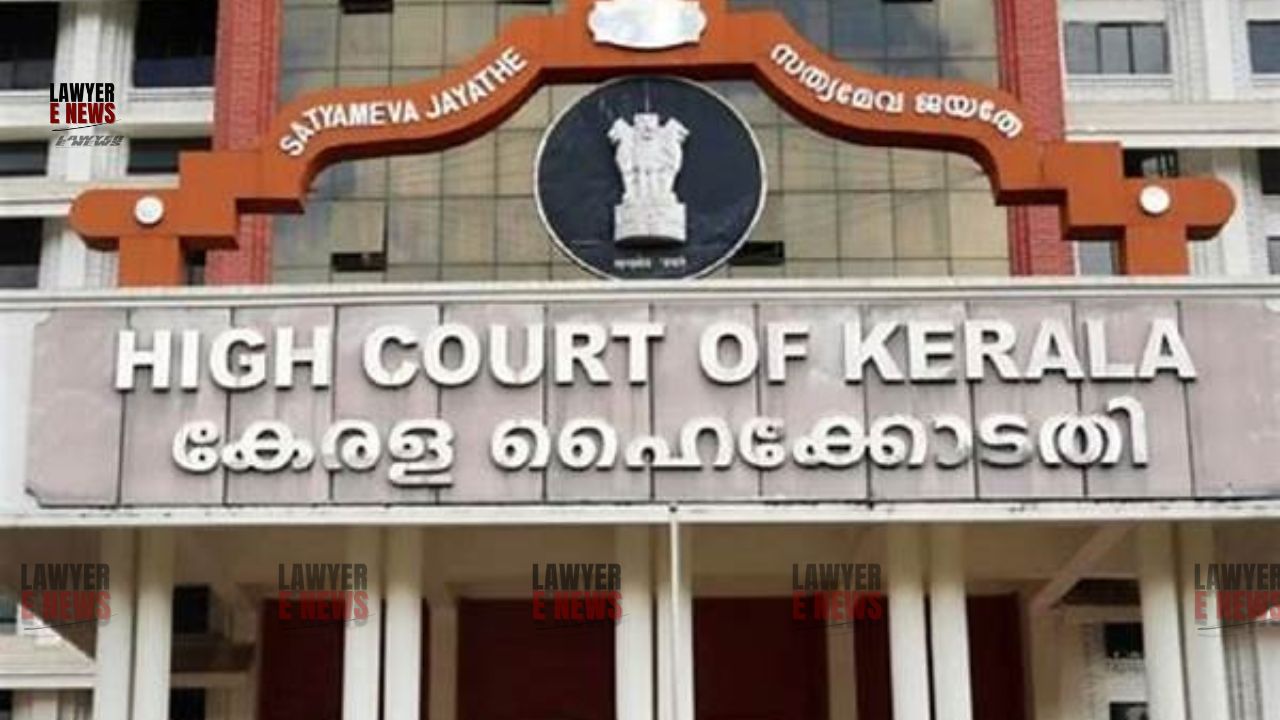
“Performance Appraisals Are Not to Be Interfered With Unless Perversity Is Writ Large on the Face of Record” – Kerala High Court, in a batch of petitions filed by retired Assistant Salt Commissioner P. Venu, delivered a decisive ruling clarifying the limits of judicial interference in adverse Annual Confidential Reports (ACRs) and Annual Performance Appraisal Reports (APARs). The Court, in P. Venu v. Union of India & Ors., dismissed six original petitions challenging adverse service entries spanning over a decade, upholding the Central Administrative Tribunal's finding that the entries were based on objective considerations. “The expression ‘best judgment’ does not authorize a government servant to question or defy lawful directions of superior officers,” the Bench observed, rejecting the petitioner’s claim that his criticism of departmental policy was justified conduct under Rule 3(2)(ii) of the Central Civil Services (Conduct) Rules, 1964.
The petitioner, P. Venu, joined the Indian Salt Service in 1984 and was promoted to the post of Assistant Salt Commissioner in 1999 with retrospective effect. Throughout his tenure, he faced multiple adverse service remarks between 2003 and 2012, which he sought to have expunged. These included allegations such as “refusal to follow rules,” “committing financial irregularities,” and “habit of questioning superior authority.”
After his representations to the competent authority were rejected, he approached the Central Administrative Tribunal (CAT) through six original applications which were later dismissed. Venu then filed writ petitions before the Kerala High Court challenging the CAT’s refusal to interfere.
“Best Judgment” Cannot Mean Sitting in Judgment Over Superiors' Directions
The petitioner placed strong reliance on Rule 3(2)(ii) of the CCS (Conduct) Rules, 1964, which states that a government servant shall, in the exercise of his official duties, act in his “best judgment,” unless under specific direction from superiors. Venu contended that he had acted in good faith and in the State’s interest, even when disagreeing with his superiors, and that such conduct could not justifiably form the basis for adverse entries.
Rejecting this interpretation, the Court observed: “The expression ‘best judgment’ requires a government servant to act judiciously, and not to sit in judgment or become judgmental over the directions issued by his official superiors.”
The High Court found no fault in the Tribunal’s view that the petitioner’s conduct amounted not to lawful independence, but insubordination. The Court concluded that “merely questioning the legality of superior officers’ orders is not a shield against adverse entries when such conduct disrupts administrative discipline.”
“Adverse Remarks Cannot Be Reassessed on Appeal by Writ Court”: Judicial Review of APAR Entries is Narrow
Another core contention was that the entries were biased, disproportionate, and did not consider the petitioner’s long-standing service. The Court, however, took note of the Supreme Court’s ruling in State of Haryana v. Ashok Khemka, AIR 2024 SC 1397, and reiterated:
“The grading and assessment of an officer require a comprehensive understanding of various facets such as personality traits, professional parameters, competency, and ability to execute projects.”
The High Court stressed that judicial review over service entries is not appellate in nature. It is restricted to procedural irregularities, patent arbitrariness, or perversity. The Court categorically held:
“Unless there is clear perversity on the face of it or complete non-consideration of the representations, the Tribunal would generally not interfere with or quash and set aside the adverse remarks.”
“Critical Assessment Is Not Malice”: Adverse Remarks Were Based on Record and Justified
The adverse remarks in ACRs and APARs were not vague or whimsical. They contained pointed observations. For example, for the year 2003–2004, the remarks stated:
“Shri Venu does not want to work to achieve targets. He wastes his time and energy in criticising policy/functions of the department, which does not suit to his whim and fancies... He is in the habit of questioning the authority of his superior officers, violating rules and regulations.”
The Competent Authority, upon representations, even went on to modify or expunge some comments—for instance, the phrase “which does not suit his whims and fancies” was removed. But others, such as his “habitual defiance of superiors,” were retained.
The Court found that this showed the authority had not acted mechanically: “These instances will show that the approach adopted by the Authority in deciding the representations was not mechanical. For each and every remark, the Competent Authority examined the records, considered the explanation of the Petitioner, expunged certain remarks, and retained the others.”
“Retirement Does Not Wash Away Administrative Record”: Post-Retirement Challenge Declared Academic
The Court further noted that all of Venu’s petitions were filed after his retirement in June 2013. No consequential relief such as promotion, pensionary benefits, or re-employment was claimed. Hence, the Court observed:
“The issue involved in these petitions has become academic and the reliefs sought for are inconsequential because the original applications were filed by the Petitioner after his retirement.”
The High Court clarified that such litigation cannot serve to retrospectively rewrite or cleanse the service record of a retired officer without compelling legal basis.
The Kerala High Court, through this meticulous verdict, has reaffirmed the delicate balance between bureaucratic discipline and the rights of civil servants. The judgment firmly holds that adverse remarks in service records—when reasoned and supported by documentation—will not be lightly set aside. A public servant’s dissent from policy decisions, especially when it manifests as defiance, is not protected under the guise of “best judgment.”
The Court placed its full trust in the institutional framework of APARs, warning that Courts cannot function as parallel review authorities for every disgruntled employee.
“We find no reason to take a different view. The representations of the Petitioner were duly considered by the Competent Authority and disposed of by reasoned orders.”
Date of Decision: 11 September 2025