-
by sayum
19 August 2026 10:42 AM







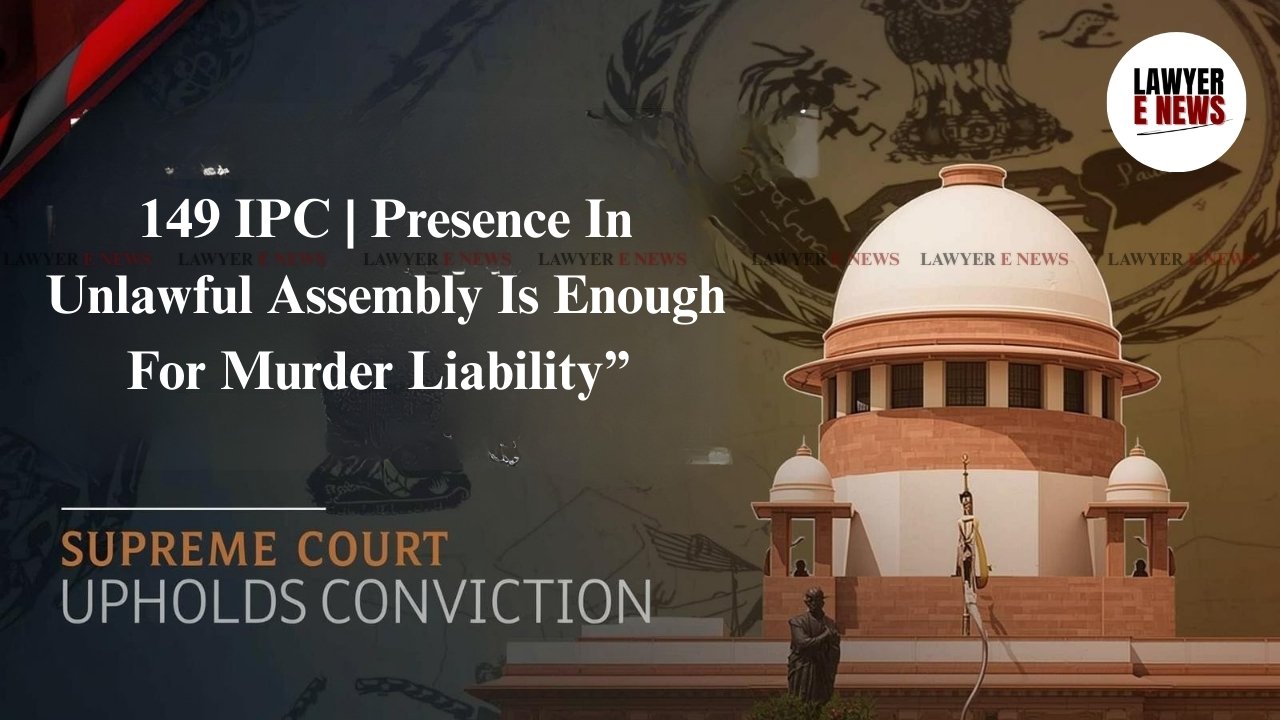
“When Accused Arrive Armed And Act With A Common Object, Each Member Becomes Vicariously Liable”, Supreme Court of India has reiterated that every member of an unlawful assembly becomes vicariously liable for the offence committed in pursuit of its common object, even if no specific overt act is attributed to each accused individually.
On 11 March 2026, a Bench of Justice Pankaj Mithal and Justice S.V.N. Bhatti dismissed criminal appeals filed by four convicts and upheld their conviction and life sentence under Sections 148 and 302 read with Section 149 of the Indian Penal Code.
The Court held that where accused persons jointly arrive armed with firearms, chase the victim and participate in the attack, the requirements of unlawful assembly and common object under Section 149 IPC stand clearly established.
The Bench observed:
“The presence of the accused persons in the unlawful assembly to achieve a common object makes all of them vicariously liable for the acts of the unlawful assembly.”
Background of the Case
The case concerned the murder of Balkishan, who was serving as the Chairman of the Watershed Committee.
On 3 June 2000 at about 8:15 a.m., Balkishan was waiting at Tihuli bus stand to attend a committee meeting. At that time, six accused persons allegedly arrived at the bus stand in a bus, armed with firearms including a mouser, 12-bore guns and country-made pistols.
According to the prosecution, the main accused Vikram fired the first shot, which hit the deceased on his arm. Balkishan attempted to escape and ran towards the village, but the accused chased him while continuously firing.
The deceased entered the house of Rattan Lal, but the accused followed him inside, dragged him to the courtyard and shot him at point-blank range at the temple, causing instantaneous death.
An FIR was lodged the same day by Budha Ram, the brother of the deceased, naming all six accused.
Conviction by Trial Court and High Court
After investigation, chargesheets were filed against five accused persons while the main accused Vikram remained absconding.
The Trial Court convicted the accused under Sections 148 and 302 read with Section 149 IPC, sentencing them to life imprisonment, while acquitting them of charges under the Scheduled Castes and Scheduled Tribes (Prevention of Atrocities) Act, 1989.
The conviction and sentence were subsequently affirmed by the Madhya Pradesh High Court, prompting the accused to approach the Supreme Court.
Supreme Court On Common Object And Section 149 IPC
Rejecting the arguments of the appellants, the Supreme Court held that the evidence clearly showed that all the accused had arrived together armed with firearms and chased the deceased, demonstrating the existence of a common object.
The Court explained that the essential requirements for invoking Section 149 IPC are the existence of an unlawful assembly and the presence of a common object.
Once these elements are established, individual overt acts need not be proved against each accused.
The Court observed:
“The presence of the accused persons as part of the unlawful assembly is sufficient for conviction even if no overt act is imputed to each one of them individually.”
The Bench noted that the accused alighted from the bus together carrying firearms, which strongly indicated that they had assembled with a common object.
Testimony of Related Witnesses Found Reliable
Addressing the argument that the prosecution witnesses were relatives of the deceased, the Court held that evidence of related witnesses cannot be rejected solely on the ground of relationship.
The Court noted that the testimonies of the deceased’s relatives were consistent and corroborated by other evidence, including medical and forensic material.
Even though the witnesses did not intervene to save the deceased — behaviour the Court described as “unnatural” — it held that such conduct does not undermine otherwise credible testimony.
Medical and Forensic Evidence Corroborated Prosecution Case
The Court relied heavily on the post-mortem findings, which showed multiple firearm injuries on the deceased, including entry and exit wounds and recovery of approximately 40 pellets from the body.
Ballistic reports and the recovery of empty cartridges from the courtyard where the deceased was shot further supported the prosecution version that the attack involved firearm shots.
Procedural Lapses Not Fatal
The defence also raised objections regarding alleged procedural irregularities in the investigation, particularly non-compliance with Section 157 CrPC.
However, the Supreme Court held that such procedural lapses do not automatically invalidate the prosecution case, especially when the overall evidence convincingly establishes the guilt of the accused.
The Court noted that the alleged lapse had not been properly proved during trial.
Conviction Upheld
After analysing the evidence, the Supreme Court concluded that both the Trial Court and the High Court had correctly appreciated the material on record.
Finding no legal infirmity in the judgments of the courts below, the Supreme Court dismissed the appeals and affirmed the conviction and life sentence imposed on the appellants.
Since the accused were on bail during the pendency of the appeals, the Court directed them to surrender forthwith to undergo the remaining sentence.
The judgment reiterates the settled principle that participation in an unlawful assembly with a shared objective can attract vicarious liability for murder under Section 149 IPC, even in the absence of specific overt acts by each accused.
By affirming the convictions, the Supreme Court emphasized that collective criminal liability arises when individuals act together with a common object to commit a serious offence such as murder.
Date of Decision: 11 March 2026