-
by sayum
27 August 2026 3:32 PM







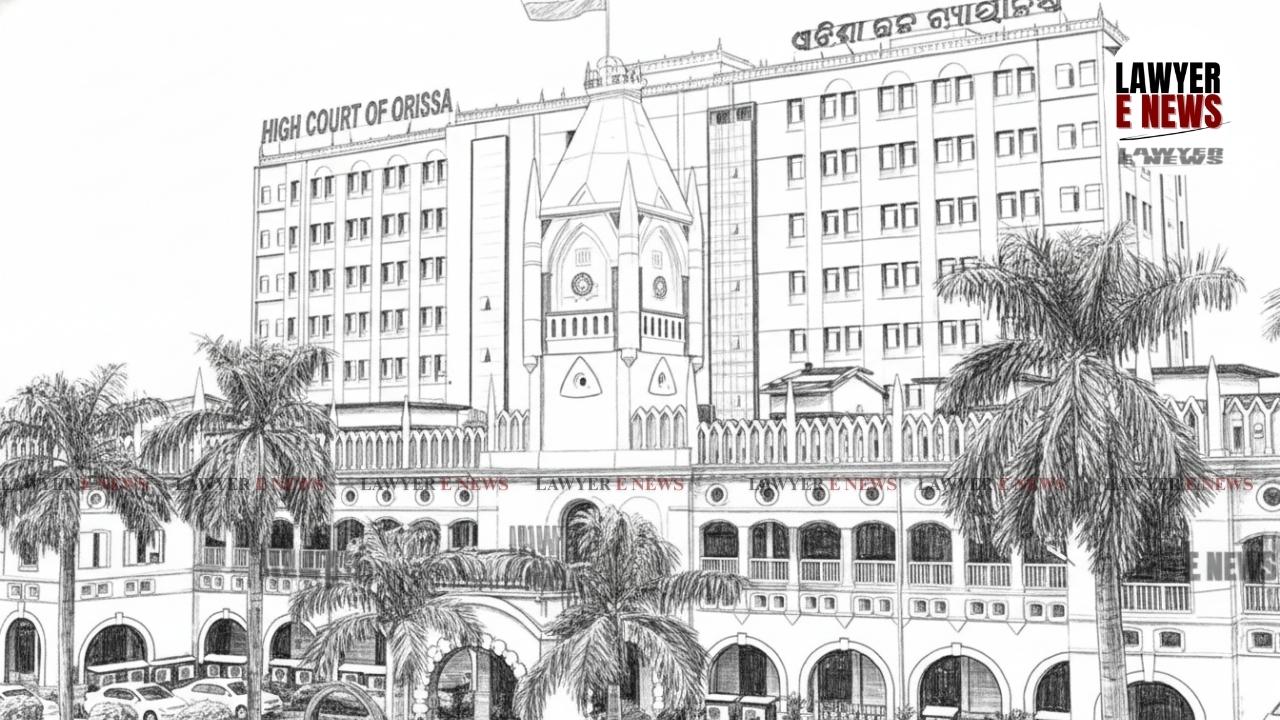
"Even if it is to be accepted for a moment that she belongs to a rich family, she cannot be left to the charity of her relation," Orissa High Court, in a significant ruling dated May 7, 2026, has clarified that the mere possession of high educational qualifications by a wife does not disentitle her from claiming maintenance if it is not proven that she is currently employed.
A Single Judge Bench of Justice Savitri Ratho observed that while a spouse may be qualified to work, the absence of a steady income necessitates financial support from the husband to prevent her from being left to the "charity of her relations."
The matter arose from a challenge to an order passed by the Family Court, Balasore, which had directed the petitioner-husband to pay monthly interim maintenance of Rs. 20,000 to his wife and Rs. 10,000 to his minor son. The husband moved the High Court seeking to set aside this order, contending that his wife was highly educated and capable of self-sustenance. He further alleged that she had been selected for a government teaching position, rendering the maintenance order unjust.
The primary question before the Court was whether a wife’s high educational qualifications and potential for employment are sufficient grounds to deny her interim maintenance under Section 125 of the CrPC. The Court was also called upon to determine if a husband’s non-disclosure of his gross salary justifies a higher maintenance award and how the status of a divorced wife affects her claim.
Husband Claims Highly Qualified Wife Disentitled To Maintenance
The petitioner-husband argued that since the wife holds M.A. and B.Ed. degrees and her name appeared in a provisional merit list for the post of 'Sikhya Sahayaka', she should not be entitled to maintenance. Relying on judicial precedents, the husband’s counsel submitted that a lady who is qualified to secure a job should not be a burden on the husband, especially while the main proceedings under Section 125 CrPC are still pending.
Court Rejects Argument Based On Potential Earning Capacity Without Proof Of Job
The Court noted that while the wife was indeed highly educated, the husband failed to produce any "prima facie document" to prove her current employment status or that she was actually drawing a salary. The Bench emphasized that for the purpose of an interim petition, the Court must look at the current financial reality of the parties.
"The said claim of the opposite party cannot be taken into consideration. Therefore, for the purpose of the present interim petition, it is to be held that the petitioner No. 1 has no source of income," the Court observed while echoing the reasoning of the lower court.
Divorced Wife Entitled To Maintenance Under Section 125 CrPC
The Court addressed the husband's contention regarding an ex-parte decree of divorce obtained in Chennai, which he claimed ended her right to maintenance. The Bench reiterated the settled legal position that under Section 125(1) explanation (b) of the CrPC, a "wife" includes a woman who has been divorced and has not remarried.
"Since there is no material to show that, after passing of said ex-parte order of divorce the petitioner has remarried, she being a divorced wife is entitled for maintenance," the Bench noted.
Husband Criticized For Suppressing Gross Salary Details
During the proceedings, it was revealed that the husband, who claimed a net salary of Rs. 1.27 Lakhs per month, had not disclosed his gross salary or provided relevant documentation. The Court viewed this as an attempt to suppress his actual income. Furthermore, the Court dismissed the husband's argument regarding personal loans, noting that voluntary hand loans cannot be treated as compulsory deductions from salary when calculating maintenance.
"The opposite party has not stated anything about his gross salary and not produced any document... thereby, he made attempt to suppress his exact income," the judgment highlighted.
Modification of Maintenance Quantum and Final Directions
While upholding the wife’s right to maintenance, the High Court modified the quantum in the interest of justice. It directed the petitioner to pay Rs. 15,000 to the wife and Rs. 10,000 to the son (including educational expenses) from the date of the original application. The Court also ordered the payment of Rs. 10,000 as litigation expenses and mandated that the arrear maintenance be cleared in six monthly instalments.
Trial Court Directed To Fast-Track Proceedings
Taking note of the fact that the case had been pending since 2022 without evidence being recorded, the High Court requested the Family Court, Balasore, to dispose of the main application within six months. The Bench urged both parties to cooperate for an early disposal to ensure finality in the matrimonial dispute.
The High Court concluded that educational degrees do not equate to actual income and the husband remains duty-bound to maintain his wife and child in the absence of evidence of their self-sufficiency. By modifying the interim amount and setting a timeline for the trial, the Court balanced the immediate financial needs of the wife with the procedural rights of the husband.
Date of Decision: 07 May 2026