-
by sayum
27 August 2026 3:32 PM







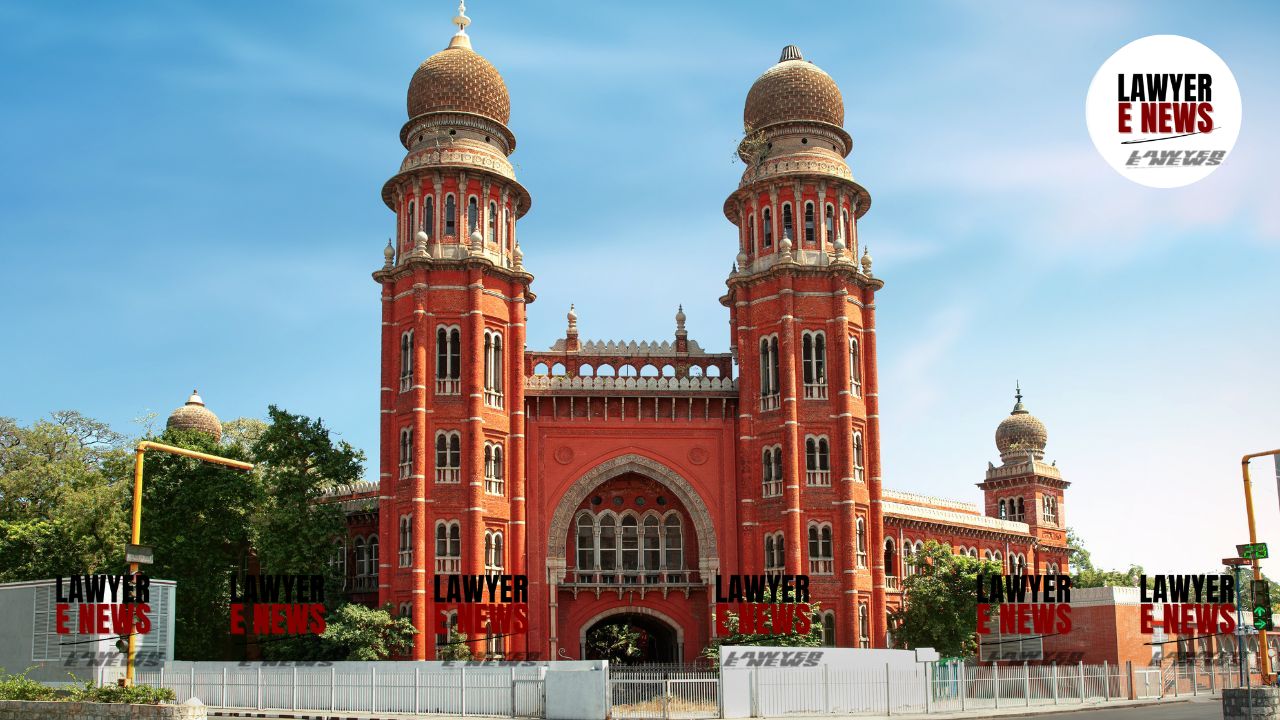
"Any collective attempt by advocates or office bearers of a Bar Association to overbear a Presiding Officer, to insist upon a particular judicial order, or to interrupt the course of a hearing in a manner unbecoming of officers of the Court, cannot be treated as protected professional conduct", Madras High Court
The Madurai Bench of the Madras High Court, in a significant ruling dated April 30, 2026, held that the statutory expression "before the rising of the Court" under Section 384 of the BNSS refers to the actual adjournment of judicial proceedings and not the conclusion of regular office hours.
Justice L. Victoria Gowri, while dismissing a batch of petitions filed by advocates seeking to quash show-cause notices issued by a Judicial Magistrate, observed that institutional integrity is preserved through the unwavering commitment of judicial officers to uphold the dignity of the court even under collective pressure from the Bar.
The case arose from an incident on January 20, 2026, where a group of advocates, including office bearers of the Madurai Bar Association, allegedly interrupted remand proceedings before the Judicial Magistrate No. V, Madurai. The advocates were protesting the remand of an accused, claiming a High Court interim order restrained his arrest, though the said order had not been marked to the Magistrate. Consequently, the Magistrate took cognizance of the disruption under Section 384 BNSS for an offence under Section 267 BNS and issued show-cause notices to the petitioners.
The primary question before the court was whether the impugned proceedings under Section 384 BNSS were without jurisdiction on the ground that cognizance was allegedly not taken before the rising of the Court on the same day. The court was also called upon to determine whether the summary proceedings were vitiated by predetermination and whether advocates have an absolute right to be represented by counsel in proceedings of this character.
Court Explains Interpretation Of "Before Rising Of The Court"
The Court found substantial force in the respondent’s contention that a Court is not a time-clock institution governed solely by the outer boundary of office hours. It noted that judicial work frequently extends beyond scheduled hours, especially in remand matters and urgent applications. The bench emphasized that the legislature consciously used the expression associated with the actual sitting and adjournment of the Court, rather than clerical timings.
"Rising Of Court" Refers To Actual Adjournment Not Clerical Hours
The Court observed that since the Magistrate asserted the Court rose only around 7:30 p.m. and that cognizance was taken in open Court before rising, the proceedings could not be declared void ab initio. The bench noted that the administrative act of assigning a case number on the subsequent day does not vitiate the judicial act of taking cognizance which had already occurred within the statutory timeframe.
"Court Is Not A Time-Clock Institution Governed Solely By Office Hours"
The Nature Of Summary Proceedings Under Section 384 BNSS
While examining the scope of Section 384 BNSS and Section 267 BNS, the Court noted that the law arms the Court with immediate powers to protect the institution when conduct tends to interrupt, insult, or overawe judicial proceedings. The bench clarified that Section 384 provides a calibrated, summary, but legally structured procedure to deal with misconduct committed in the face of the Court.
Immediate Action Justified To Restore Order In Hearings
Referring to the Supreme Court's decision in Vinay Chandra Mishra, In re, the High Court reiterated that in certain cases, immediate or summary action is the only realistic way of dealing with disruptive conduct. The purpose of such power is not to protect the Judge personally but to safeguard the administration of justice and maintain the efficacy of judicial administration at the threshold of the trial process.
"The Purpose Is Not To Protect The Judge Personally But To Protect The Administration Of Justice"
Advocates As Officers Of The Court And Professional Ethics
The Court restated the first principles governing the legal profession, highlighting that the Bar and the Bench are joint guardians of the rule of law. It observed that while an advocate is entitled to be fearless, they are never entitled to be intemperate or overbearing. The bench remarked that the monopoly statutorily granted to the legal profession obligates lawyers to observe norms that make them worthy of public confidence.
Brazenness Is Not Outspokenness And Arrogance Is Not Fearlessness
Justice Gowri noted that the dignity of the judicial office is essential for the survival of a free community. The Court emphasized that practices such as entering the Court during proceedings to influence or advise the presiding officer must be regulated or discontinued in the interest of the institution. It held that the Court’s power to preserve order is not subordinate to the sensibilities of any individual or association.
"Law Is No Trade And Briefs Are No Merchandise"
On Representation Through Counsel In Summary Proceedings
Regarding the challenge to the Magistrate's order returning vakalaths and insisting on personal appearance, the Court held that it was not inclined to hold that Section 384 BNSS absolutely bars representation through counsel. However, it equally maintained that a person proceeded against is not entitled, as of right, to avoid personal appearance altogether and participate solely through counsel in a proceeding of this nature.
Personal Presence May Be Insisted Upon In Summary Misconduct Proceedings
The Court observed that the form of opportunity to show cause must be meaningful, but it need not mirror a full-fledged criminal trial. It ruled that the assistance of counsel, where appropriate, may be regulated by the Court in a manner consistent with orderly procedure. The bench found that the grievance regarding the return of vakalaths could be worked out before the Magistrate during the ongoing proceedings.
Appreciation For The Young Judicial Officer
In a notable epilogue, the Court placed on record its deep appreciation for the conduct of the Judicial Magistrate, Ms. Lakshmi Priya. The bench described her as a young judicial officer and a first-generation graduate who stood firm in the face of considerable pressure. The Court remarked that she chose to uphold the majesty of the law and the dignity of the judicial office rather than yielding to expediency or conciliatory overtures.
Institutional Integrity Preserved By Firmness Of Trial Judges
The Court concluded by stating that the trial court is the face of justice for the ordinary citizen. If the atmosphere of the court is permitted to be clouded by shouting or collective pressure, the injury is to the entire justice system. The bench held that the inherent power under Section 528 BNSS must be used sparingly and only to prevent palpable abuse of process, which was not the case here.
The High Court dismissed the petitions, directing the Judicial Magistrate to proceed strictly in accordance with the statutory framework of Sections 384, 385, and 387 of the BNSS. It clarified that the petitioners remain at liberty to place all their factual and legal objections before the Magistrate during the show-cause stage, ensuring that the majesty of law is upheld through disciplined fidelity to institutional norms.
Date of Decision: 30 April 2026