-
by sayum
04 August 2026 9:39 AM








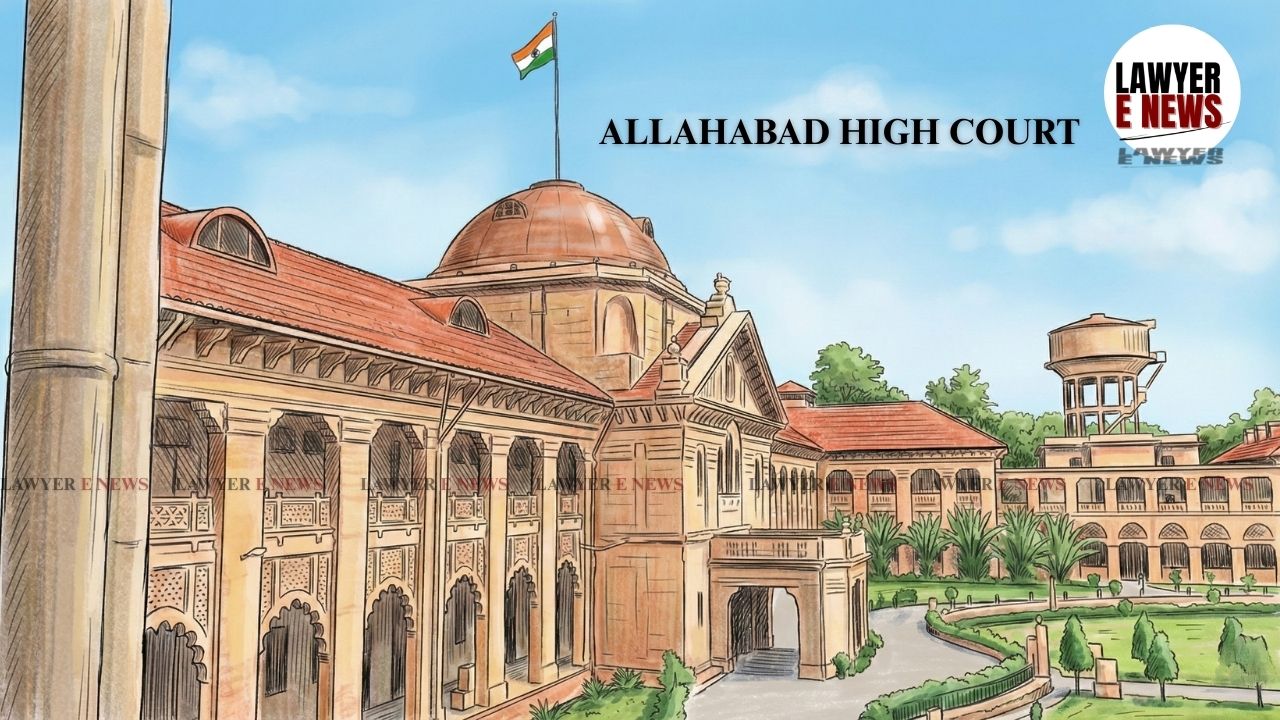
"Mere Agreement to Sell and Receipt Are Insufficient to Prove Possession for Injunction Relief" – Allahabad High Court delivered a significant ruling dealing with the interplay between unregistered agreements, possession, and the grant of interim injunctions under Order 39 Rule 1 of the Code of Civil Procedure, 1908 (CPC). The Court refused to interfere with the trial court’s rejection of interim relief, holding that mere execution of an unregistered agreement to sell, without credible proof of possession, cannot entitle the plaintiff to an injunction.
The plaintiffs filed a suit for permanent prohibitory injunction, claiming possession over a property on the basis of an unregistered agreement to sell dated March 16, 2021. They alleged that they had paid ₹1.11 crores as earnest money out of the total consideration of ₹75 crores. They also relied upon an authority letter dated June 11, 2019, which allegedly permitted them to supervise the property.
The defendant denied the existence of any such agreement, labeling it as forged, and opposed the interim relief sought under Order 39 Rule 1 CPC. The trial court rejected the injunction application, and the plaintiffs appealed to the High Court.
The Court underscored that for granting an interim injunction, the elements of a prima facie case, balance of convenience, and irreparable harm must be satisfied. The High Court held that:
"Prima facie title and prima facie case are distinct. Prima facie case relates to interim protection; prima facie title concerns final adjudication."
It observed that there was no unequivocal recital of possession being delivered in the authority letter or the agreement to sell. Referring to the authority letter, the Court pointed out:
"The document merely authorizes the plaintiff to supervise and protect the company's assets. There is no mention of transfer of possession or title."
Additionally, regarding the agreement to sell, the Court noted:
"The phrase 'one part' of the property being handed over is vague and cannot be stretched to infer possession over the entire property."
The High Court further stressed that possession could not be assumed based solely on an earnest money receipt:
"The receipt of ₹1.11 crores, without credible corroborative material, is insufficient to establish possession or title over the disputed property."
Justice Dinesh Pathak meticulously distinguished the cited cases, particularly Ramakant Ambalal Choksi v. Harish Ambalal Choksi, and clarified that mere reference to interim protection does not apply where possession is unestablished. He emphasized:
"The trial court was right to refuse the interim injunction as the plaintiffs failed to prove actual possession or establish any enforceable right to the property at the interlocutory stage."The Court also rejected the applicability of judgments supporting admissibility of unregistered agreements, stating:
"The reliance on R. Hemalatha v. Kasthuri (2023) is misplaced because the U.P. Registration Laws are different and mandate registration."
Ultimately, the High Court dismissed the appeal, affirming that no illegality, perversity, or infirmity existed in the trial court’s decision.
Summing up, the Allahabad High Court reiterated that in the absence of credible evidence establishing possession, plaintiffs relying merely on an unregistered agreement to sell and a receipt cannot claim interim injunction. The judgment strengthens the legal principle that interim protection of property demands strong prima facie evidence of possession and right, not just contractual claims.
Date of Decision: 25 February 2025