
-
by sayum
25 August 2026 9:55 AM







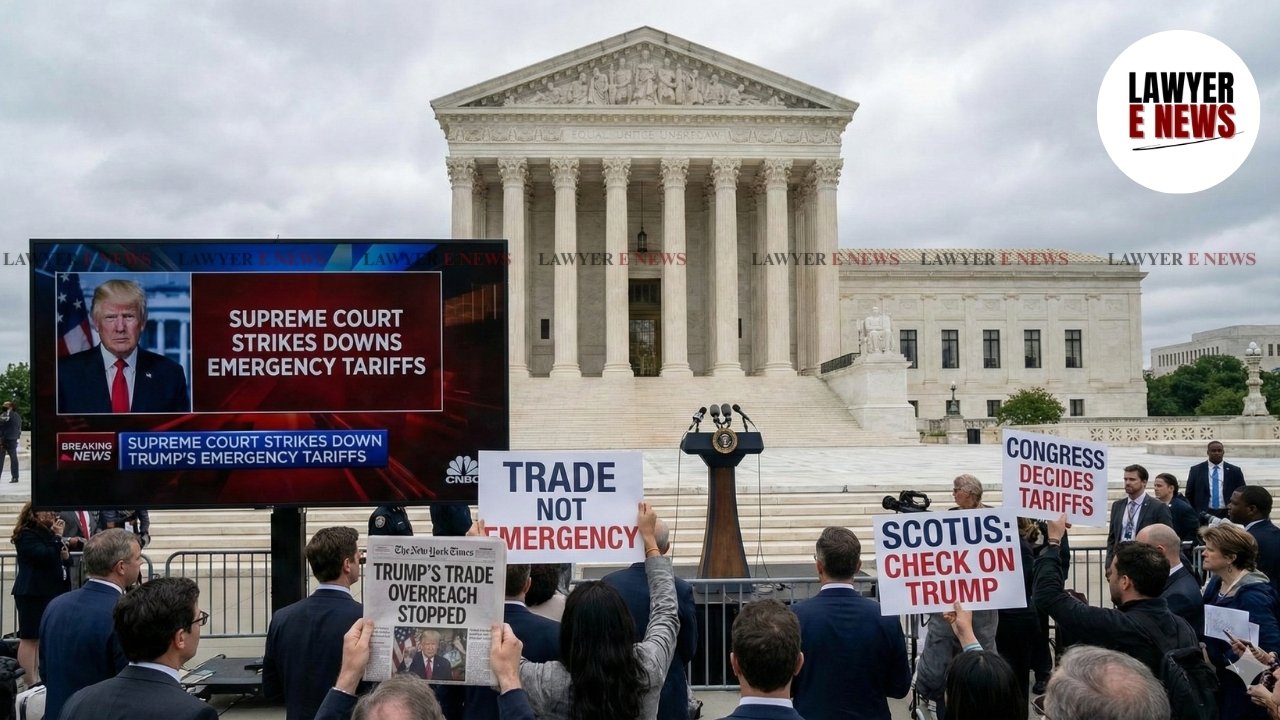
‘Regulate’ Cannot Be Read as ‘Tax’, In a landmark constitutional ruling with profound economic consequences, the Supreme Court of the United States has invalidated the sweeping global tariffs imposed by former President Donald Trump, holding that the Executive cannot unilaterally levy import duties without a clear and unmistakable mandate from Congress. The Court, by a 6–3 majority, struck down the tariff measures purportedly issued under the International Emergency Economic Powers Act (IEEPA), declaring that the statute does not authorize the imposition of customs duties.
The judgment marks a decisive reaffirmation of the separation of powers, emphasizing that taxation and revenue-raising measures fall squarely within the legislative domain under Article I of the U.S. Constitution.
The majority held that although IEEPA empowers the President to “regulate” certain economic transactions during a declared national emergency, such authority cannot be expansively interpreted to include the power to impose tariffs—an inherently fiscal measure. As the Court observed, accepting such a construction would permit the Executive to reshape national trade policy by merely invoking an emergency, thereby eroding Congress’s constitutionally entrenched authority over taxation.
“Major Questions Doctrine Applies: Congress Must Speak with Unmistakable Clarity”
Invoking the major questions doctrine, the Court underscored that when executive action carries “vast economic and political significance,” the statutory authorization must be explicit and unequivocal. The judgment noted that other trade statutes, such as the Trade Expansion Act and the Trade Act of 1974, contain express delegations permitting tariff adjustments under specified conditions. In stark contrast, IEEPA contains no such language authorizing the imposition of customs duties.
The Court categorically rejected the government’s argument that the term “regulate” could be stretched to cover tariffs of indefinite scale and duration. In a pointed observation, the majority clarified that reading IEEPA as conferring such sweeping fiscal authority would amount to an impermissible transfer of Congress’s taxing power to the President—something the Constitution does not contemplate.
The decision therefore reinforces a structural principle: emergency powers cannot be deployed as a substitute for legislative authorization.
The dispute arose from a series of executive orders issued during the Trump administration imposing broad tariffs on imports from multiple countries. The administration justified the measures under IEEPA, arguing that trade imbalances and related economic factors constituted a national emergency warranting regulatory intervention.
Challengers contended that IEEPA, enacted to address extraordinary foreign threats, was never intended to serve as a vehicle for imposing revenue-generating tariffs. Lower courts delivered conflicting opinions, prompting the matter to reach the Supreme Court for authoritative resolution.
The central legal question before the Court was whether the statutory power to “regulate” economic transactions during emergencies encompasses the authority to levy tariffs—traditionally regarded as taxes.
Court’s Observations and Legal Reasoning
The majority placed significant reliance on constitutional text and structure. Article I expressly vests in Congress the power to “lay and collect Taxes, Duties, Imposts and Excises.” The Court reasoned that tariffs are not merely regulatory tools but revenue-generating instruments historically treated as taxation measures.
The judgment emphasized that statutory interpretation cannot disregard constitutional boundaries. If Congress intends to delegate such consequential fiscal powers, it must do so in “clear and unmistakable terms.” Silence or ambiguity cannot be construed as consent to executive taxation.
The Court further observed that permitting such an expansive reading of IEEPA would fundamentally disturb the balance of power between the branches of government. Emergency declarations, the majority cautioned, cannot become a constitutional shortcut for bypassing Congress.
While the dissenting judges warned that the ruling could unduly constrain executive flexibility in responding to international economic threats, the majority maintained that constitutional fidelity requires strict adherence to legislative supremacy in matters of taxation.
Economic and Fiscal Implications
The decision carries immediate financial ramifications. Estimates indicate that approximately $175 billion in tariff revenue was collected under the impugned executive orders. Though the Court did not directly rule on refund procedures, it made clear that revenue collected under an unconstitutional exercise of authority cannot be legally sustained.
The ruling triggered positive reactions in financial markets, with investors interpreting it as a move toward greater predictability in U.S. trade policy and a check on abrupt executive-driven trade disruptions.
Global Trade Consequences
Internationally, the judgment is being viewed as a stabilizing development. Export-driven economies, including India and other major trading partners, may benefit from the removal of elevated tariff barriers that had disrupted supply chains and trade flows.
Trade experts describe the ruling as reinforcing rule-based governance in international commerce, reducing the risk of unilateral tariff escalation based solely on executive discretion.
Executive Response and Future Outlook
Former President Trump sharply criticized the ruling, calling it “deeply disappointing” and suggesting that alternative statutory mechanisms might be explored to pursue tariff measures in the future. However, the Court’s pronouncement sends an unmistakable institutional message: executive authority, even in emergencies, remains bounded by constitutional design.
The judgment is widely regarded by legal scholars as one of the most consequential separation-of-powers decisions in recent decades, potentially influencing future disputes involving emergency statutes and executive overreach.
The Supreme Court’s decision decisively curtails presidential tariff-making authority under IEEPA, restores congressional primacy over taxation, and reasserts constitutional discipline in economic governance. By clarifying that “regulation” cannot be conflated with “taxation,” the Court has drawn a firm constitutional line—ensuring that the power of the purse remains where the Framers placed it: in the hands of Congress.