-
by kapil
11 October 2026 3:09 AM







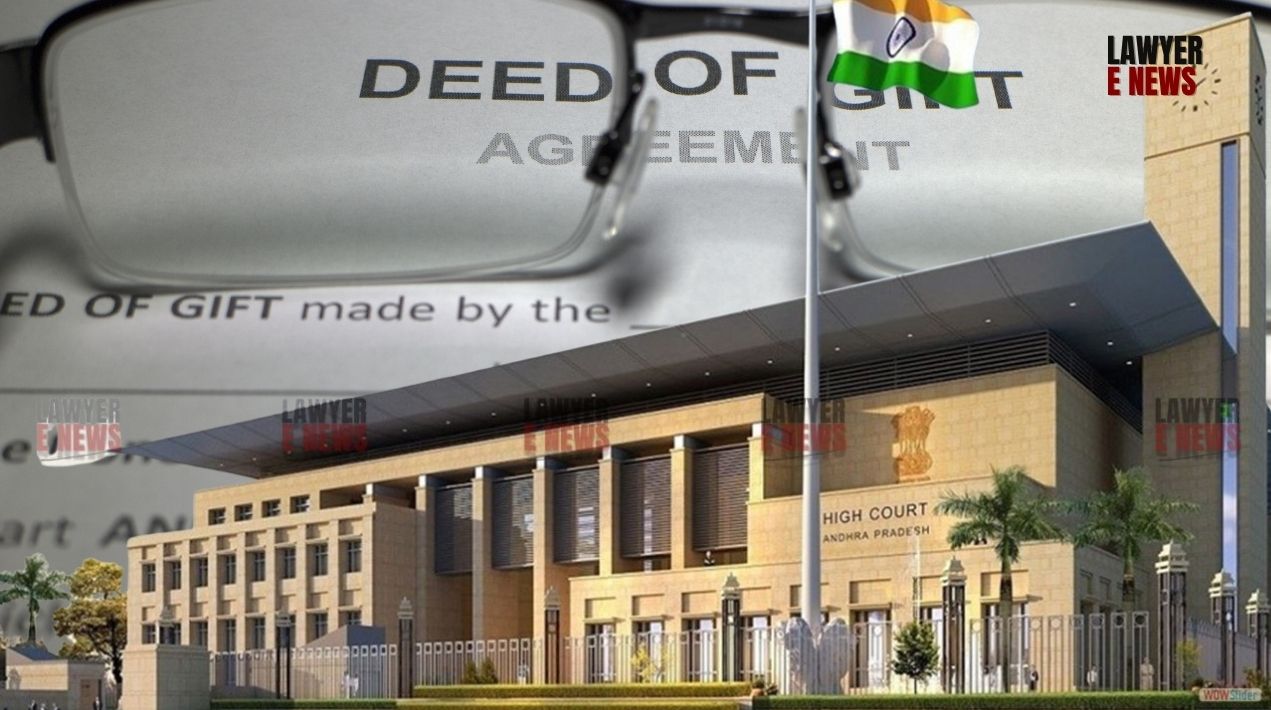
"By no stretch of imagination, can a cancellation deed be executed or registered. This is unheard of in law." Andhra Pradesh High Court, in a significant ruling, held that a donor lacks the legal authority to unilaterally revoke a registered gift or settlement deed once it has been accepted by the donee.
A bench of Justice Subba Reddy Satti emphasized that such an instrument of cancellation is non-est in law and void ab-initio, and that any attempt to register such a document is beyond the jurisdiction of the Registering Officer.
The petitioner, Selam Komala Kumar, was the beneficiary of a settlement deed executed by his mother (the 8th respondent) in 2015, upon which he had subsequently constructed a building. In 2022, the mother unilaterally executed a deed of revocation, which was registered by the 6th respondent-Sub-Registrar. The petitioner only became aware of this cancellation when the Municipal Corporation issued a notice to remove his name from the municipal records, prompting him to challenge the registration of the revocation deed before the High Court.
The primary question before the court was whether a donor can unilaterally revoke a registered gift or settlement deed at their mere will, and whether the Registering Officer has the jurisdiction to register such a document. The court further examined the validity of executive instructions that sought to permit the registration of such unilateral cancellations by restricting the scope of the Andhra Pradesh Registration Rules.
Nature of Registered Gift Deeds
The court noted that under Section 123 of the Transfer of Property Act, 1882, a gift of immovable property is complete upon registration and acceptance. Once the donor divests themselves of the title, they retain no residual right to unilaterally revoke the transfer. Relying on Section 126 of the TP Act, the court clarified that a gift can only be revoked under specific conditions agreed upon by the parties or through a decree from a competent Civil Court, not by the donor's unilateral whim.
"Once a gift is accepted by the donee and the deed is registered, the transfer is complete, absolute, and title immediately passes from the donor to the donee."
Scope of Rule 26(i)(k)(i)
The court addressed the contention that Rule 26(i)(k)(i) of the Registration Rules applies only to sale deeds and not to gift deeds. It affirmed that the term "conveyance" in the rule carries a wide connotation, effectively encompassing gifts and settlements. Consequently, the Registering Officer is duty-bound to ensure that any cancellation of such a deed is supported by mutual consent or a court order, failing which the registration is void.
"The obvious intention of the rule making authority appears to be to cover transactions which are not merely in the nature of deeds of sale. It thus, in my opinion, intended to cover not only 'gift'/'exchange' deeds but also 'agreements for sale'."
Invalidity of Executive Memos
The court categorically struck down Memo No.G4/4597/2016 and Memo RC.No.G1/10547/2008, which had been used by the registration department to permit the unilateral cancellation of gift deeds. The court held that administrative circulars cannot supplant or override substantive statutory provisions or established legal precedents. These memos were deemed a "backdoor entry" for void transactions that contradict the Transfer of Property Act.
"It is a trite law that administrative circulars, memos, or executive instructions cannot override, supplant, or run contrary to substantive law or statutory rules."
Exercise of Article 226 Powers
Despite the petitioner not having specifically prayed for the striking down of the administrative memos, the court invoked its plenary powers under Article 226 of the Constitution. It observed that as a "reservoir of equity," the High Court is not bound by technicalities when the interests of justice demand the removal of illegal executive instructions that threaten property rights.
The Court ultimately allowed the writ petition, set aside the registered revocation deed, and struck down the impugned government memos. This judgment reinforces the sanctity of registered property titles and mandates that any challenge to a gift must be litigated exclusively before a Civil Court.
Date of Decision: 01 October 2026