-
by kapil
11 October 2026 3:22 AM







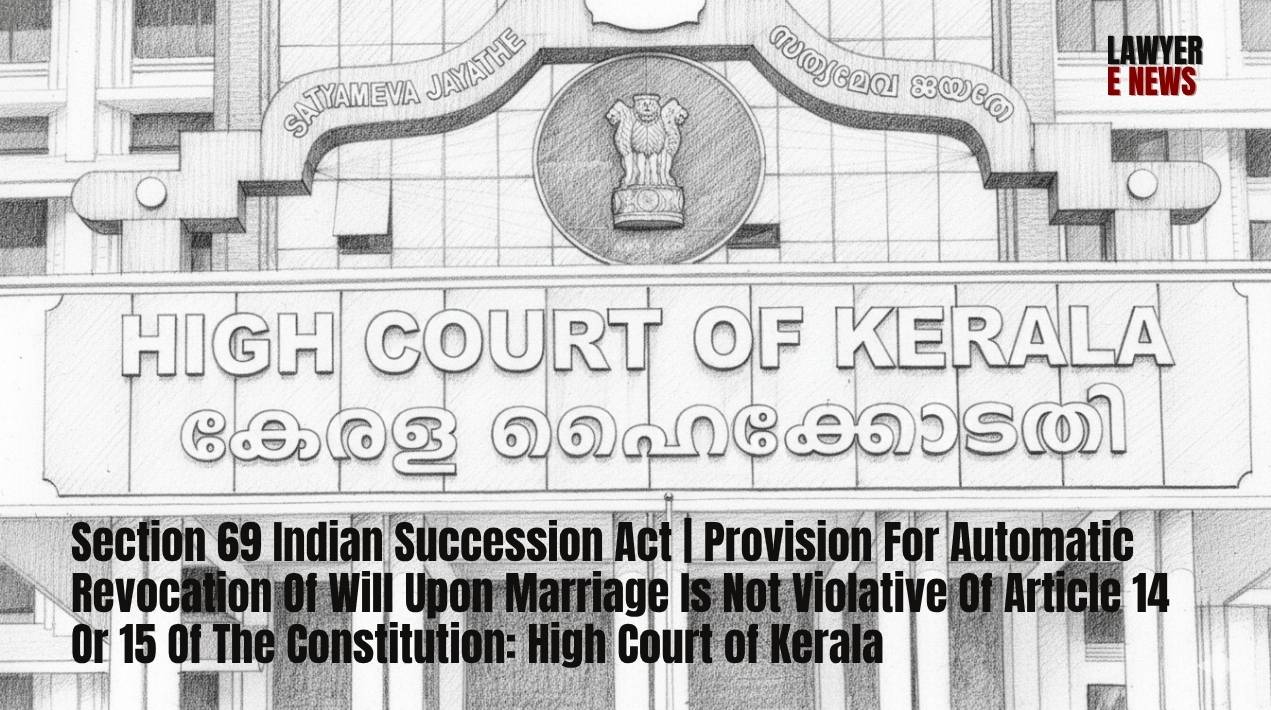
"The object of the Rule providing for revocation is to protect the interests of the new family of the testator, against accidental survival of the old Will" Kerala High Court, in a significant ruling dated October 8, 2026, upheld the constitutional validity of Section 69 of the Indian Succession Act, 1925, which provides for the automatic revocation of a Will upon the marriage of the testator.
A division bench comprising Justice Sathish Ninan and Justice P. Krishna Kumar held that the provision is based on a reasonable classification and does not violate Part III of the Constitution, including Articles 14 and 15. The court observed that the provision is intended to protect the interests of a newly formed family unit, noting that "a fundamental change in the familial set up happens; priorities change. There is an ordinary presumption that he would not adhere to the Will if any, he had previously executed."
The matter reached the High Court following a civil reference (CR No. 1 of 2025) and connected writ petitions challenging the validity of Section 69. The core of the dispute involved whether the statutory exclusion of Hindus from the purview of Section 69—while it remains applicable to Christians—constituted impermissible discrimination under the equality clause of the Constitution. The court examined whether this distinction, rooted in colonial-era legislative history, holds up against modern constitutional standards.
The primary questions before the court were whether Section 69 of the Indian Succession Act, 1925, is restrictive in its operation to Christians, Parsis, and Jews in a manner that violates Part III of the Constitution, and whether the provision stands in direct conflict with Section 20 of the same Act.
Legislative Intent and History
The court traced the origin of Section 69 to the English Wills Act, 1837, noting that the provision was designed to reflect the fundamental change in a testator's obligations upon marriage. The court observed that while the provision was made inapplicable to Hindus by the Hindu Wills Act, 1870, this was a conscious legislative decision based on the then-prevalent societal structure, including the practice of polygamy among Hindus. The court emphasized that the legislature, in a pluralistic society, is entitled to bring about reforms gradually.
Application of Twin Tests of Article 14
The bench reiterated that Article 14 does not forbid reasonable classification. It held that the classification in Section 69 is founded on an intelligible differentia and has a rational nexus to the object sought to be achieved—the protection of the new family. The court stated, "The legislature is free to recognise degrees of harm and may confine its restrictions to those cases where the need is deemed to be the clearest."
"The classification must not be arbitrary but must be rational, that is to say, it must not only be based on some qualities or characteristics which are to be found in all the persons grouped together and not in others who are left out but those qualities or characteristics must have a reasonable relation to the object of the legislation."
Absence of Conflict with Section 20
Addressing the contention that Section 69 conflicts with Section 20(1) of the Indian Succession Act, which states that marriage does not acquire interest in property, the court clarified that no such conflict exists. Section 69 does not create a property interest but merely operates as a rule of revocation for testamentary disposition. The court held that the two provisions operate in different spheres and are not contradictory.
No Violation of Article 15
The court rejected the argument that the provision discriminates on the ground of religion under Article 15. Relying on the Supreme Court's precedent in John Vallamattom v. Union of India, the bench held that the fundamental right guaranteed by Article 15 is an individual right of a citizen. The court emphasized that Section 69 is not "unfair, unfavourable or prejudicial" but serves a "laudable object."
"We find that the provisions are in no way conflicting, contradictory or operating against each other. Section 69 does not provide for creating any interest in the property consequent on the marriage nor does it restrict the power of disposal of the spouse."
The High Court concluded that the challenge against Section 69 failed, as the provision continues to serve a valid legislative purpose. The court underscored that in matters of personal law and succession, the judiciary should adopt a cautious approach, acknowledging that legislative reform is a gradual, piecemeal process. The reference and the connected petitions were disposed of accordingly, affirming the constitutional validity of the impugned section.
Date of Decision: 08 October 2026