-
by sayum
27 August 2026 7:40 AM







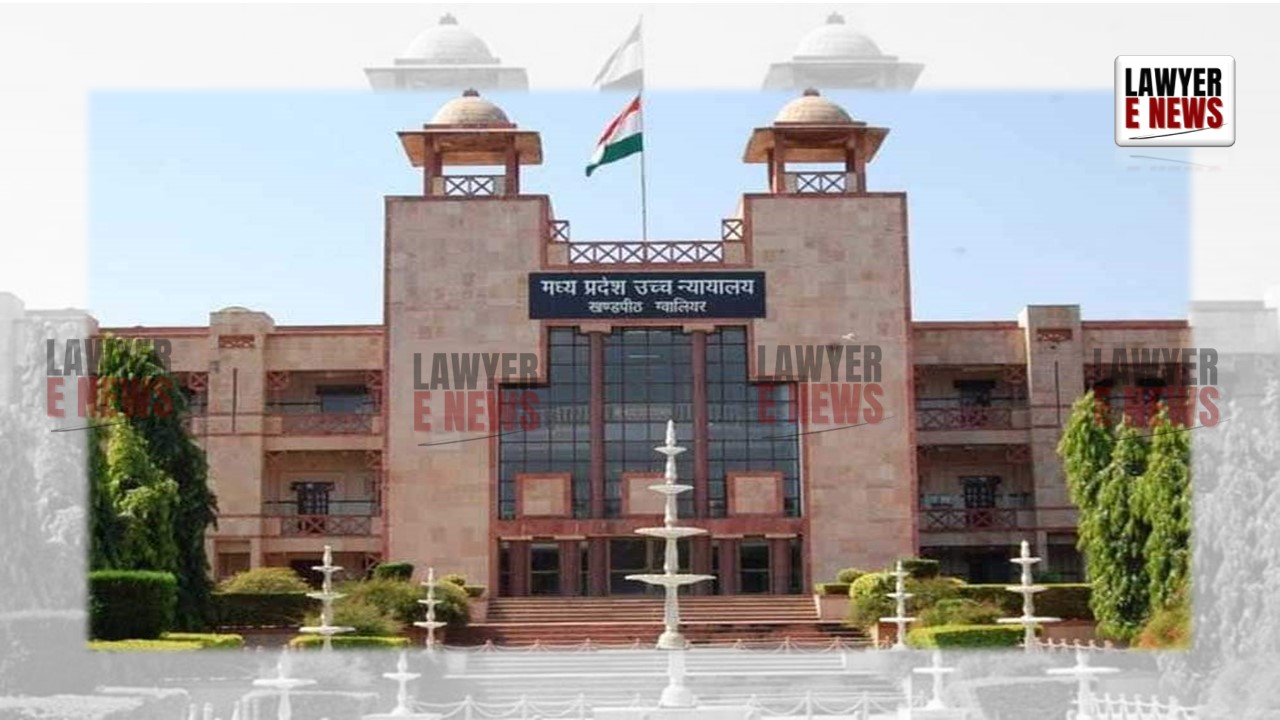
"The trial court is not obliged to assign detailed reasons while framing charges; however, the order must reflect that the court has formed its opinion on the basis of the material available on record." Madhya Pradesh High Court, in a significant ruling dated April 6, 2026, held that trial courts cannot pass mechanical or non-speaking orders while framing charges against an accused.
A single-judge bench of Justice Dwarka Dhish Bansal observed that while elaborate judgments are not required at this stage, the order must expressly indicate the material on record that justifies the court's prima facie satisfaction to proceed with the trial.
The petitioner was charged by an Additional Sessions Judge under Sections 351(1) and 351(3) of the Bharatiya Nyaya Sanhita, 2023, based on allegations of criminally intimidating the victim. The petitioner challenged this order, arguing that the First Information Report contained no allegation of a threat to cause death, which is a mandatory ingredient for a charge under Section 351(3) of the BNS. He further contended that the trial court dismissed his discharge application under Section 250 of the Bharatiya Nagarik Suraksha Sanhita, 2023, without disclosing what specific material justified the framing of the charges.
The primary question before the court was whether an order framing charges can be sustained if it fails to disclose the specific material on which the trial court based its prima facie satisfaction. The court was also called upon to determine the scope of revisional jurisdiction when a subordinate court omits to record findings while deciding on the framing of charges.
No Substantial Difference Between CrPC And BNSS Provisions
Analyzing the statutory framework, the court juxtaposed Sections 250 and 251 of the BNSS with the erstwhile Sections 227 and 228 of the Code of Criminal Procedure, 1973. The bench noted that the transition to the new procedural code has not altered the fundamental principles governing the discharge of an accused and the framing of charges. The court emphasised that the judicial standard remains unchanged, requiring the judge to sift through the evidence to ascertain if a prima facie case exists.
Mechanical Orders Impermissible At Charge Stage
The High Court strongly deprecated the practice of passing opaque orders that merely reproduce statutory provisions or make bare assertions. Relying on Supreme Court precedents including Century Spinning and Manufacturing Co. Ltd. v. The State of Maharashtra and Ghulam Hassan Beigh v. Mohammad Maqbool Magrey, the bench stressed that framing charges substantially affects a person's liberty. The court observed that the trial judge must not blindly adopt the prosecution's narrative or act merely as a post office.
Order Must Reflect Application Of Judicial Mind
Examining the impugned order, the court found it entirely silent on what specific documents or statements led to the inference that the petitioner threatened to cause the victim's death. The bench noted that this omission created serious doubts about the veracity of the charge framed under Section 351(3) of the BNS. The court held that an order framing charges must be preceded by at least a brief indication of the documentary basis that satisfies the court about the existence of the essential ingredients of the offence.
"Such material, forming the basis of the satisfaction of the court, ought to be indicated in the order itself so as to demonstrate that the court has duly considered the record..."
Limits Of Revisional Jurisdiction
Addressing its own powers, the High Court clarified the strict boundaries of revisional jurisdiction. The bench stated that where a subordinate court fails to record necessary findings or omits to apply its judicial mind, the revisional court cannot step in to independently appreciate the evidence. The court noted that substituting its own conclusions in the absence of lower court findings would improperly convert the revisional court into a court of first instance.
"Where the subordinate court has failed to record necessary findings or has omitted to apply its judicial mind upon material issues, the revisional court cannot undertake an independent appreciation of evidence or substitute its own conclusions..."
Remand Is The Proper Course
The bench observed that the revisional jurisdiction is supervisory in nature and relies on the existence of findings recorded by the court below. Therefore, the court held that in cases where the trial court passes a non-speaking order, the proper and only course of action is to remand the matter back to the trial court for recording findings afresh.
The High Court allowed the criminal revision and set aside the impugned order framing charges against the petitioner. The matter was remanded to the trial court with a direction to pass a fresh, reasoned order in accordance with the settled legal position. To prevent future recurrence, the court directed the Principal Registrar to circulate the judgment among all judicial officers across Madhya Pradesh.
Date of Decision: 06 April 2026