-
by sayum
28 July 2026 1:44 PM







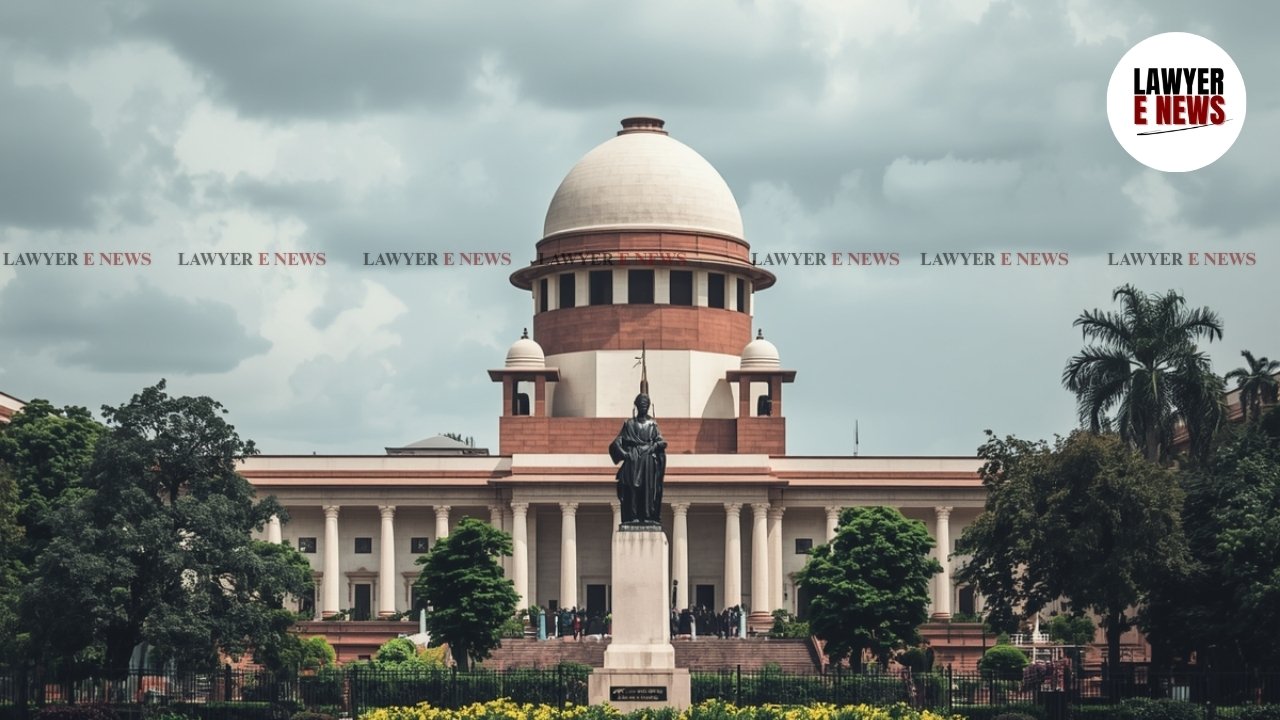
"Demonstration as required by Regulation 11.3.13 is a stand-alone provision, the penalty for which is ingrained therein... requiring mens rea and the latter inviting strict liability," Supreme Court, in a significant ruling, held that the penalty for failure to demonstrate 'Declared Capacity' by a power generating station is a matter of strict liability and does not require proof of 'gaming' or fraudulent intent.
A bench of Justice K. Vinod Chandran and Justice Sanjay Kumar observed that the obligation of a generator to maintain its declared capability flows from a civil contract, and any default attracts an imperative penalty under the statutory scheme.
The court set aside a judgment of the Appellate Tribunal for Electricity (APTEL) which had previously deleted penalties imposed on Talwandi Sabo Power Limited (TSPL). The bench clarified that "gaming"—which involves intentional misdeclaration for undue gain—is a distinct misdemeanor from a simple failure to demonstrate capacity upon notice from the State Load Despatch Centre (SLDC).
The Punjab State Load Despatch Centre (PSLDC) and the Punjab State Power Corporation Limited (PSPCL) challenged an APTEL order that reversed a finding of ‘misdeclaration of Declared Capacity’ against TSPL for four days in January 2017. Initially, the Punjab State Electricity Regulatory Commission (SERC) had affirmed the findings of the PSLDC and upheld a penalty exceeding Rs. 162 Crores, finding that the generator failed to demonstrate its capacity when sought. However, APTEL reversed this, holding that misdeclaration requires a finding of deliberate intention or 'gaming' to earn undue profits.
The primary question before the court was whether the penalty for misdeclaration under the Punjab State Grid Code, 2013, requires the establishment of mens rea or 'gaming' intent. The court was also called upon to determine if the '4th time block' rule for revised schedules applies to the demonstration of declared capability to ensure grid discipline.
Distinction Between 'Gaming' And 'Misdeclaration'
The Supreme Court emphasized that 'Gaming' and the 'Demonstration of Declared Capability' are two distinct concepts under the State Grid Code. While 'Gaming' is defined as an intentional misdeclaration of a parameter to make an undue commercial gain, the demonstration of capability is a performance-based check. The bench noted that while gaming requires an inquiry into intent and illegal enrichment, the failure to demonstrate capacity is a breach of a civil obligation.
The court observed that Regulation 11.3.13 of the SG Code is a stand-alone provision where the penalty is ingrained for the failure to perform. It held that there is no reason to intermingle these concepts even if both are colloquially referred to as misdeclarations. The former invites an inquiry into a guilty mind, whereas the latter is governed by the principles of strict liability.
"The penalty as coming out from Regulation 11.3.13 of the SG Code is a civil liability since the obligation of the SGS to generate power in accordance with its declared capability flows from the contract, a civil obligation."
Strict Liability In Civil Obligations
Relying on the precedent in Union of India vs. Dharamendra Textile Processors, the court reiterated that a penalty arising from a civil liability does not require the presence of mens rea. The bench noted that the State Generating Station (SGS) receives fixed capacity charges based on its declared availability, making it imperative that such declarations are faithful and verifiable.
The court held that the mandatory nature of the penalty for failing to demonstrate capacity is essential to prevent generators from declaring far more than their actual capacity to claim 'deemed generation' benefits. Such practices, if left unchecked, would result in undue gain at the cost of the procurer and the ultimate consumers.
"A default therein as coming out from a failure to demonstrate declared capability attracts penalty, without anything more, making its imposition imperative, as per the statutory scheme."
Importance Of The 4th Time Block Rule
The bench rejected the APTEL’s finding that the '4th time block' rule only applied to the revision of schedules and not to the demonstration of capacity. The court held that when the SLDC issues a notice to demonstrate capacity, the response must materialize within the 4th time block to test the efficiency of the system to respond to contingencies on a real-time basis.
The court noted that the alacrity and expedition with which a generator responds to such a notice is the hallmark of the integrity of its declaration. Failure to achieve the declared levels within the stipulated timeframe constitutes a breach of the Grid Code, regardless of whether the generator had sufficient coal stock or functional machinery at other times of the day.
"The demonstration of capability checks the efficiency of the system to respond to every contingency... which response has to be materialized within four-time blocks. Thus, the fourth time block is relevant for demonstration."
Application To Factual Matrix
Analyzing the specific instances in January 2017, the court found that on multiple days, TSPL failed to achieve its hiked declared capacity within the required window. For instance, on January 15, 2017, despite hiking its declared capability to 1841.40 MW, the generator failed to achieve this level at any point during the day following the notice. Similar failures were noted for other dates, establishing the misdeclaration unequivocally.
The court also clarified that the 12% margin provided by Deviation Settlement Mechanism (DSM) Regulations is intended for grid discipline and does not govern the specific "demonstration of declared capacity" which is strictly controlled by the State Grid Code.
The Supreme Court set aside the APTEL order and restored the order of the SERC, affirming the penalty imposed on the generator. The bench modified the SERC's reasoning to clarify that 'deliberate intention' is not a prerequisite for penalties under Regulation 11.3.13. The appeals were allowed, and the court directed that any refunds made to the generator based on the reversed APTEL order must be returned to the PSPCL with applicable interest.
Date of Decision: May 20, 2026