-
by sayum
04 August 2026 9:39 AM







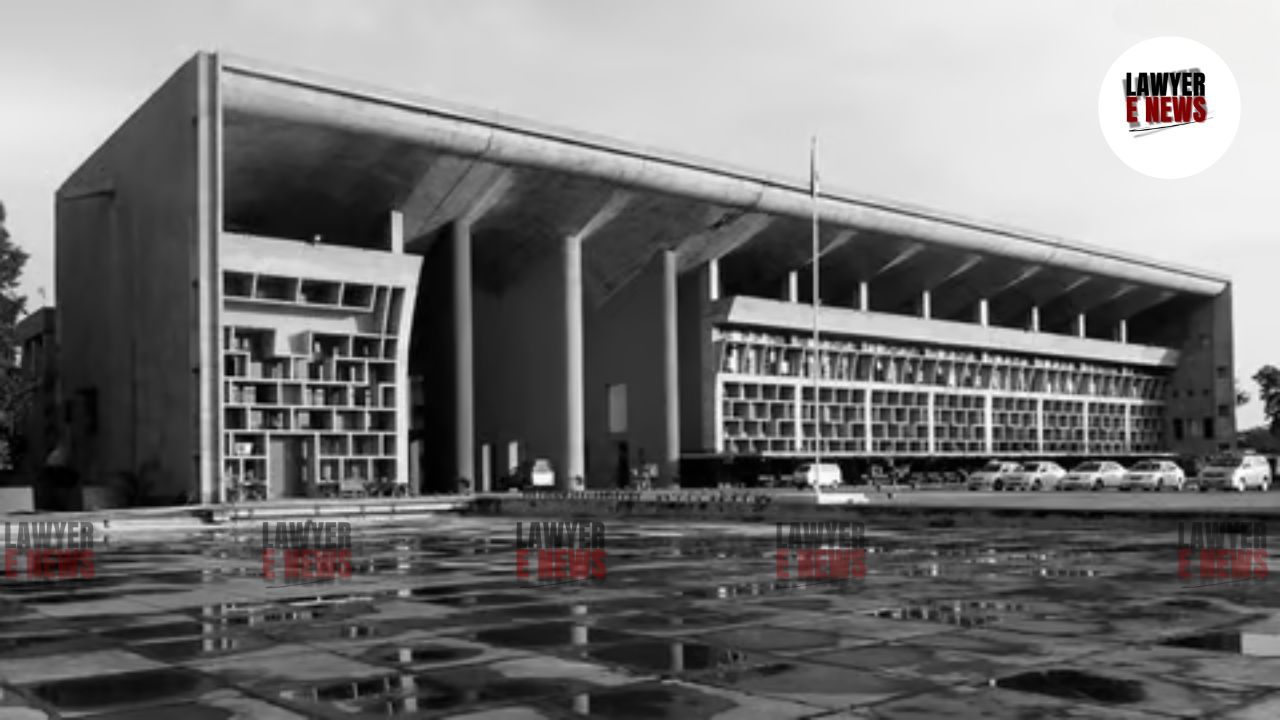
“A testator is entitled to disturb the natural line of succession — exclusion of legal heirs in itself is not a suspicious circumstance” - Punjab and Haryana High Court, in a sweeping reversal of two concurrent judgments, restoring the sanctity of a registered Will and holding that “well-founded suspicion must exist” before a Will can be invalidated.
Justice Deepak Gupta strongly rebuked the approach of the trial and first appellate courts, observing: “Suspicion alone cannot form the foundation of a judicial verdict – positive or negative... The law of evidence does not permit conjecture or suspicion having the place of legal proof.”
The court reaffirmed the legal position that where the execution of a Will is proved in accordance with Section 63 of the Indian Succession Act and Section 68 of the Evidence Act, the burden shifts only when specific suspicious circumstances are pleaded — which, in this case, were conspicuously absent.
A Family Inheritance Dispute Turned into a Legal Battle over a Will
The origin of the case lies in a 177 kanal 7 marla estate in Rasulpur, previously owned jointly by three brothers — Tara Singh, Chanan Singh, and Sadhu Singh. Chanan Singh, who died unmarried and without children on May 20, 1977, had executed a registered Will on November 17, 1976, bequeathing his entire share to two nephews — Kashmir Singh and Sukhdev Singh, sons of his brother Tara Singh.
The plaintiffs, daughters of Sadhu Singh, filed suit in 1988, seeking joint possession by alleging that the Will was fictitious, forged, and that Chanan Singh lacked testamentary capacity. The trial court in 1990, and later the first appellate court in 1992, discarded the Will citing suspicious circumstances, and granted the plaintiffs 1/6th share each.
However, the High Court found this approach fundamentally flawed in law.
“A Will Cannot Be Declared Invalid on Imagined Doubts”
The High Court examined the testimony of Sadhu Singh (DW1), the attesting witness, who fully supported the execution and registration of the Will, stating that: “Chanan Singh signed the Will in my presence... He was in sound disposing state of mind... the Will was read over and explained... and was registered before the Sub-Registrar the same day.”
Despite lengthy cross-examination, the court noted that the witness was not discredited. The trial court’s finding — that the signatures on the Will appeared different — was rejected as speculative: “The trial court based its conclusion on conjecture, without handwriting expert evidence... Such an approach is legally impermissible.”
The High Court emphasized that the statutory requirement for proving a Will is satisfied once one attesting witness testifies to its proper execution, stating: “There is no contradiction or infirmity in DW1’s statement... The due execution of the Will stands proved.”
“Suspicion Must Be Pleaded, Not Inferred” — Courts Cannot Fill Gaps in Pleadings
Justice Gupta took issue with the fact that neither the plaint nor the replication by the plaintiffs had pleaded any concrete suspicious circumstances. Instead, the Will was broadly alleged to be “false and fictitious”.
Referring to the Supreme Court’s guidance in Derek A.C. Lobo v. Ulric M.A. Lobo, the Court ruled: “A party challenging execution of a Will as suspicious must plead the suspicious circumstances... Only then would the propounder be bound to dispel them.”
“The court cannot invent suspicions where the opponent has pleaded none.”
In rejecting the plaintiffs’ claim that Chanan Singh’s alleged exclusion of other legal heirs was suspicious, the Court remarked: “The very purpose of a Will is to alter the natural line of succession... Preferring two nephews cannot by itself be called unnatural or suspicious.”
“Mere Injury Does Not Equal Mental Incapacity” — Testamentary Capacity Was Intact
The plaintiffs had also alleged that Chanan Singh had suffered a hip injury, which they claimed impaired his capacity to execute a Will. But DW1, the attesting witness, firmly testified: “He was in sound disposing mind... There was no mental infirmity whatsoever at the time of execution.”
The High Court held that the burden of proving lack of testamentary capacity lay on the challengers — a burden they failed to discharge: “There is not a shred of medical or independent evidence to suggest incapacity.”
Delay in Suit, No Challenge by Brothers, Strengthens Will’s Validity
The Court noted that both Tara Singh and Sadhu Singh, the brothers of the deceased, were alive when the Will was executed and never contested its validity.
“Mutation was sanctioned in 1977. Sadhu Singh died in 1984. Suit was filed only in 1988. The long silence is telling... the suit is clearly barred by limitation.”
A Rare Reversal of Concurrent Findings on Solid Legal Grounds
While acknowledging the general principle that second appellate courts rarely interfere with concurrent findings, the Court reminded:
“When the findings are vitiated by misapplication of law, non-consideration of crucial evidence, or reliance on inadmissible material — the High Court must step in.”
“The lower courts drew incorrect inferences, misinterpreted documentary evidence, and ignored the legal standards for proving a Will.”
In a comprehensive and reasoned ruling, the High Court upheld the sanctity of testamentary freedom, underscored the importance of pleading in civil disputes, and restored the rightful ownership of property in accordance with a registered, legally proven Will.
“The propounder has satisfied the conscience of the Court... The Will is valid. The suit must fail.”
The plaintiffs’ suit was dismissed, and the lower court decrees were set aside, marking a significant reaffirmation of the law governing proof and challenge to Wills.
Date of Decision: April 7, 2025