CBI Can’t Prosecute When Bank Suffers No Loss: Andhra Pradesh High Court Discharges Bhimavaram Hospitals Directors in ₹1.5 Crore SBI Case Section 256 CrPC Cannot Be A Shield For An Accused Who Never Faced Trial: Allahabad High Court Restores 8 Cheque Bounce Complaints Minimum Wages Cannot Be Ignored While Determining Just Compensation: Andhra Pradesh High Court Re-Fixes Income of Deceased Mason, Enhances Interest to 7.5% 34 IPC | Common Intention Is Inferred From Manner Of Attack, Weapons Carried And Concerted Conduct: Allahabad High Court Last Date of Section 4 Publication Is Crucial—Error in Date Cannot Depress Market Value: Bombay High Court Enhances Compensation in Beed Land Acquisition Appeals Order 26 Rule 10-A CPC | Rarest of Rare: When a Mother Denies Her Own Child: Rajasthan High Court Orders DNA Test to Decide Maternity Acquittal Is Not a Passport Back to Uniform: Punjab & Haryana High Court Upholds Dismissal of Constable in NDPS Case Despite Trial Court Verdict Limitation Under Section 468 Cr.P.C. Cannot Be Ignored — But Section 473 Keeps the Door Open in the Interest of Justice: P&H HC Non-Stamping Renders A Document Inadmissible, Not Void – Defect Is Curable Once Duty Is Paid: Punjab & Haryana High Court Upholds Specific Performance MP High Court Upholds Ladli Behna Yojana Criteria; Rules Registration Deadlines and Age Limits Fall Under Executive Domain Criminal Courts Are Not Recovery Agents: Orissa High Court Grants Bail in ₹3.5 Crore Land Fraud Cases Citing Article 21 and Terminal Illness Employee Cannot Switch Cadre At His Sweet Will After Accepting Promotion: J&K High Court Rejects Claim For Retrospective Assistant Registrar Appointment Anticipatory Bail Cannot Expire With Charge-Sheet: Supreme Court Reiterates Liberty Is Not Bound by Procedural Milestones Order II Rule 2 Cannot Eclipse Amendment Power Under Order VI Rule 17: MP High Court Refuses to Stall Will-Based Title Suit Grounds of Arrest Must Be Personal, Not Formal – But Detailed Allegations Suffice: Kerala High Court Upholds Arrest in Sabarimala Gold Misappropriation Case Grounds of Arrest Are Not a Ritual – They Are a Constitutional Mandate Under Article 22(1): Allahabad High Court Sets Aside Arrest for Non-Supply of Written Grounds Sect. 25 NDPS | Mere Ownership Cannot Fasten NDPS Liability – ‘Knowingly Permits’ Must Be Proved Beyond Reasonable Doubt: MP High Court Section 308 CrPC | Revocation of Pardon Is Not Automatic on Prosecutor’s Certificate: Karnataka High Court Joint Family and Ancestral Property Are Alien to Mohammedan Law: Gujarat High Court Sets Aside Injunction Right to Health Cannot Wait for Endless Consultations: Supreme Court Pulls Up FSSAI Over Delay in Front-of-Pack Warning Labels If A Son Dies Intestate Leaving Wife And Children, The Mother Has No Share: Karnataka High Court

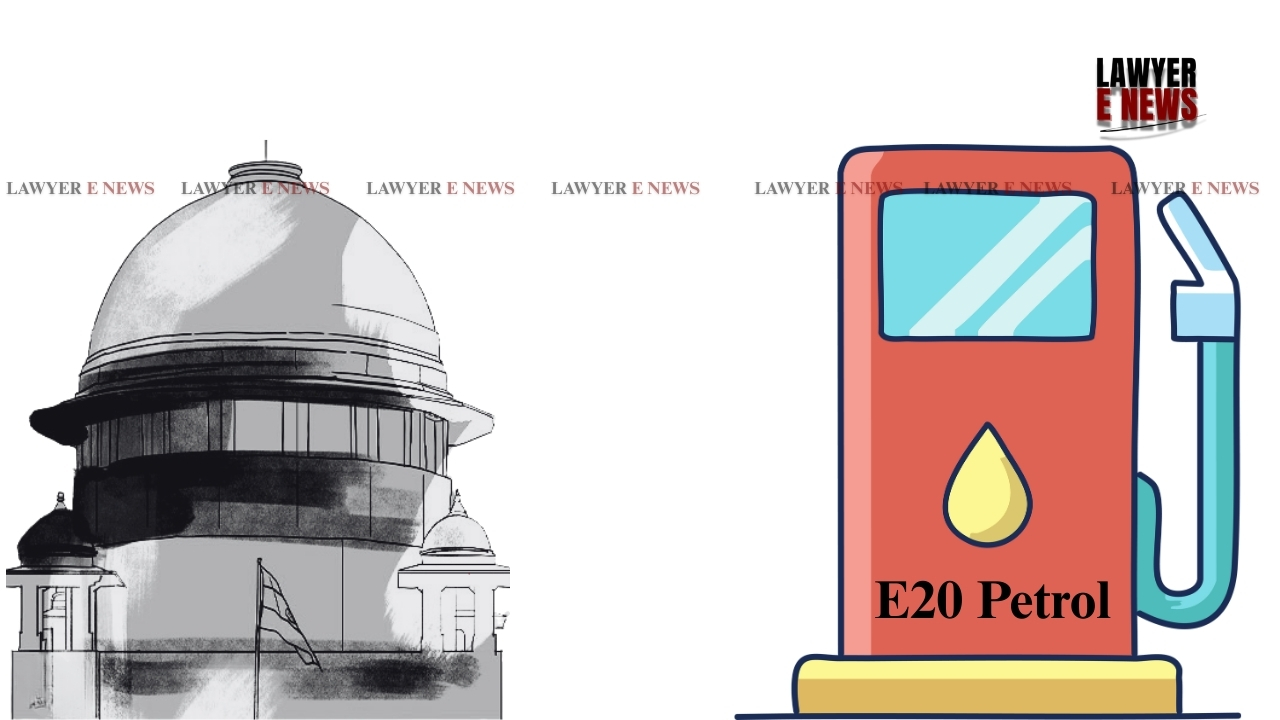
Supreme Court Dismisses Plea Against E20 Petrol – No Relief for Old Vehicles, Govt Stands Firm

02 September 2025 10:36 AM

By: sayum


“Supreme Court Says No to Challenge on Ethanol-Blended Petrol”, Supreme Court dismissed a Public Interest Litigation (PIL) that questioned the Union Government’s decision to mandate 20% ethanol-blended petrol (E20) across the country.

The matter was heard by a bench of Chief Justice BR Gavai and Justice K Vinod Chandran, who, after hearing submissions from both sides, curtly pronounced: “Dismissed.”

“Older Vehicles Not Compatible, But No Relief”

Appearing for the petitioner, Senior Advocate Shadan Farasat relied on a 2021 NITI Aayog report to argue that E20 fuel causes serious problems for vehicles manufactured before April 2023. He clarified that the petitioner was not opposed to ethanol blending itself, but sought the availability of ethanol-free petrol (E0) for older vehicles.

Farasat pointed out that “only vehicles manufactured after April 2023 are truly compliant with E20 petrol,” and highlighted reports of a “6% drop in fuel efficiency” along with risks of “engine corrosion, premature wear and tear, and rising repair costs.” He also stressed that consumers were not benefiting financially since ethanol, though cheaper, had not reduced petrol prices at the pump.

“Policy Made After Due Thought, Says AG”

Attorney General R Venkataramani, opposing the PIL, did not mince words. He told the Court that the petitioner was nothing more than a “name-lender” with powerful lobbies behind him. Defending the policy, he declared that the programme was framed after considering every aspect and was already bringing direct benefits to India’s sugarcane farmers.

In a strong remark, the AG asked: “Will people outside the country dictate what kind of fuel India should use?”

“Dismissed – One Word Ends the Debate”

After hearing the submissions, the Chief Justice delivered a short order: “Dismissed.” With that, the Court shut the door on any judicial intervention in India’s ethanol fuel policy.

“Petition Claimed Violation of Consumer Rights”

The petition had contended that the absence of ethanol-free petrol violated the fundamental rights of vehicle owners with incompatible engines. It argued that the Consumer Protection Act, 2019 was being breached since fuel pumps lacked proper labelling and buyers had no informed choice.

It further claimed that while countries such as the United States and European Union ensured the continued availability of ethanol-free petrol, India had denied this option to its citizens.

Date of Decision: 01 September 2025

Akshay Malhotra v. Union of India | W.P.(C) No. 000813 / 2025

 

Latest Legal News