
-
by sayum
26 August 2026 1:49 PM







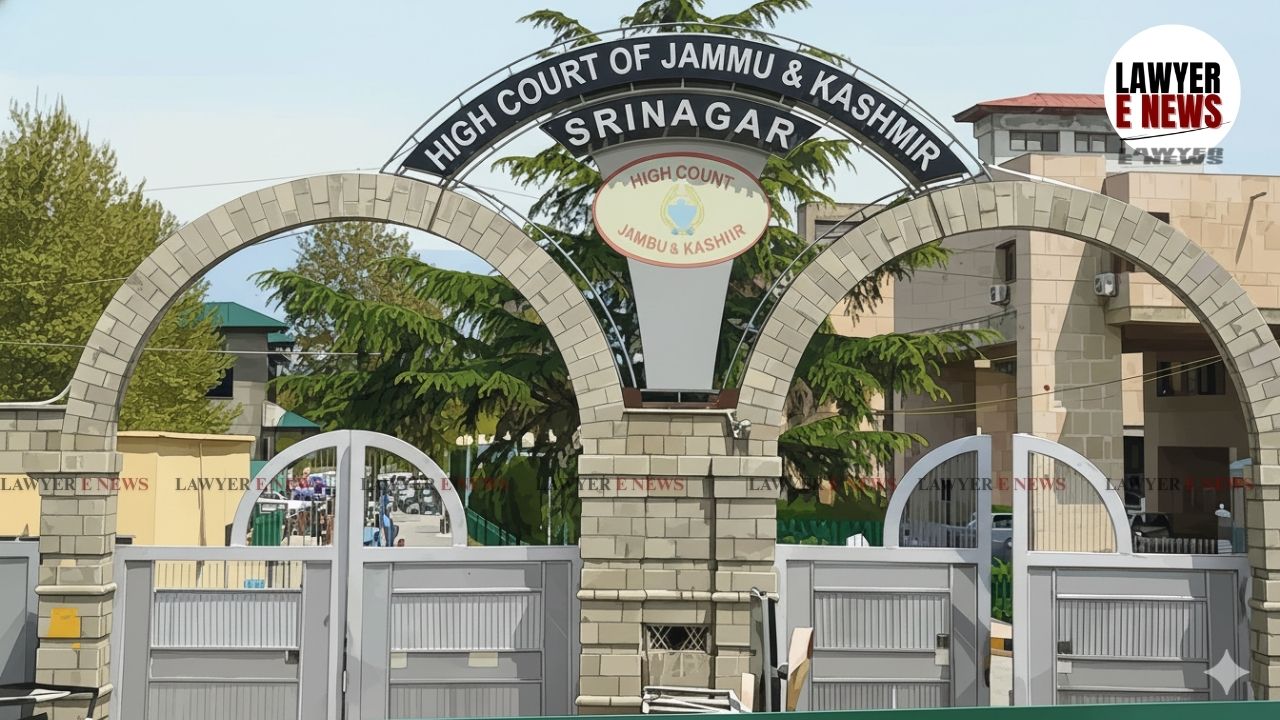
“A Wife Living Separately By Mutual Consent Is Disentitled To Maintenance” High Court of Jammu & Kashmir and Ladakh at Jammu clarifying the legal effect of mutual separation agreements on maintenance claims.
Justice Sanjay Parihar held that although a private settlement or “farakhtnama” cannot legally dissolve a Hindu marriage without a decree of divorce or proof of custom, such an agreement can still demonstrate that the spouses are living separately by mutual consent, which operates as a statutory bar to maintenance under Section 488(5) CrPC.
While upholding the revisional court’s decision denying monthly maintenance to the wife, the Court directed the husband to pay ₹2.50 lakh as a one-time settlement in order to prevent the petitioner from falling into destitution.
Background of the Case
The petitioner Sarita Devi and respondent Mohan Singh were married in 1990, and a son was born from the marriage.
In 1995, the petitioner filed proceedings against the respondent for bigamy and maintenance under Section 488 CrPC. However, the dispute was settled through a compromise dated 28 August 1995, under which the wife received ₹10,000 as full and final settlement and withdrew both the maintenance petition and criminal complaint.
A document described as “farakhtnama” (customary divorce deed) was also executed, after which the parties began living separately.
In later years, the petitioner filed proceedings only for maintenance of the minor child, describing herself as divorced in those proceedings. Maintenance for the child was granted and subsequently enhanced.
In 2008, more than a decade after the compromise, the petitioner filed a fresh maintenance petition under Section 488 CrPC claiming maintenance for herself, without disclosing the earlier proceedings.
The Chief Judicial Magistrate, Ramban, eventually granted maintenance of ₹2,000 per month with annual enhancement, but the Principal Sessions Judge (Revisional Court) set aside the order on 03 November 2020, holding that the parties had been living separately by mutual consent.
The wife then approached the High Court under Section 482 CrPC, challenging the revisional court’s decision.
Legal Issues Before the Court
The High Court primarily examined three questions:
“Whether the alleged customary divorce was legally valid?”
“Whether the petitioner was living separately due to neglect by the husband or by mutual consent?”
“Whether the revisional court exceeded its jurisdiction in overturning the Magistrate’s order granting maintenance?”
Customary Divorce Not Proved
The Court first addressed the validity of the customary divorce (farakhtnama) relied upon by the husband.
Justice Parihar reaffirmed that customary divorce must be specifically pleaded and strictly proved. Both the trial court and revisional court had already concluded that no evidence was produced to establish any valid custom permitting divorce in the community.
The Court therefore held that the marriage between the parties had not been legally dissolved, observing that:
“Execution of a settlement deed alone cannot dissolve a Hindu marriage in absence of proof of a valid custom or a decree of divorce from a competent court.”
Thus, the marital status of the petitioner legally continued despite the separation agreement.
Admissions And Conduct Showed Mutual Separation
Even though the marriage was not legally dissolved, the Court found that the petitioner’s own conduct and admissions clearly established that the parties were living separately by mutual consent.
The Court noted several crucial facts:
The petitioner had accepted ₹10,000 as full and final settlement in 1995 and withdrew her earlier maintenance proceedings.
For many years thereafter she did not seek maintenance for herself.
In proceedings relating to maintenance of her minor son, she described herself as divorced.
She never filed a petition for restitution of conjugal rights and lived separately for over a decade.
Justice Parihar emphasized that such consistent admissions in judicial proceedings constitute substantive evidence and can operate as estoppel against the person making them.
The Court observed:
“Admissions, if clear and unequivocal, are the best evidence against the party making them.”
Because the petitioner had repeatedly acknowledged separation and divorce in earlier proceedings, the Court held that she could not later claim that she had been deserted by the respondent.
Effect of Mutual Separation Agreement on Maintenance
The Court explained an important legal distinction.
Even though a private agreement cannot dissolve a statutory Hindu marriage, it can still be used as evidence to determine whether spouses are living apart by mutual consent.
If it is established that the spouses voluntarily agreed to live separately and acted upon that agreement, the statutory bar under Section 488(5) CrPC applies, preventing the wife from claiming maintenance.
The Court summarized the principle:
“While such an agreement may not dissolve the marriage in law, it is relevant to determine whether the parties are residing separately by mutual consent.”
Based on the petitioner’s conduct and admissions, the Court concluded that the separation was consensual rather than due to neglect by the husband.
Accordingly, the revisional court was justified in denying maintenance.
Scope of Revisional Jurisdiction
The petitioner had argued that the revisional court exceeded its powers by re-appreciating evidence.
The High Court acknowledged that maintenance proceedings are summary in nature and revisional courts normally should not interfere with findings of fact unless they are perverse or illegal.
However, in the present case the revisional court’s finding that the parties were living separately by mutual consent was based on documentary evidence and the petitioner’s own admissions, and therefore could not be termed perverse.
Court Grants One-Time Settlement of ₹2.50 Lakhs
Despite denying monthly maintenance, the Court considered the financial circumstances of the petitioner.
It noted that:
The petitioner had no independent source of income.
She had been living separately since 1995.
Her civil status remained that of a legally wedded wife, as the marriage had not been lawfully dissolved.
The Court also observed that during earlier proceedings in Lok Adalat, the husband had agreed to pay ₹2.50 lakh as full and final settlement, though the payment was never completed.
Taking these circumstances into account, the Court exercised its inherent powers to ensure substantial justice and directed the respondent to pay ₹2.50 lakh as a one-time settlement within six months.
The Court further ordered that ₹1,40,091 already deposited in the Registry in the form of an FDR be released to the petitioner.
If the respondent fails to pay the remaining amount within six months, the petitioner would be entitled to recover it with interest at 6% per annum.
The High Court ultimately held that the petitioner was not entitled to maintenance under Section 488 CrPC because the parties had been living separately by mutual consent since 1995.
At the same time, recognizing the petitioner’s financial vulnerability and the earlier settlement proposal, the Court directed the respondent to pay ₹2.50 lakh as a one-time settlement to secure her financial support.
Date of Decision: 06 March 2026





