-
by sayum
27 August 2026 3:32 PM







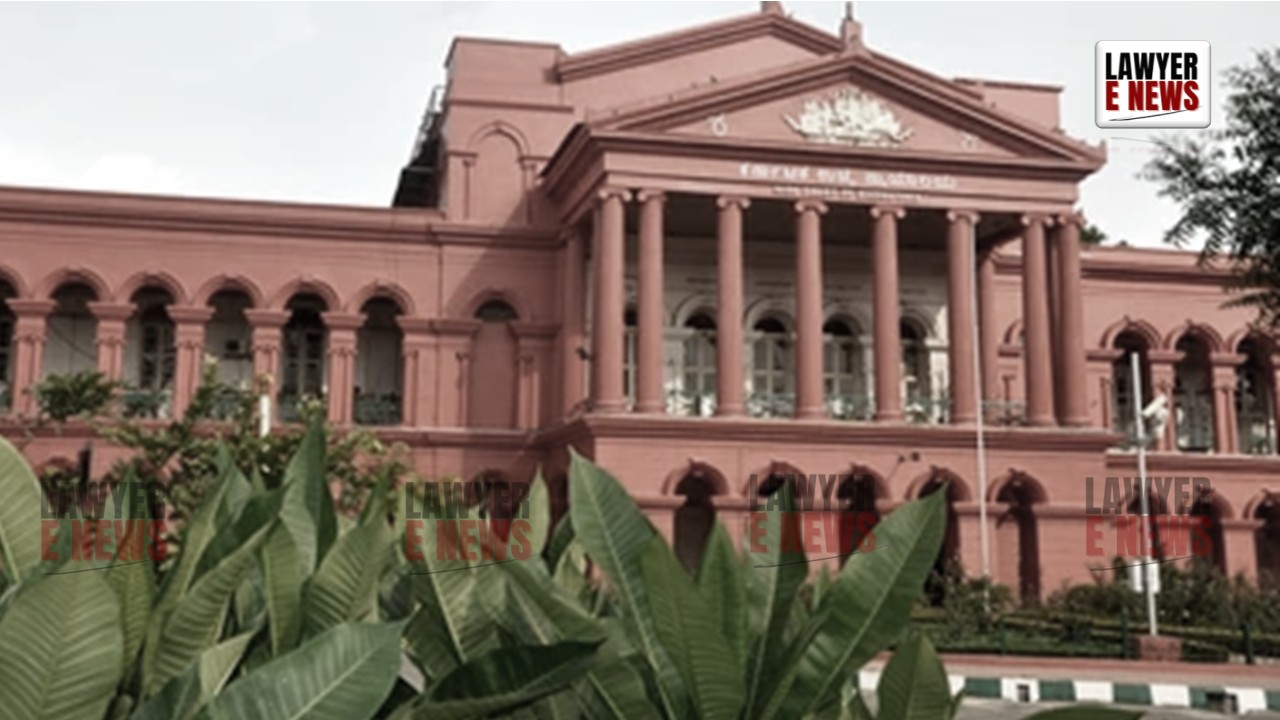
"The entire exercise of acquiring land for a non-existent entity was nothing but a monumental fraud committed by the authorities in criminal conspiracy with the applicant" Karnataka High Court delivered a landmark ruling exposing one of the most brazen abuses of eminent domain power in recent memory — a State Government that acquired over 53 acres of valuable agricultural land near Bengaluru for an entity that did not even legally exist at the time of the application, and which, more than two decades later, has a net worth of minus Rs. 8,60,686/- and zero income.
A Division Bench of Justice D.K. Singh and Justice Tara Vitasta Ganju quashed the entire acquisition, imposed costs of Rs. 10 lakhs on the private respondent payable to the Army Battle Casualties Welfare Fund, and directed the Central Bureau of Investigation to register and investigate a criminal case against the government officials and private individuals involved.
Background of the Case
In the year 2000, one P. Satish Pai submitted an application before the State Government on behalf of M/s Lakeview Tourism Corporation — an entity that had not yet been incorporated — seeking acquisition of 37 acres of land in Hebbal and Hebbal Ammanikere Villages, Bangalore North Taluk. The stated project was a "Unicare Tourist Centre" comprising a five-star hotel, resort, amusement park, water park and recreation facilities, with a promised investment of Rs. 2,500 crores and commencement of operations by December 2001. The State High Level Committee, within five days of receiving this application, held a meeting and recommended acquisition. The State Government obliged. Preliminary Notification was issued on November 25, 2002, and a Final Notification under Section 28(4) of the Karnataka Industrial Areas Development Act, 1966 was issued on May 11, 2004, acquiring 53 acres and 26 guntas at compensation of Rs. 15 lakhs per acre. The landowners challenged the acquisition through writ petitions. The Single Judge dismissed the petitions in 2012. The writ appeals came before the Division Bench, which undertook a deeper examination of the record — and what it found was staggering.
Legal Issues
Three questions arose before the Division Bench. First, whether the acquisition for a non-existent entity was legally valid under the KIAD Act and served any genuine public purpose. Second, whether the entire exercise was a fraud on statute committed in criminal conspiracy between State authorities and private individuals to transfer valuable land to real estate developers at throwaway prices. Third, whether an earlier Division Bench judgment in W.A. No. 333/2013 upholding the acquisition operated as a bar to the present proceedings.
Court's Observations and Judgment
The Entity Did Not Exist — And the State Knew It
The Division Bench's most damning finding was factual: the application filed on June 23, 2000, was submitted by a non-existent entity. The prescribed checklist for applications under the Single Window Agency required, among other things, the Memorandum and Articles of Association of the company — a document that can only belong to an entity already in existence. The application was blank in critical details. The expected commencement date was December 31, 2001 — yet the entity, M/s Lakeview Tourism Corporation, was incorporated only on January 4, 2011, a full ten and a half years after the application was filed.
More damning still, the promoters who filed the application — Dr. Ramdas Pai, Syed Mohammed Salahuddin, P. Dayananda Pai, and P. Satish Pai — had absolutely no connection with the entity that was eventually incorporated. When the company was finally registered in 2011, its promoters were Sushil Mantri and Snehal Mantri of the Mantri Group, a real estate developer. The Court noted the address of the registered entity: Mantri House, 41, Vittal Malya Road, Bengaluru. The financial statements for the year 2022-23 disclosed zero income, a net worth of Rs. -8,60,686/-, and a cash balance of Rs. 45,963/-. The company's own Directors' Report stated that it was "still in the process of identifying viable business opportunities and start its principal business operations."
"The high speed and alacrity with which the Government had acted to exercise its power of eminent domain to favour a non-existent entity for its business and private gain was nothing but a gross abuse of the powers by the State machinery and fraud on statute."
The KIAD Act Does Not Permit Acquisition for Private Enrichment
The Court carefully analysed the object and purpose of the Karnataka Industrial Areas Development Act, 1966. The Act exists to provide for the orderly establishment and development of industries in suitable areas of the State. Suitable industrial areas are to be identified by the State or the KIADB — not by private individuals or entities pointing at lands of their choice. The statute empowers acquisition for development by the Board or for any other purpose in furtherance of the objects of the Act. It does not authorise the State to acquire land on the behest of a private party, hand it over at pittance, and allow the beneficiary to then develop it as a real estate township.
"The Act does not contemplate for acquiring the land for making profit or wealth by an individual entity and such a purpose cannot be said to be a public purpose. Setting up an industrial area is a public purpose and not putting the land after exercising the power of eminent domain in the hands of unknown parties, real estate developers and such other persons."
The Court held that this kind of exercise is a "statutory and constitutional fraud by the State Authorities and a criminal act." The entire premise of land use — from tourism project to real estate township — was transformed in 2023 when the State, again obligingly, issued Government Order No. CI 82 SPI 2023 changing the activity from a Unicare Tourist Centre to an "Integrated township with development of Commercial office spaces, IT Park, R&D Centre, Retail, Shopping Mall, Residential multi-storeyed apartment complex." This metamorphosis, the Court found, only confirmed the true design of the exercise from the very beginning.
Article 300A: Seven Sub-Rights of Property, All Violated
The Court delivered a significant elaboration of the constitutional right to property under Article 300A. Relying on the Supreme Court's ruling in Kolkata Municipal Corporation v. Bimal Kumar Shah (2024), the Bench held that the right to property is not merely a binary of public purpose and compensation — it encompasses seven distinct sub-rights. These are the right to notice, the right to be heard, the right to a reasoned decision, the duty of the State to acquire only for public purpose, the right to restitution and fair compensation, the right to an efficient and expeditious process, and the right of conclusion. "Non-compliance of these will amount to violation of the right to property being without the authority of law."
The Court emphasised that any law or State action that deprives persons of property for private interest — even if incidentally beneficial to the public — is unlawful, undermines the rule of law, and is amenable to judicial review. Acquiring land from farmers and handing it to real estate developers through a fraudulent corporate façade violated each of these seven sub-rights in its substance and spirit.
Fraud Vitiates Everything — Even Final Judgments
The respondent's counsel argued strenuously that the acquisition had attained finality by virtue of the Division Bench judgment in W.A. No. 333/2013 dated March 26, 2014, and the dismissal of the review petition in R.P. No. 363/2015 on April 6, 2018. The Court rejected this contention with a settled principle of law: fraud vitiates every judicial act.
Relying on the Supreme Court's landmark ruling in S.P. Chengalvaraya Naidu v. Jagannath (1994), the Court reiterated that "the principle of finality of litigation cannot be pressed to the extent of such an absurdity that it becomes an engine of fraud in the hands of dishonest litigants." A judgment or decree obtained by fraud is a nullity — whether passed by the first court or the highest court — and can be challenged at any stage, even in collateral proceedings.
The Court noted that the monumental fraud now uncovered was not before the earlier Division Bench when it upheld the acquisition in 2014. The facts revealed upon closer examination of the complete record — the non-existence of the entity, the blank application, the five-day turnaround, the complete change of promoters upon incorporation, the zero-income company, the land use conversion — none of these were detected or placed before the earlier bench. Courts and Tribunals retain the inherent power to recall or set aside their own orders where fraud taints the proceedings, even after the matter has attained finality and statutory review has been exhausted.
CBI Investigation: Because the State Cannot Investigate Itself
Having found that the State instrumentality itself was a participant in the criminal conspiracy, the Division Bench held that investigation could not be entrusted to any State agency. "We cannot expect an impartial and independent investigation at the hands of the State agencies when the State instrumentally itself was involved in committing the monumental fraud." The Court accordingly directed the Central Bureau of Investigation to register a criminal case and investigate the offences against the government machinery officials and private individuals involved, bringing all of them to book.
The entire acquisition was quashed. Costs of Rs. 10 lakhs were imposed on M/s Lakeview Tourism Corporation, payable to the Army Battle Casualties Welfare Fund within four weeks. A copy of the judgment was directed to be forwarded to the Director, CBI, for compliance.
Date of Decision: April 10, 2026