-
by sayum
27 August 2026 3:32 PM







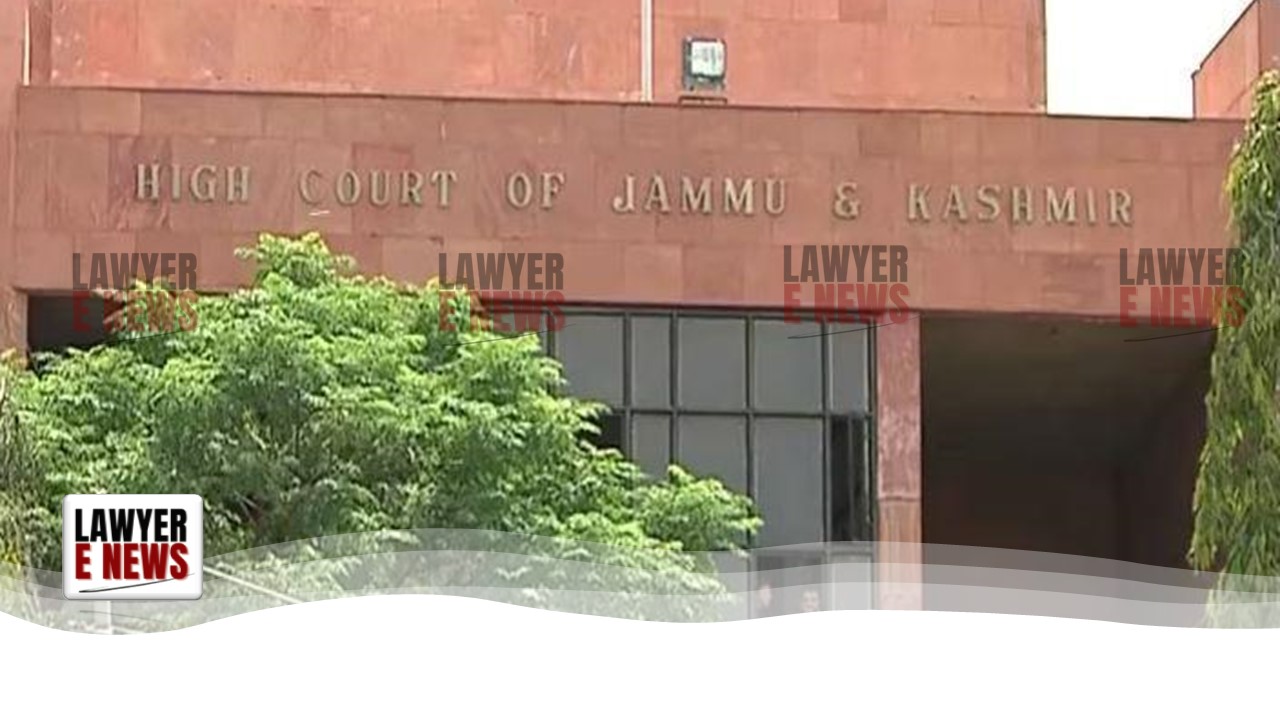
"State being a model employer is expected to act fairly and cannot follow a, 'hire and fire' policy. The fact a junior’s case was recommended by the Empowered Committee along with the deceased and was regularized further establishes hostile discrimination", High Court of Jammu & Kashmir and Ladakh, in a significant ruling, held that the State cannot adopt a "hire and fire" policy after extracting work from an employee for over two decades.
A bench of Justice Sindhu Sharma and Justice Shahzad Azeem observed that continuous service for such a long duration imparts a character of permanency to the post, and the State must act as a model employer.
The case involved Sara Begum, the widow of late Mohd. Rafi Khan, who was engaged as a Junior Assistant on an adhoc basis in 1993 and served uninterruptedly until his death in 2014. Despite being recommended for regularization by the Empowered Committee under the J&K Civil Services (Special Provisions) Act, 2010, his name was excluded from the final order while his juniors were regularized. The Central Administrative Tribunal (CAT) had earlier directed his posthumous regularization, which the State challenged before the High Court.
The primary question before the court was whether the State could deny regularization to an employee who served for 21 years and was recommended by a statutory committee, merely because he was initially an adhoc appointee. The court also considered whether the repeal of the J&K Civil Services (Special Provisions) Act, 2010, would extinguish the rights that had already accrued to the deceased employee during his lifetime.
State Cannot Resort To Arbitrary Hire And Fire Policy
The Court emphasized that after extracting work from an employee for more than twenty years, the State is precluded from claiming that the engagement was merely a temporary stop-gap arrangement. The bench noted that the continuity of service in any capacity demonstrates the permanent nature of the work the employee performed.
The Court observed that the State, as a model employer, is bound by the principles of fairness and cannot exploit workers through long-term temporary engagements. The bench remarked that "work of such a long duration cannot be deemed adhoc or temporary; it had acquired the character of permanency with the passage of time."
Hostile Discrimination Violates Article 14 Of The Constitution
The bench found that the deceased employee had been subjected to hostile discrimination because his juniors were regularized while his name was arbitrarily left out. The Court held that once the Statutory Empowered Committee had recommended the deceased for regularization, the State had no rational basis to exclude him.
Such an action, the Court held, is a direct violation of the principle of equality enshrined under Article 14 of the Constitution of India. The Court noted that the petitioners failed to provide any justification for treating the deceased differently from his junior, Farooq Ahmed Zargar, who had been granted the benefit of regularization.
"Once the Empowered Committee has recommended the deceased’s name and similarly situated juniors were regularized, the petitioners cannot be heard to say his service could not be regularized."
Repeal Of Statute Does Not Extinguish Accrued Rights
The State had argued that the J&K Civil Services (Special Provisions) Act, 2010, stood repealed in 2020 and therefore the direction for regularization was unsustainable. However, the Court rejected this contention, clarifying that a right that had already accrued to the deceased during his long years of service and through the committee's recommendation cannot be taken away by a subsequent repeal.
The Court held that the legal right to be considered for regularization arose during the subsistence of the Act and the lifetime of the employee. Therefore, the subsequent change in the legal framework or the Re-organization Act, 2019, would not provide a shield for the State to escape its obligations toward its long-serving employees.
State Expected To Act With Compassion Toward Widows
The Court took a compassionate view of the fact that the respondent was a widow seeking benefits to support her children and live with dignity. The bench stressed that in such cases, the State should avoid prolonging litigation on technicalities and should instead ensure that retiral and family benefits are released promptly.
The High Court concluded that the Tribunal had taken a pragmatic view of the matter. Finding no error of law or fact, the Court dismissed the State's writ petition and directed that the deceased be treated as regularized from January 11, 2013—the date his juniors were regularized—with all consequential benefits to be paid to the widow.
The High Court affirmed that long-term continuous service creates an entitlement to fairness that the State cannot ignore through technical or legalistic arguments. The dismissal of the State's petition ensures that the widow and children of the deceased employee receive the family pension and statutory dues accrued over two decades of service.
Date of Decision: 24 April 2026