-
by sayum
27 August 2026 3:32 PM







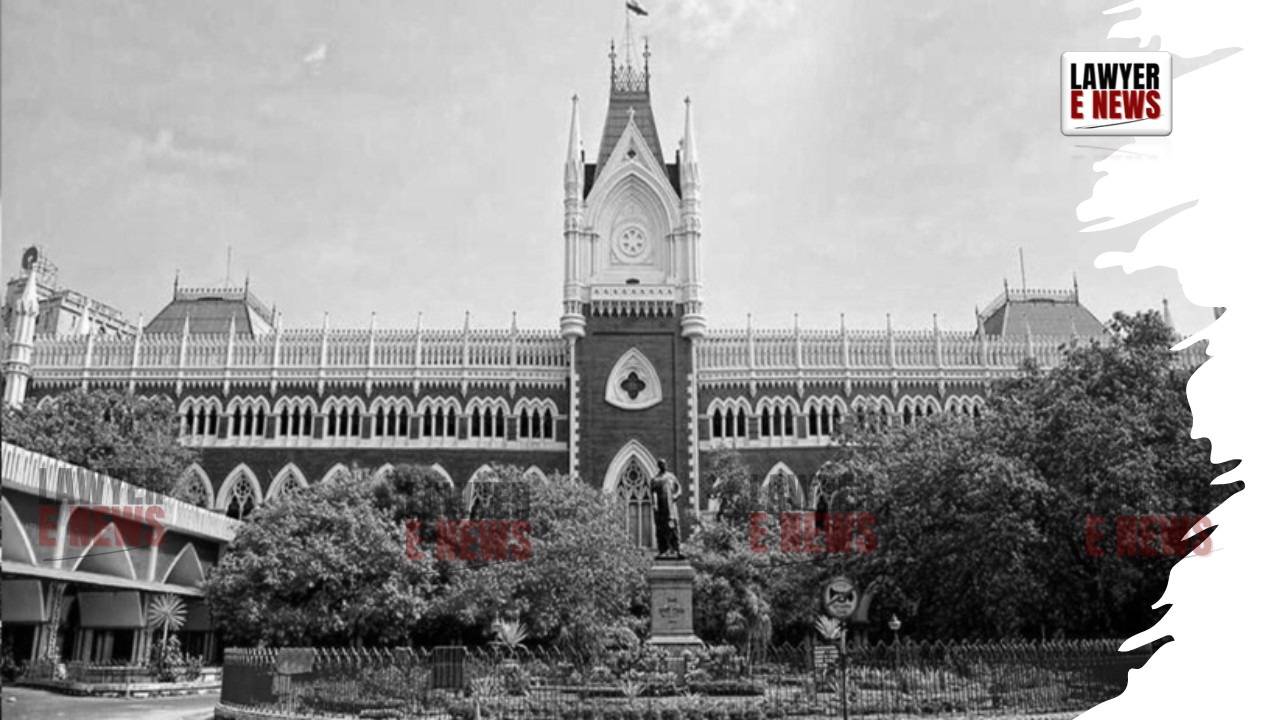
"Any deviation, disruption or derailment from the process as specified in the SOP by the State clearly warrants interference as it is a procedural impropriety touching the parameter of illegality and irrationality and warrants judicial interference." Calcutta High Court, in a significant ruling, held that the State government cannot unilaterally deviate from the Standard Operating Procedure (SOP) governing the merit-cum-counselling based posting of Senior Resident doctors.
A bench of Justice Reetobroto Kumar Mitra observed that such postings are not routine service transfers but are fresh appointments governed by established protocols of fairness and transparency. The Court emphasized that the State is bound to adhere to its own standards to avoid arbitrariness and discriminatory treatment under Article 12 of the Constitution of India.
The petitioner, Dr. Debashis Halder, a Rank 24 merit candidate in Anesthesiology, was originally allotted Howrah District Hospital through centralized counselling based on his MD examination marks. After completing his first year of residency, he was unceremoniously posted to Gazole State General Hospital, Malda—a facility that was not part of the original vacancy list and lacked an operational surgical setup. Dr. Halder challenged this move, alleging that it was a retaliatory measure for his participation in protests related to the R.G. Kar Medical College incident and a gross violation of the 2023 SOP.
The primary question before the Court was whether the posting of a Senior Resident doctor under an indemnity bond constitutes a routine service transfer or a fresh posting governed by the SOP. The Court was also called upon to determine whether the State can arbitrarily deviate from merit-cum-counselling results for select candidates while following the procedure for the vast majority of others.
Court Explains Distinction Between Fresh Posting And Service Transfer
The Court rejected the State’s contention that the petitioner’s movement was a routine transfer over which he had no right. Justice Mitra clarified that the genesis of the engagement is a merit list and a counselling process, making it a fresh posting rather than a shift of an existing employee.
"The decisions relied upon by the respondent are all in respect of transfer of an employee relating to his service... This is an accepted principle and cannot be equated with the posting of a doctor in the present case as the same does not qualify as a transfer," the Court noted.
State Bound By Its Own Standard Operating Procedure
The Court highlighted that the SOP contained in Memo No. HF/O/HS(MA)/222/HFW43011(11)/152/2022-ADMIN was formulated to ensure transparency in the deployment of doctors during their bond period. It observed that the SOP's mandate for merit-cum-counselling applies to subsequent years of residency, not just the first year.
"The State is thus bound to adhere to the standard fixed by it by way of this SOP," the bench held, noting that any departure from these rules constitutes a procedural impropriety that invites judicial review.
Selective Deviation From SOP Amounts To Discrimination
The Court found it "interesting" and "ex-facie discriminatory" that out of 778 candidates, the SOP was meticulously followed for 777 doctors, with the petitioner being one of only two exceptions. This selective application of rules was seen as an arbitrary exercise of power.
"This alteration in the posting cannot be glossed over in any manner. Significantly, the SOP has been followed while posting of all others except for the petitioner, this is ex-facie discriminatory," the judgment read.
"The very purpose of the SOP is to eliminate any sort of arbitrariness, unfairness or opaque action on behalf of the state authorities."
Posting To Hospital Without Surgical Setup Lacks Rationality
On a factual assessment, the Court noted that while the petitioner, an Anesthesiologist, was sent to Gazole Malda, not a single surgery had been performed there from the date of his joining until March 2026. Furthermore, a vacancy continued to exist at the Howrah District Hospital, which the petitioner had originally secured through his merit rank.
"The petitioner is an Anesthesiologist who went to work and had opted for Howrah... but has been unceremoniously sent to Gazole, where for the past almost one year he has not had the occasion to participate in a single surgery," the Court observed, terming the move "unfounded."
Judicial Review Of Administrative Actions Under Article 12
Citing the landmark precedent of Tata Cellular v. Union of India (1994), the Court reiterated that while it does not usually sit in appeal over administrative decisions, it must intervene when an action reeks of irrationality or procedural bias. The Court held that the SOP is a mechanism to uphold the fundamental rights of citizens against the State.
"The mechanism of the SOP has been devised with the ulterior aim to guarantee the rights of all doctors... This SOP is merely the mechanism to uphold the rights of the citizen under Article 12 of the Constitution of India," the bench remarked.
Relevance Of The Dr. Aniket Mahata Precedent
The Court drew parallels with the case of Dr. Aniket Mahata v. State of West Bengal, where a similar arbitrary posting was set aside by a coordinate bench and later upheld by the Supreme Court. Justice Mitra held that although the petitioner was a second-year resident, the principle of merit-and-choice based entitlement remained equally applicable.
The Court concluded that the petitioner's posting was bad in law and directed the State to immediately reinstate him at the Howrah District Hospital in accordance with his original merit-based allotment. By allowing the writ petition, the Court reinforced that administrative discretion in professional postings must remain subservient to established rules and the principle of non-discrimination.
Date of Decision: 17 April 2026